

Our Verdict
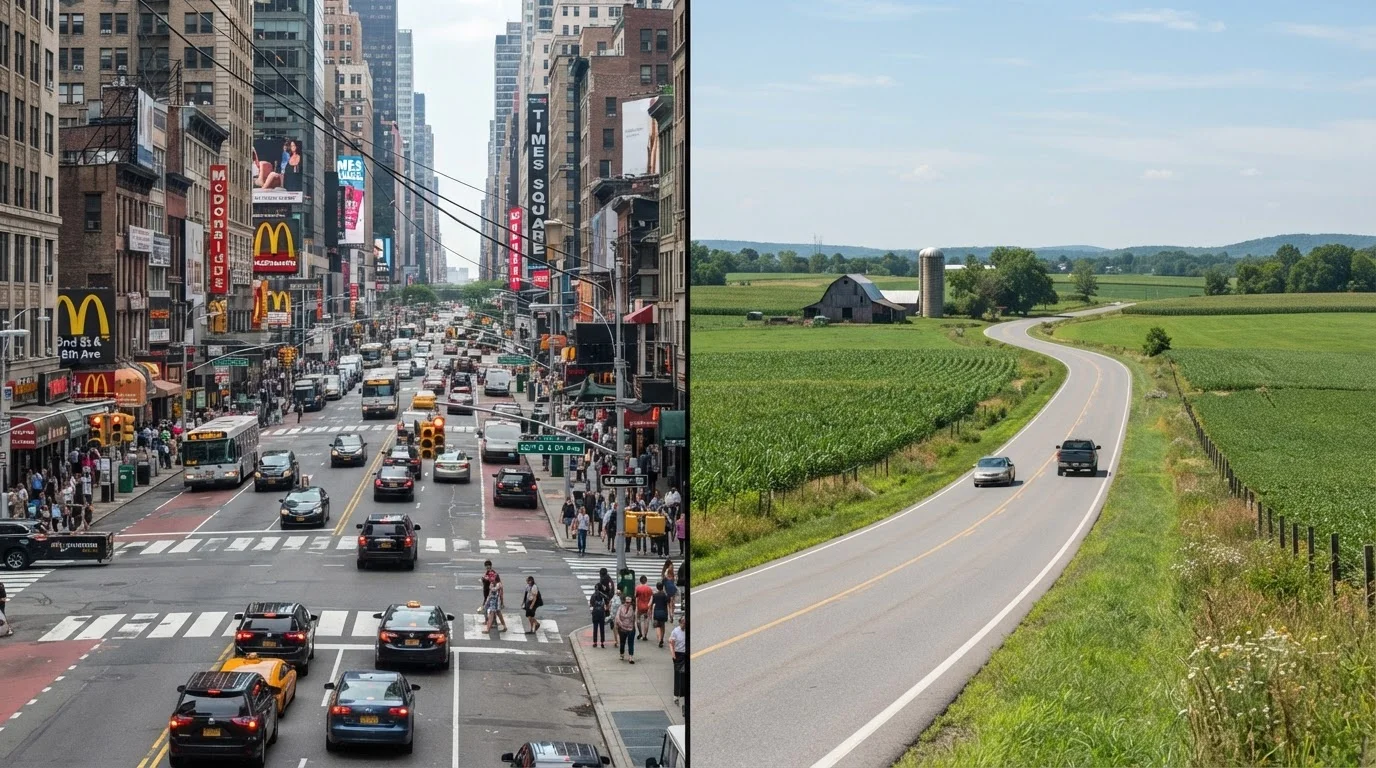
Neither urban nor rural driving is inherently safer - they simply present different categories of risk. City roads generate more frequent crashes but at lower severity, while rural roads produce fewer crashes that are far more likely to be fatal. Recognizing which hazards are active in your current environment, and adjusting your behavior accordingly, is the foundation of safe driving in either setting.
| Best for | Recommended |
|---|---|
| Drivers primarily navigating city streets | Urban risk awareness - focus on intersections, vulnerable road users, and stop-and-go attention management |
| Drivers who regularly travel rural highways or back roads | Rural risk awareness - prioritize speed management, fatigue control, and readiness for wildlife or unmarked hazards |
| Drivers who regularly switch between both environments | Environment-adaptive driving - consciously reset your expectations and habits each time the road type changes |
The Core Difference: Frequency vs. Severity
A common assumption is that city driving is more dangerous simply because there is more traffic. The crash data tells a more nuanced story. Urban environments do generate more total crashes - largely due to high vehicle density, pedestrian traffic, and complex intersections. However, rural roads are responsible for a strikingly disproportionate share of fatal crashes.
According to the National Highway Traffic Safety Administration (NHTSA), rural roads consistently account for roughly half of all U.S. traffic fatalities despite carrying only a fraction of total vehicle miles traveled. The core reason is speed: higher posted limits and longer stretches without stops mean that when something goes wrong on a rural road, the consequences are more severe. Emergency response times are also typically longer, which compounds injury outcomes.
Urban crashes tend to happen more often but at lower speeds - fender-benders, sideswipes, and intersection collisions that injure more than they kill. Understanding this frequency-versus-severity split is the starting point for calibrating your behavior to the road you're actually on.
Urban Road Hazards: What the City Demands
City driving is a constant attention task. Stop-and-go traffic, frequent lane changes, cyclists sharing lanes, and pedestrians crossing mid-block all compress the margin for error. Intersections are where the majority of urban crashes occur - particularly left-turn movements, which require drivers to judge oncoming speed while managing cross-traffic and pedestrian signals simultaneously.
Vulnerable road users - pedestrians and cyclists - face significantly elevated risk in urban settings simply because they are present in far greater numbers. A driver's blind spots, wide turns in tight intersections, and distracted driving all become acute dangers when the road is shared with people on foot or two wheels.
Distracted driving is amplified in stop-and-go urban traffic, where drivers may feel a false sense of security at low speeds. In reality, even a slow-speed collision with a cyclist or pedestrian can cause serious injury. Distraction and impairment affect reaction time regardless of speed, making them especially consequential in unpredictable city environments.
Reset Your Mindset When the Road Type Changes
Drivers who regularly switch between city and rural driving are most at risk of carrying the wrong set of assumptions into a new environment. Before a long rural leg, consciously remind yourself that speed consequences are amplified and hazards are less predictable. When returning to city streets after highway driving, give yourself a few minutes to recalibrate to slower, denser traffic before assuming full alertness.
Rural Road Hazards: Speed, Isolation, and the Unexpected
Rural roads introduce a different category of threat. Higher speed limits - often 55 mph or above - mean that driver error has far less recovery time. Narrow two-lane roads with no median barriers, minimal lighting, and degraded shoulder markings leave little room for correction if a vehicle drifts or a hazard appears suddenly.
Wildlife crossings are a hazard that urban drivers may underestimate until their first encounter. Deer, for example, are most active at dawn and dusk and can appear with almost no warning. Striking a large animal at highway speed is frequently catastrophic. Night driving on rural roads compounds this risk significantly, as reduced visibility and drowsiness combine with wildlife activity peaks.
Fatigue is a disproportionate rural risk factor. Long, straight stretches with minimal visual stimulation can induce highway hypnosis - a state of reduced alertness despite eyes remaining open. This is distinct from drowsy driving, though both are dangerous. Weather conditions also interact more severely with rural roads, which are less likely to be treated promptly after ice or snow events.
Speed itself deserves direct attention here. Understanding the real relationship between speed and crash severity is essential for rural drivers who may feel that slightly exceeding a posted limit on an empty road carries no meaningful risk.
| Urban Roads | Rural Roads | |
|---|---|---|
| Crash frequency | Higher - dense traffic, more interactions | Lower - fewer vehicles per mile |
| Crash severity | Lower - more low-speed collisions | Higher - high-speed impacts more common |
| Primary hazards | Intersections, pedestrians, cyclists | Speed, wildlife, fatigue, road condition |
| Speed environment | Lower posted limits, stop-and-go | Higher posted limits, long uninterrupted stretches |
| Emergency response time | Typically faster | Often significantly delayed |
| Road infrastructure | Well-marked, lit, regularly maintained | Often poorly lit, narrow, infrequent maintenance |
| Key driver behavior adjustment | Sustained attention, vulnerable user awareness | Speed discipline, fatigue management |
Adapting Your Driving to the Environment
The most effective safety behavior in both settings is environmental awareness - deliberately recognizing which hazards are active for the road type you are currently on, rather than applying a one-size-fits-all driving style.
In urban areas, this means scanning further ahead through intersections, anticipating pedestrian movement at crosswalks even when you have the right of way, and resisting the urge to look at your phone during slow-moving traffic. Subtle aggressive behaviors - such as rolling through stop signs or cutting off cyclists - are easy to rationalize in dense city traffic but carry real consequences.
On rural roads, building in adequate following distance, staying alert to animal crossing signs, and pulling over when fatigued are non-negotiable habits. Drivers switching from a city commute to a rural highway leg should consciously reset - the cognitive load drops, but the severity stakes rise. If you're navigating unfamiliar rural routes, the principles covered in staying safe in unfamiliar environments translate to road awareness as much as to neighborhood safety.
Neither environment rewards complacency. The safest drivers are those who treat each road type as its own operating context - because in practice, it is.
The content on this site is provided for informational purposes only and should not be considered a substitute for professional advice. While we strive to provide accurate and up-to-date information, we make no guarantees regarding its completeness or accuracy. Always consult a qualified professional for advice specific to your circumstances before making any decisions.