

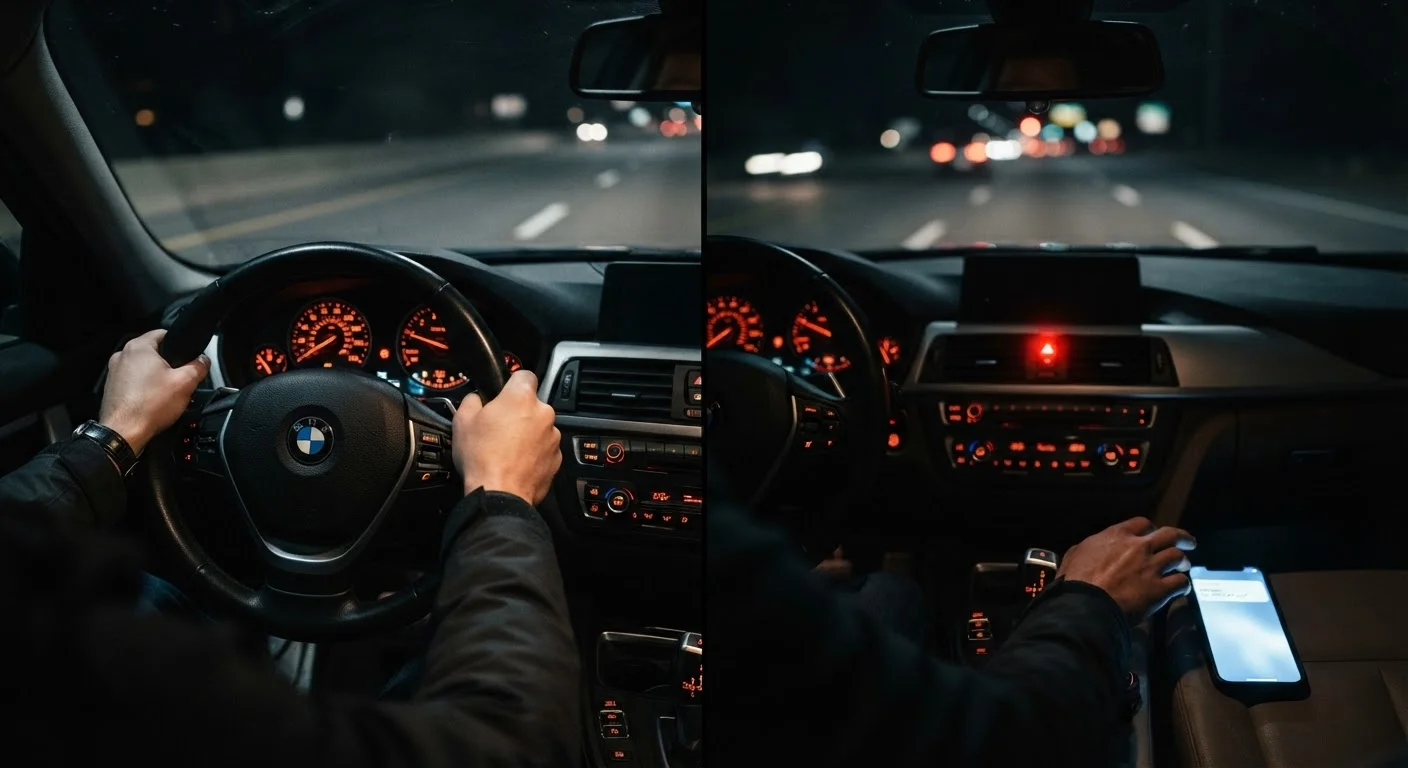
Option A
Distracted Driving
The attention thief hiding in plain sight.
Best for: Understanding how cognitive, visual, and manual diversions - like phone use - remove driver focus from the road.
Option B
Impaired Driving
A chemical compromise of judgment and control.
Best for: Understanding how alcohol, drugs, or certain medications chemically degrade perception, coordination, and decision-making.
How Each Risk Actually Works
Distracted driving and impaired driving are both leading causes of traffic crashes in the United States, but they compromise driver performance through fundamentally different mechanisms. Understanding that difference matters - both for recognizing danger in yourself and spotting it in drivers around you.
Distracted driving occurs when a driver diverts attention away from the primary task of operating the vehicle. Researchers and regulators typically break distractions into three categories:
- Visual: Taking your eyes off the road (e.g., glancing at a GPS screen or looking at a passenger)
- Manual: Taking your hands off the wheel (e.g., reaching for a drink or adjusting the radio)
- Cognitive: Taking your mind off driving (e.g., engaging in a mentally demanding conversation)
Texting while driving is widely cited as especially dangerous because it triggers all three types at once. According to the National Highway Traffic Safety Administration (NHTSA), reading or sending a text at 55 mph is comparable to driving the length of a football field with your eyes closed.
Impaired driving, by contrast, works from the inside out. Alcohol, cannabis, certain prescription medications, and illicit drugs interfere with brain chemistry - slowing neural signaling, distorting depth perception, degrading coordination, and impairing the judgment needed to assess risk. Unlike distraction, impairment doesn't require an external trigger. The driver's baseline processing capacity is simply reduced. A driver can be fully focused on the road ahead and still be dangerously impaired.
| Criterion | Distracted Driving | Impaired Driving |
|---|---|---|
| Primary cause | External attention diversion | Chemical brain impairment |
| Reaction time impact | Situational; improves when distraction ends | Sustained until substance metabolizes |
| Self-awareness of impairment | Driver usually knows they are distracted | Driver often overestimates their ability |
| Common triggers | Phone, passengers, GPS, food/drink | Alcohol, cannabis, drugs, some medications |
| Legal threshold | Varies by state; activity-based laws | Defined BAC limits (typically 0.08% for adults) |
| Typical legal penalty | Traffic infraction, fine | Criminal charge, license suspension, possible jail |
| Crash fatality association | Significant, especially at speed | Disproportionately high fatality rate |
Reaction Time: A Shared Consequence, Different Causes
Both forms of dangerous driving converge on one critical outcome: slower reaction time. But how they get there differs in ways that affect severity and predictability.
With distraction, reaction time degrades situationally. A driver who puts the phone down is largely restored to full capacity. The impairment is external and removable - though in the moment, the window of inattention can be fatal. Research published by the AAA Foundation for Traffic Safety has shown that even hands-free phone conversations impose measurable cognitive load, with attention returning to baseline gradually rather than instantly.
With chemical impairment, recovery is physiological and time-dependent. There is no way to mentally override the effects of alcohol or drugs - the driver's brain is chemically altered until the substance is metabolized. This makes impaired driving particularly insidious: impaired drivers consistently overestimate their own capability, a phenomenon well documented in alcohol impairment research.
~3,300
U.S. distraction-related traffic deaths per year
According to NHTSA data, distraction is a reported factor in thousands of annual U.S. traffic fatalities, with phone use as a leading contributor.
~37%
Share of traffic deaths involving impaired drivers
NHTSA consistently reports that alcohol-impaired driving alone accounts for roughly one-third of all annual U.S. traffic fatalities.
4-5 sec
Average eyes-off-road time per text
NHTSA estimates the average text message diverts a driver's gaze for approximately 4-5 seconds - enough to cover significant distance at highway speed.
For drivers who want to improve their overall situational awareness behind the wheel, defensive driving techniques offer practical strategies for anticipating hazards - whether those hazards come from a distracted or impaired driver nearby.
Legal and Social Dimensions
The legal treatment of these two behaviors reflects the severity with which each is viewed - and underscores why they're worth distinguishing.
Impaired driving carries the more severe statutory consequences in every U.S. state. Driving under the influence (DUI) or driving while intoxicated (DWI) charges can result in license suspension, fines, mandatory treatment programs, ignition interlock device requirements, and in cases involving injury or death, felony charges. Blood alcohol concentration (BAC) thresholds - typically 0.08% for adults in most states - create a defined legal line, though impairment can begin well before that level.
Distracted driving laws vary significantly by state and are generally treated as traffic infractions, though penalties are escalating as the data on phone-related crashes has grown. Some states have enacted hands-free-only laws that prohibit handheld device use entirely while driving.
It's also worth noting that fatigue can mimic aspects of both - impaired-like cognitive dulling combined with microsleep episodes that function like distraction. Driver fatigue deserves its own attention as a distinct category of risk that intersects with both impairment and distraction.
On the road, both types of compromised driving produce recognizable behavioral patterns: lane drift, inconsistent speed, delayed response to signals, and wide turns. Maintaining generous following distance and scanning well ahead helps buffer against the unpredictability of either type of driver.
This article is intended for general educational purposes and does not constitute legal advice. Traffic laws vary by state; consult your state's motor vehicle authority or a licensed attorney for guidance specific to your situation.
The content on this site is provided for informational purposes only and should not be considered a substitute for professional advice. While we strive to provide accurate and up-to-date information, we make no guarantees regarding its completeness or accuracy. Always consult a qualified professional for advice specific to your circumstances before making any decisions.