

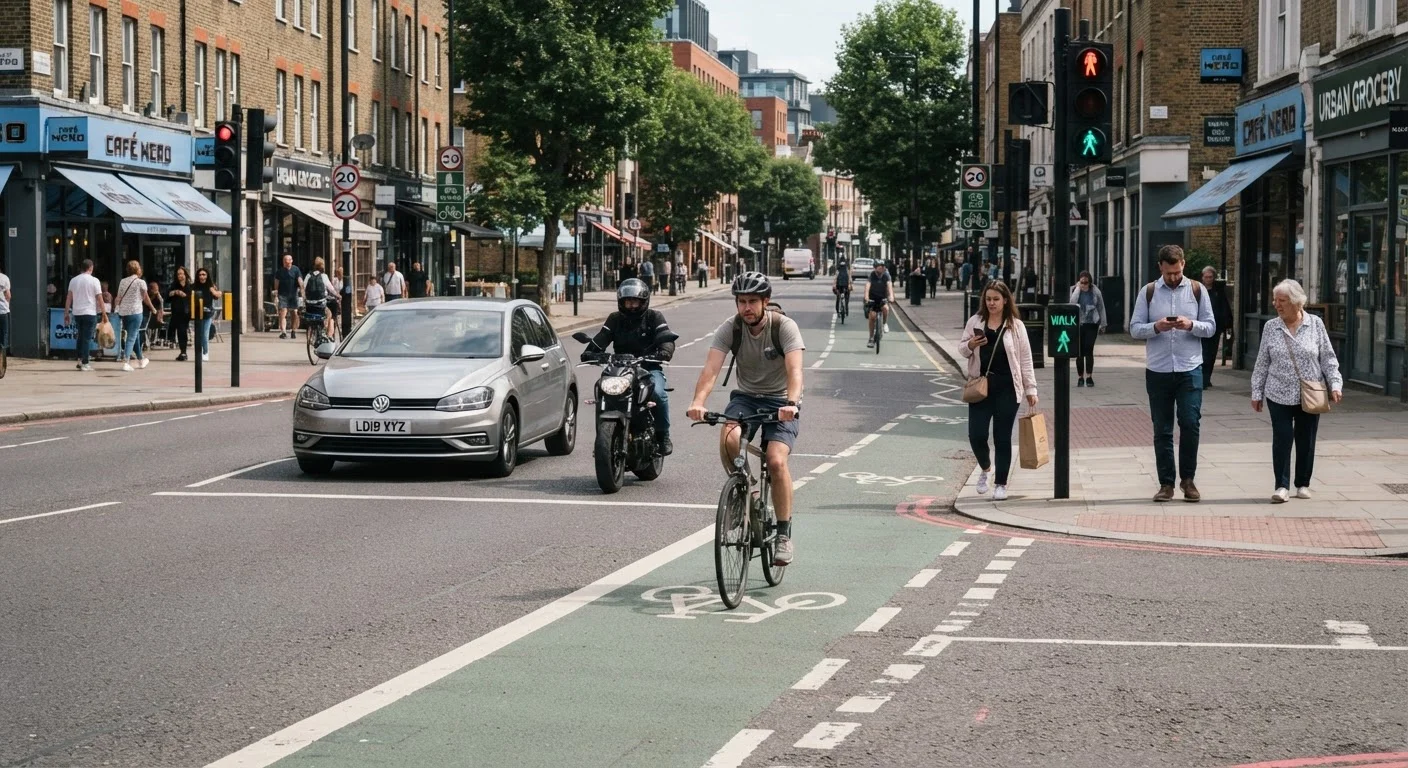
Why Vulnerable Road Users Face Disproportionate Risk
When a car collides with a motorcycle, bicycle, or pedestrian, the physics are brutally one-sided. A vehicle's steel frame, crumple zones, and airbags protect its occupants; the person outside has none of those layers. The National Highway Traffic Safety Administration (NHTSA) consistently reports that pedestrians and cyclists account for a disproportionate share of traffic fatalities relative to their share of road use. Motorcyclists face a per-mile fatality rate dramatically higher than passenger car occupants.
Understanding this imbalance shifts responsibility. Drivers of enclosed vehicles carry the greater protective duty - not because other road users are always blameless, but because the consequences of a driver's lapse are so much more severe. That mindset is the foundation of every practice in this article.
For a broader look at how road type shapes these risks, see our breakdown of urban vs. rural driving risk profiles.
~7,500
Pedestrian fatalities in a recent U.S. year
NHTSA data shows pedestrian deaths have trended upward over recent years, making this one of the most pressing road safety concerns in the U.S.
29x
Higher fatality rate for motorcyclists vs. car occupants (per mile)
According to NHTSA, motorcyclists face a fatality rate per vehicle mile traveled roughly 29 times higher than passenger car occupants.
Best Practices for Sharing the Road
The following practices address the most common failure points - perception, distance, speed, and communication - that lead to crashes involving motorcycles, cyclists, and pedestrians.
Give cyclists at least three feet of clearance - and more when passing at speed.
Most U.S. states legally require a minimum passing distance of three feet for cyclists, but at highway-adjacent speeds that buffer may not be enough to prevent wind turbulence or a panic-swerve collision. A wider berth accounts for road debris, potholes, and unpredictable movements that are routine for cyclists.
Check before opening your car door into a bike lane (the 'Dutch Reach').
Dooring - opening a car door into the path of an oncoming cyclist - is a leading cause of cyclist injury in urban areas. The Dutch Reach technique, which involves opening the door with your far hand, naturally turns your body so you can see approaching cyclists before the door swings open.
Maintain extra following distance behind motorcycles.
Motorcycles can slow rapidly without the visible brake-light warning drivers expect from cars, and their stopping distances differ from those of four-wheeled vehicles. Tailgating a motorcycle leaves almost no reaction time. Following too closely is more dangerous than most drivers realize - and the stakes are even higher behind a motorcycle.
Treat a pedestrian at a crosswalk as a full stop - not a slow-down.
Many state laws require drivers to stop and remain stopped until a pedestrian has fully cleared the lane, not merely yielded momentarily. Pulling forward while a pedestrian is still in the roadway is both a legal violation and a leading cause of pedestrian fatality.
Never pass a motorcycle using the same lane (lane splitting rules vary by state).
Attempting to share a lane with a moving motorcycle is dangerous and illegal in most U.S. states. The motorcycle occupies a full travel lane by law, and squeezing past creates an unpredictable interaction in a confined space.
Quick Actions You Can Take Starting Today
Some of the most impactful behaviors require no new skill - only a shift in habit. The actions below can be applied on your very next drive.
Speed is closely tied to every outcome here. Even modest reductions in speed at crosswalks or bike lanes meaningfully reduce both the likelihood of a crash and the severity of injury if one occurs. See how speed and stopping distance interact in our evidence-based look at speed limits and traffic safety.
Intersections, Blind Spots, and the Moments That Matter Most
The majority of serious crashes involving cyclists and pedestrians happen at or near intersections. Right-turn conflicts - where a driver looks left for oncoming cars and pulls forward without noticing a cyclist approaching from the right - are especially common. Slow down before every turn, look twice in the direction of travel, and yield to any road user already in or entering the crosswalk or bike lane.
Blind spots are a separate but related problem. Motorcycles, because of their narrow profile, can disappear entirely from a side mirror. Before changing lanes, a physical head-check - turning to look over your shoulder - is essential. Learn exactly where your blind spots are and how to manage them before your next lane change.
Right-of-way rules also apply fully to cyclists and pedestrians. A cyclist in a bike lane has the same right-of-way as a vehicle in an adjacent travel lane. Review what right-of-way rules actually require at intersections to avoid the confusion that causes thousands of crashes each year.
State Laws Vary - Know Yours
Minimum passing distances for cyclists, crosswalk yield requirements, and lane-splitting legality differ from state to state. Some states require a full three-foot buffer for cyclists; others mandate four feet. Checking your state's DMV or traffic safety authority for the specific rules in your jurisdiction ensures you're meeting - not just approximating - the legal standard.
This article provides general safe-driving information and education. Always follow your state's traffic laws, which may differ from general guidance presented here.
The content on this site is provided for informational purposes only and should not be considered a substitute for professional advice. While we strive to provide accurate and up-to-date information, we make no guarantees regarding its completeness or accuracy. Always consult a qualified professional for advice specific to your circumstances before making any decisions.