

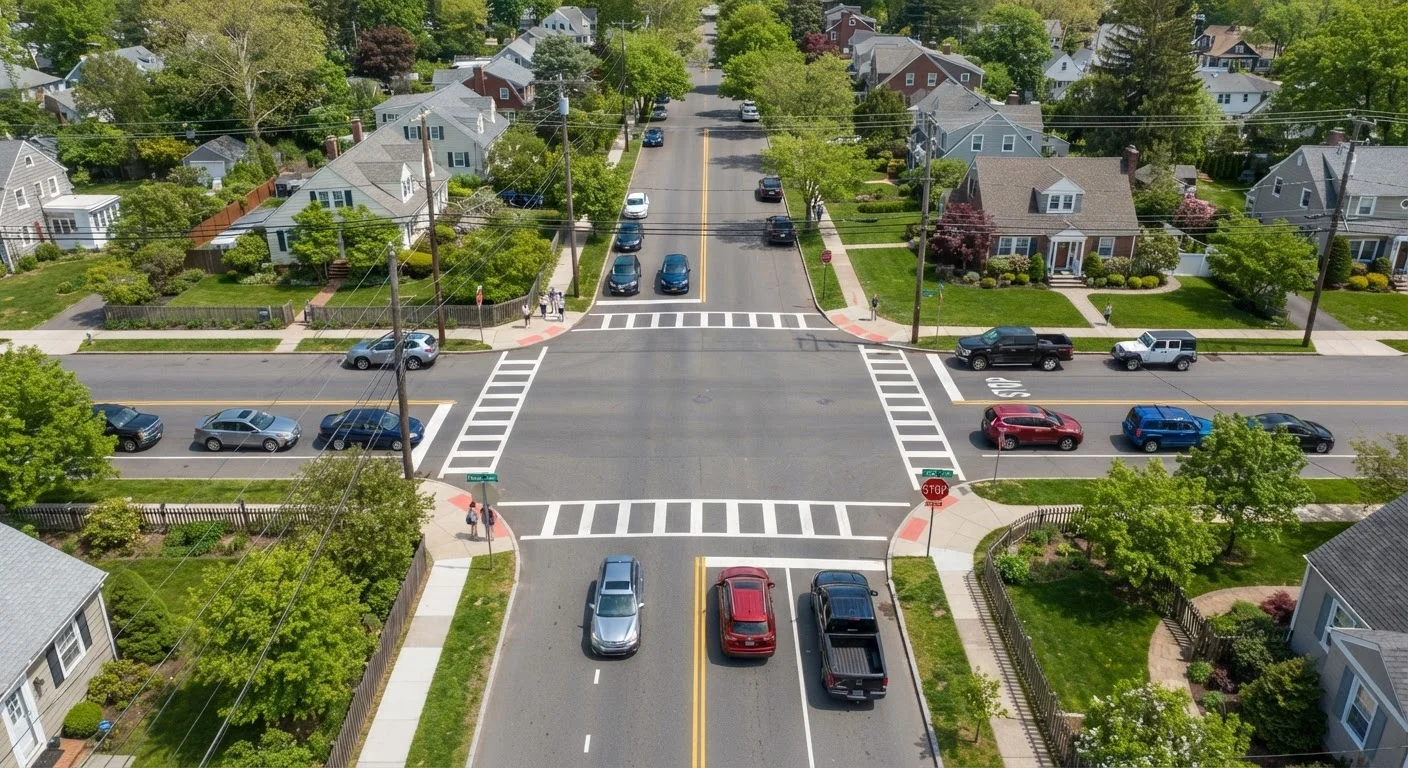
Why Intersection Rules Matter More Than You Think
Intersections are where the majority of traffic conflicts occur. According to the Federal Highway Administration, roughly 40% of all traffic crashes in the United States happen at or near intersections. Most of those incidents involve a failure to correctly observe right-of-way rules - not recklessness, but genuine confusion about who goes first.
The problem is compounded by the fact that most drivers learn these rules once for their license exam and rarely revisit them. Misapplied right-of-way is especially dangerous because both drivers may believe they are in the right. Understanding these rules precisely - not approximately - is one of the most impactful safe-driving habits you can build. See also our guide on road signs every driver should know for the regulatory context that surrounds these rules.
40%
Of U.S. crashes occurring at intersections
According to the Federal Highway Administration, approximately 40% of all traffic crashes occur at or near intersections.
~700
Annual U.S. pedestrian deaths at intersections
NHTSA data consistently shows hundreds of pedestrian fatalities occur at intersections each year, often involving failure-to-yield violations.
75%
Reduction in serious injury crashes at roundabouts
The Insurance Institute for Highway Safety reports roundabouts reduce serious injury crashes by approximately 75% compared to conventional stop-controlled intersections.
The Four-Way Stop: Sequence and Simultaneous Arrivals
The four-way stop is the intersection type that generates the most day-to-day confusion. The rules, however, are straightforward once you internalize them:
- First to stop, first to go. The vehicle that comes to a complete stop first has the right-of-way. This requires every driver to actually stop - a rolling stop does not count and is illegal.
- Tie goes to the right. If two vehicles stop at the same time, the driver on the left yields to the driver on the right.
- Straight beats turning. A vehicle going straight has priority over a vehicle turning left across its path, even if the turning driver arrived first in some interpretations - always confirm local law, but the yielding-when-turning-left principle is near-universal.
- Opposite-direction simultaneous arrival. Two vehicles directly across from each other and both going straight may proceed at the same time. If one is turning left, it yields to the oncoming straight-traveling vehicle.
When in doubt, make eye contact with other drivers and use a brief, deliberate pause to communicate intent. Never assume another driver understands the rules.
Use Eye Contact at Multi-Way Stops
At a four-way stop, brief eye contact with other drivers helps confirm who intends to go next. A slight nod or hand wave can resolve ambiguous simultaneous arrivals without frustration. Never rely solely on assumption - confirm before you move.
Yield Signs, Uncontrolled Intersections, and T-Intersections
A yield sign requires you to slow down and give the right-of-way to traffic on the main road. You must stop if necessary, but you do not have to stop if the way is clear. This is different from a stop sign, which requires a full stop regardless of conditions.
At uncontrolled intersections - those with no signs or signals - the same first-to-arrive rule applies. When arrivals are simultaneous, yield to the driver on your right. These intersections demand extra caution because both parties are relying solely on shared knowledge of the rule.
At a T-intersection, the driver on the terminating road (the bottom of the T) must yield to traffic on the through road. This is true even if no yield sign is posted.
Roundabouts: Yield Before You Enter
Roundabouts have become increasingly common across the U.S. as traffic engineers recognize their safety advantages over traditional intersections. The core rule is simple: traffic inside the roundabout has the right-of-way. Drivers entering must yield at the entry point and wait for a safe gap.
Common mistakes include entering too aggressively, stopping inside the circle unnecessarily, or attempting to change lanes mid-roundabout. Signal your exit to help other drivers anticipate your move. Roundabouts eliminate left-turn conflicts - one of the most dangerous intersection maneuvers - which is a key reason they reduce serious crash rates.
Roundabout Rules Vary Slightly by Design
Some large multi-lane roundabouts have specific lane-use signs that govern which lane is required for certain exits. Always read posted signage on entry. If you miss your exit, continue around - do not stop or reverse inside the roundabout.
Pedestrians, Cyclists, and Turning Vehicles
When you turn at an intersection - whether right or left - you must yield to pedestrians crossing the street you are turning onto. This applies even when you have a green light. A green signal authorizes you to enter the intersection, not to override pedestrian right-of-way.
Cyclists in a bike lane or on the roadway are generally treated as vehicle traffic and have corresponding right-of-way protections. Turning drivers must yield to a cyclist traveling straight through an intersection just as they would for another car. For a fuller picture of how to share the road safely, our article on sharing the road with motorcycles, cyclists, and pedestrians covers this in depth.
The practical takeaway: any time you are turning, treat it as a yielding maneuver. Scan for people and cyclists before, during, and after completing your turn.
Emergency Vehicles and Other Special Circumstances
When an emergency vehicle approaches with lights and sirens activated, every driver is required to pull to the right and stop until the vehicle has passed. Do not block intersections or stop in a way that impedes the emergency vehicle's path. Resume only when it is safe.
Funeral processions and some authorized convoys have right-of-way by law in many states. Check your state's specific vehicle code for these provisions.
Right-of-way rules don't exist to assign blame after a crash - they exist to prevent one. Even when you have the right-of-way, you are never absolved of the duty to drive safely. If another driver fails to yield to you, that does not mean it is safe to proceed. Defensive driving means verifying safety before acting, every time. The same mindset applies to highway situations - our guide on highway merging and lane changes explains how right-of-way logic extends to high-speed traffic flow.
Frequently Asked Questions
At an intersection with no signs or signals, the driver who arrives first has the right-of-way. If two vehicles arrive at the same time, the driver on the left yields to the driver on the right. Always proceed with caution regardless.
Pedestrians have the right-of-way in marked crosswalks and, in most states, in unmarked crosswalks at intersections. However, pedestrians cannot legally dart into traffic from a non-crosswalk location without yielding. Drivers should still exercise caution around pedestrians in all situations.
The driver on the left yields to the driver on the right. If vehicles are directly across from each other and both going straight, they may proceed simultaneously. When one is turning left, it must yield to the oncoming vehicle going straight.
Vehicles already traveling inside a roundabout have the right-of-way. Vehicles entering the roundabout must yield and wait for a safe gap. Do not stop inside the roundabout unless necessary for safety.
Yes. Failing to yield right-of-way when legally required is a traffic violation in every U.S. state. It can result in a citation, points on your license, and significant legal liability if a crash occurs.
Yes. When an authorized emergency vehicle is approaching with lights and sirens active, all drivers are required to pull over to the right and stop until it passes. This is federal- and state-mandated across the U.S.
The content on this site is provided for informational purposes only and should not be considered a substitute for professional advice. While we strive to provide accurate and up-to-date information, we make no guarantees regarding its completeness or accuracy. Always consult a qualified professional for advice specific to your circumstances before making any decisions.