

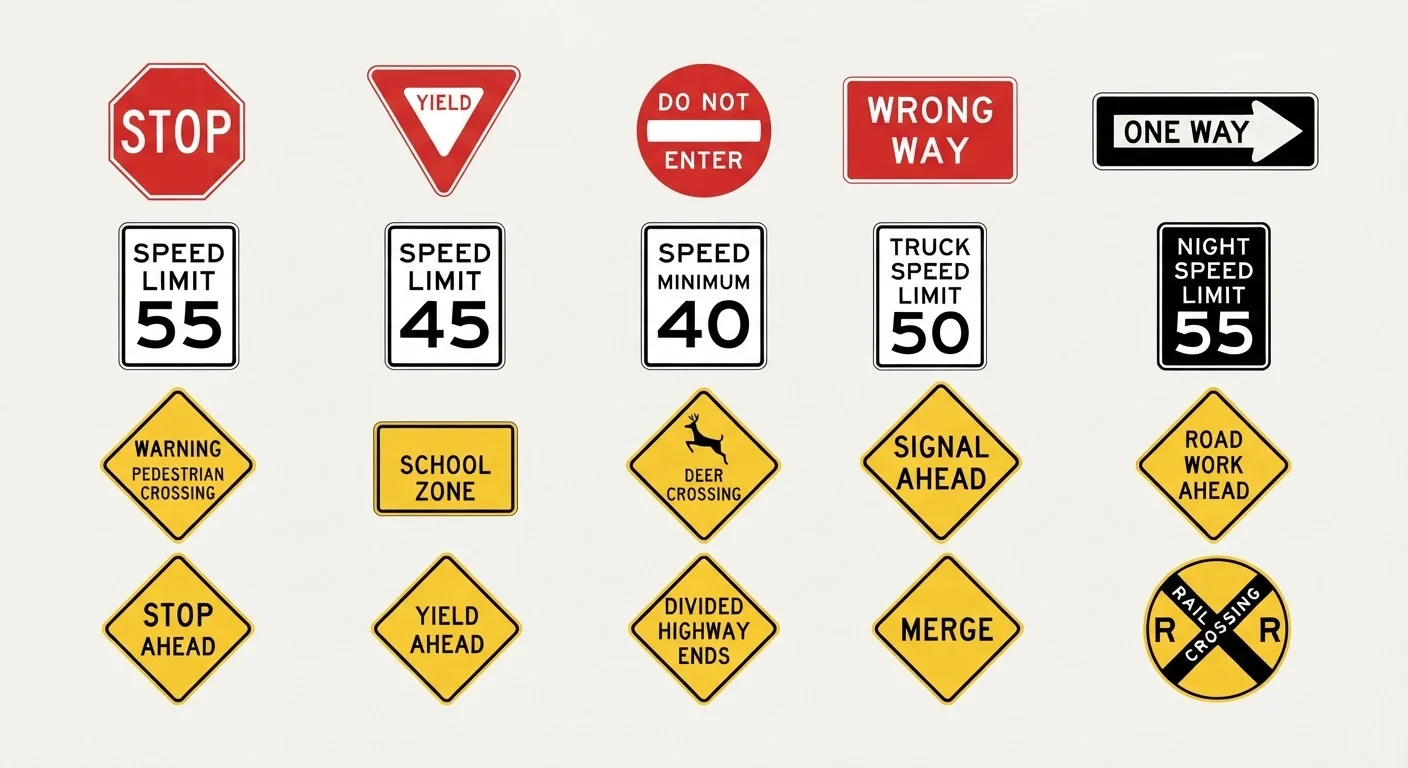
Why Sign Recognition Still Matters for Experienced Drivers
Most drivers pass a sign recognition test once - during their initial licensing exam - and rarely revisit the topic. But road signs are a living communication system, and gaps in knowledge directly affect safety. Misreading a yield sign at a roundabout, ignoring a no-passing zone marker, or missing a reduced-speed warning in a construction zone can have serious consequences.
Sign literacy also becomes more critical in unfamiliar areas. When you're navigating new roads, your ability to interpret a sign's shape, color, and symbol instantly - without stopping to read every word - is what keeps traffic moving safely. These demands become even sharper after dark. See how nighttime driving amplifies sign-reading challenges for a closer look at low-visibility risks.
| Primary sign categories in the U.S. | 3 types: Regulatory, Warning, and Guide (Federal Highway Administration MUTCD) |
| Color of most warning signs | Yellow with black symbols (diamond shape) (Federal Highway Administration MUTCD) |
| Stop sign shape | Octagon (8-sided) (Federal Highway Administration MUTCD) |
| Yield sign shape | Downward-pointing triangle (Federal Highway Administration MUTCD) |
| Blue signs indicate | Services - gas, food, lodging, hospitals (Federal Highway Administration MUTCD) |
| Regulatory sign background color | White with black or red text/symbols (Federal Highway Administration MUTCD) |
The Three Sign Categories and What Each Controls
U.S. road signs fall into three functional families defined by the Federal Highway Administration's Manual on Uniform Traffic Control Devices (MUTCD):
- Regulatory signs (white background, black or red text/symbols) communicate laws you are legally required to follow. Stop, yield, speed limit, do not enter, and one-way signs all belong here. Failure to comply is a traffic violation.
- Warning signs (yellow diamond, black symbols) alert you to conditions ahead - sharp curves, pedestrian crossings, merging lanes, low clearances, and school zones. They signal that you should adjust your speed or attention.
- Guide signs (green or blue rectangles) provide navigation and service information. Green signs indicate route numbers and destinations; blue signs point to nearby services like gas, food, lodging, and emergency care.
Shape recognition acts as a critical backup when text is obscured by snow, glare, or vegetation. An octagon always means stop. A downward triangle always means yield. A diamond always signals a hazard. Knowing these shapes by memory means you can respond correctly even in imperfect conditions.
Signs Can Vary by State
While the Federal Highway Administration's MUTCD sets national standards, individual states may supplement with their own signs for local conditions, toll systems, or regional hazards. When driving in an unfamiliar state, slow down and read carefully when you encounter an unfamiliar sign - and verify local rules through your state's DMV resources.
Regulatory Signs Drivers Most Often Misread
Some regulatory signs are routinely misunderstood, even by experienced drivers:
- Do Not Enter
- A white horizontal bar on a red background. It means you cannot proceed in the direction you are traveling - typically posted at exits of one-way streets or freeway ramps. Entering past this sign puts you directly in oncoming traffic.
- No Turn on Red
- Prohibits turning right (or left from a one-way onto a one-way) at a red light. This overrides the general right-on-red permission most states grant, and applies only at the specific intersection where posted.
- Regulatory Speed Limit vs. Advisory Speed
- A standard white rectangular sign posts the legal maximum. A smaller yellow sign with a number (often posted beneath a curve warning) is an advisory speed - a safe recommendation for that specific condition, not a legal cap.
Regulatory signs work alongside right-of-way rules. For a detailed breakdown of how signs and road law interact at four-way stops and roundabouts, see what right-of-way rules actually require at intersections.
Warning Signs Worth Slowing Down For
Warning signs are sometimes treated as suggestions, but they reflect real engineering assessments of road conditions. A sharp-curve warning with an advisory speed of 25 mph represents the geometry of that specific curve - drivers who ignore it are taking a genuine risk.
Key warning signs to know well:
- Pedestrian Crossing: Slow down and prepare to stop. These are especially common near schools, parks, and business districts. Sharing the road safely with pedestrians and cyclists starts with recognizing and respecting these zones.
- Slippery When Wet: Identifies roads where the surface is especially prone to reduced traction. Wet pavement can significantly reduce braking distance, so increase your following distance accordingly.
- Merge / Lane Ends: Your lane or an adjacent lane is closing ahead. Begin identifying a safe gap early rather than forcing a last-second merge.
- Low Clearance: A height measurement posted in advance of an overpass or underpass. Critical for trucks, campers, and vehicles carrying roof-mounted cargo - striking an overpass is a serious and preventable hazard.
Regulatory Sign
A sign that communicates laws and rules drivers are legally required to obey. Violations can result in traffic citations or fines.
Warning Sign
A sign that alerts drivers to upcoming hazards, changes in road conditions, or situations requiring extra caution. Typically diamond-shaped and yellow.
Guide Sign
An informational sign that helps drivers navigate routes, find services, or locate destinations. These are usually rectangular and green or blue.
Right-of-Way
The legal priority given to one driver, cyclist, or pedestrian to proceed before others in a shared traffic situation.
Advisory Speed
A recommended - not legally mandated - speed shown on some warning signs, indicating a safe pace for a specific road condition such as a sharp curve.
School Zone
A designated area near a school where reduced speed limits and additional pedestrian protections apply, typically enforced during school hours.
The content on this site is provided for informational purposes only and should not be considered a substitute for professional advice. While we strive to provide accurate and up-to-date information, we make no guarantees regarding its completeness or accuracy. Always consult a qualified professional for advice specific to your circumstances before making any decisions.