

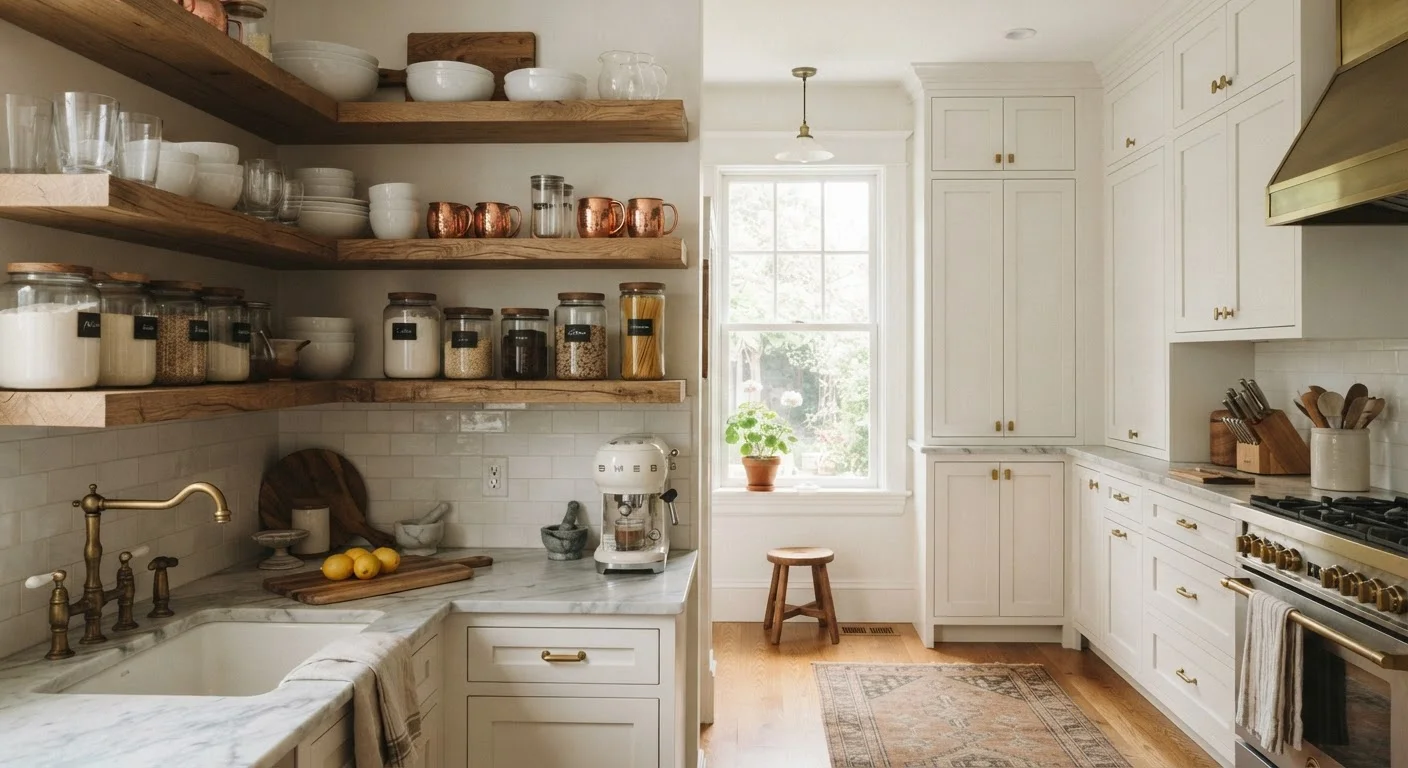
Option A
Open Shelving
The visible, design-forward choice.
Best for: Households that keep frequently used items tidy and want easy, at-a-glance access to everyday kitchenware.
Option B
Cabinet Storage
The practical, clutter-concealing standard.
Best for: Busy families who prioritize hiding mess, protecting dishes from dust, and keeping the kitchen looking consistently tidy.
The Real Difference Between These Two Storage Approaches
Open shelving and cabinet storage aren't just aesthetic preferences - they reflect fundamentally different relationships with your kitchen. Open shelves put everything on display: the pretty olive oil bottle sits next to the half-used bag of lentils and the coffee mug you grabbed in a hurry. Cabinets, by contrast, create a backstage - doors close, clutter disappears, and the kitchen looks presentable with almost no effort.
That distinction matters more than it sounds. For households where multiple people cook, kids grab snacks, and life moves fast, cabinets offer forgiveness. For households where one or two people cook deliberately and take pride in a curated, organized space, open shelving can genuinely work - and look great doing it.
This choice also intersects with how you're thinking about organizing your home room by room - the kitchen is usually the highest-traffic space, which means its storage system needs to hold up under real daily pressure, not just look good in a photo.
| Criterion | Open Shelving | Cabinet Storage |
|---|---|---|
| Visual access | Everything visible at a glance | Items hidden behind doors |
| Tidiness required | High - clutter always visible | Low - doors conceal mess |
| Dust & grease exposure | Items exposed; need regular wiping | Items protected by doors |
| Perceived kitchen size | Opens up sightlines, feels larger | Can feel heavier and more enclosed |
| Installation reversibility | May require patching or repainting | Standard; easy to leave in place |
| Storage capacity | Limited by display considerations | Maximized with organizer inserts |
| Accessibility | Fast grab-and-go for daily items | Deep shelves can obscure rear items |
| Aesthetic flexibility | Requires styled, cohesive items | Accommodates any mix of items |
Where Open Shelving Wins - and Where It Struggles
The strongest argument for open shelving is accessibility. When you can see everything, you reach for it faster. There's no hunting through deep cabinet corners for the colander you use once a week. Items you use daily - a go-to skillet, your everyday plates, drinking glasses - are genuinely easier to grab and put back when they live on an open shelf.
Open shelves also give a kitchen visual breathing room. In a compact space, replacing upper cabinets with floating shelves can make the room feel significantly larger by eliminating the visual weight of closed cabinet boxes. This makes open shelving worth considering alongside other small-space storage solutions that don't require major renovations.
The honest downside: open shelves accumulate grease, dust, and cooking residue - especially near the stove. In a kitchen used heavily for frying or roasting, items on open shelves need to be wiped down regularly or they'll look grimy quickly. Mismatched or cluttered items also become a permanent visual feature rather than something a cabinet door can hide.
~67%
U.S. kitchens with full upper cabinet coverage
Standard American kitchen designs have historically defaulted to full upper cabinet runs, making open shelving a deliberate departure from the norm.
2-3×
More frequent cleaning needed for open shelves near stove
Kitchen surfaces near cooking zones accumulate grease and particulate significantly faster than those away from heat sources, according to general cleaning guidance.
Where Cabinets Excel - and Their Limitations
Cabinets remain the default in American kitchens for good reason: they offer enclosed, protected storage that tolerates mess. Close the door and the kitchen looks tidy, regardless of what's inside. This is particularly valuable for households with kids, frequent entertaining, or simply less time to maintain a curated display.
Cabinets also protect items. Dishes, glassware, and dry goods stored behind doors stay cleaner longer - a meaningful practical benefit in kitchens where cooking happens most days. Deep cabinets with pull-out organizers can also maximize storage capacity in ways that open shelving simply cannot match.
The limitation is accessibility. Standard upper cabinets - especially those mounted at typical heights - can be difficult to reach for shorter household members, and items stored at the back of a deep shelf become effectively invisible. This is where cabinet organization tools (pull-out drawers, lazy Susans, tiered shelf inserts) earn their keep. It's also worth thinking about how to use vertical space more effectively inside cabinets, not just on walls.
How to Decide - and Why Most Kitchens Do Best With Both
Rather than treating this as an all-or-nothing choice, most American kitchens benefit from a deliberate mix. A practical approach: use open shelving for items you use every single day and that you're proud to display - a set of matching glasses, a small collection of cookbooks, a few attractive jars of pantry staples. Use cabinets for everything else, including items you use infrequently, mismatched pieces, and anything that doesn't hold up visually.
If you're drawn to open shelving but unsure about the commitment, a low-risk test is to remove the doors from one or two upper cabinets and live with the result for a few weeks. You'll quickly find out whether your household naturally keeps that space tidy or whether the novelty fades fast. Note that if removing cabinet doors means patching holes or dealing with exposed cabinet interiors that need painting, factor that work in before you decide.
For guidance on structuring the rest of your home's storage alongside the kitchen, the distinction between load-bearing and partition walls matters if you're considering any structural changes as part of a kitchen refresh. And if a chaotic kitchen drawer is part of what's pushing you toward a rethink, getting a junk drawer under control is a practical place to start before committing to a bigger storage overhaul.
The best storage system is the one your household will actually maintain. That's a more useful question than which one looks better on a design blog.
A Note on Rental Kitchens
If you're renting, check your lease before removing cabinet doors or installing wall-mounted shelving. Many leases require returning the unit to its original condition, which could mean reinstalling doors or patching anchor holes before moving out. Freestanding shelving units are a fully reversible alternative worth considering in rental situations.
The content on this site is provided for informational purposes only and should not be considered a substitute for professional advice. While we strive to provide accurate and up-to-date information, we make no guarantees regarding its completeness or accuracy. Always consult a qualified professional for advice specific to your circumstances before making any decisions.