

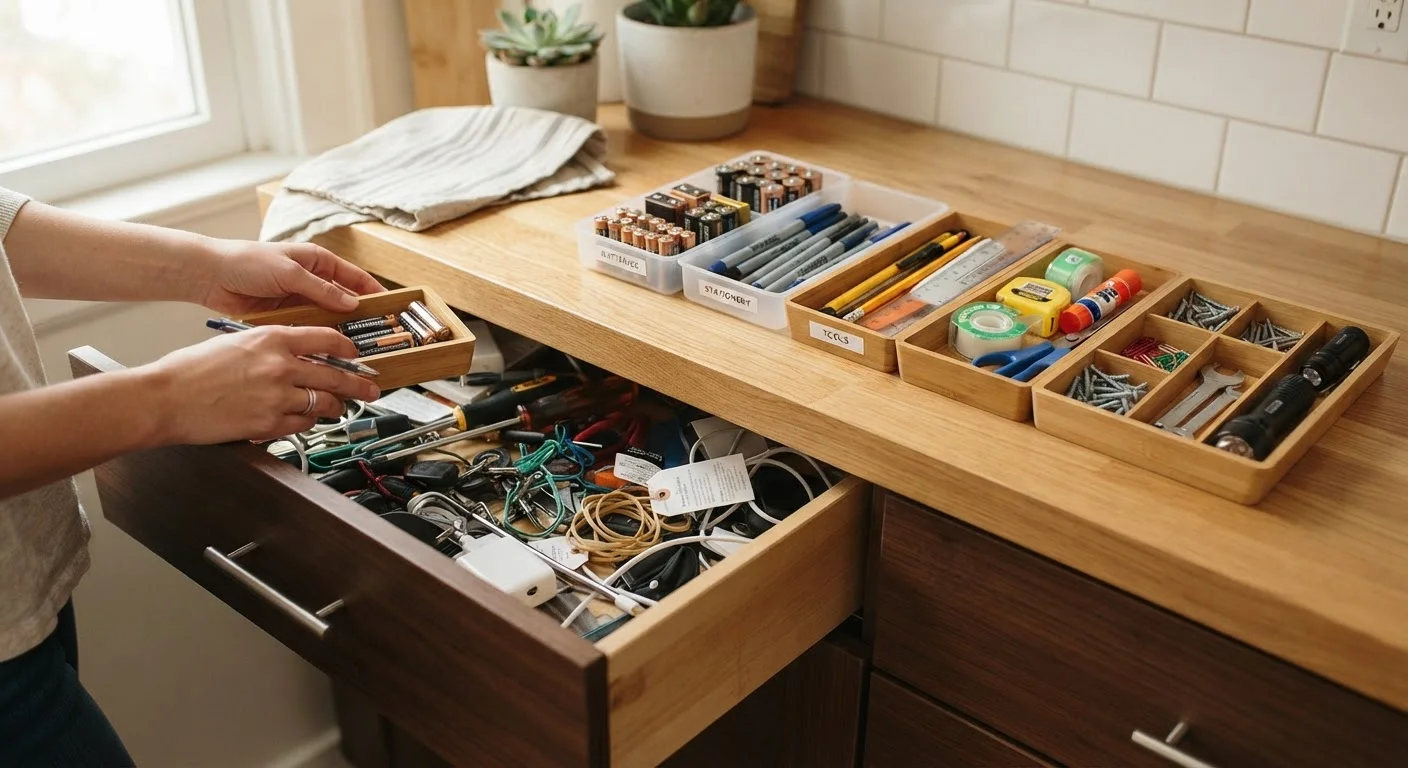
Why Junk Drawers Spiral Out of Control
The junk drawer isn't a failure of willpower - it's what happens when a household needs a catch-all space but never defines what that space is actually for. Without a clear purpose, everything becomes a candidate. Twist ties, expired coupons, dead batteries, mystery keys, and three half-used rolls of tape accumulate because there's no system telling them where else to go.
The good news: a junk drawer doesn't need to be eliminated. It needs to be defined. Once you decide what belongs there - say, small tools, batteries, pens, and household tape - everything else has a reason to leave. This guide helps you get there without the drama of dumping everything onto the kitchen floor and spending an afternoon sorting through it.
If your household tends to collect clutter in multiple spots, the room-by-room organization framework is a natural companion to this process - it applies the same principles across every space in your home.
Start When You Only Have 20 Minutes
You don't need a free afternoon to tackle this. Working through just the front third of the drawer in one sitting - and stopping there - is a legitimate first step. Progress in small sessions beats waiting for a perfect block of time that never comes.
What You'll Need Before You Start
You don't need to buy anything before tackling this project. Most households already have what's required. That said, a few items will make the process noticeably smoother.
What you will need
Small divider tray or insert
Separates the drawer into defined zones so items don't migrate and mix over time.
Repurposed small boxes or containers
Free alternative to dividers - mint tins, small food containers, or checkbook boxes all work as drawer organizers.
Trash bag or bin
Captures discards immediately so nothing gets set aside and forgotten.
Sticky note and pen
Label zones during setup so household members know where things go.
Step-by-Step: Organizing Without the Mess
The approach below works section by section inside the drawer, so you're never overwhelmed and the drawer stays functional the whole time.
Define the drawer's purpose before touching anything
Decide in one sentence what this drawer is for. A reasonable scope might be: small household tools, batteries, pens, and tape. Write it on a sticky note and keep it visible while you work. Anything that doesn't fit that definition gets relocated or discarded - not debated.
Work front to back in thirds - don't dump everything out
Pull items from the front third of the drawer only. Sort each one into three informal groups on the counter next to you: keep (fits the drawer's purpose), relocate (belongs somewhere else in the house), and discard (expired, broken, or genuinely unknown). Handle the discard pile immediately - bag it, don't set it aside.
Repeat with the middle and back thirds
Once the front third is cleared and sorted, move to the middle, then the back. The back of most junk drawers is where the real mystery items live - things that have been untouched for years. Apply the same three-group logic. If you genuinely don't know what something is or does, it's almost certainly safe to discard.
Place dividers or containers to create zones
With the drawer cleared down to its keepers, add a divider tray or repurposed containers to create distinct zones - one for writing tools, one for small tools, one for batteries, one for tape or cord, for example. Place the items you're keeping into their designated zones. Don't overfill any zone; leave a little breathing room so it stays easy to find things at a glance.
Relocate the 'belongs elsewhere' pile before you close the drawer
Walk the relocated items to their proper homes now, not later. Items left on the counter as a 'deal with it later' pile have a way of finding their way back into the drawer. If something doesn't have a home, decide in that moment whether it needs one or whether it can be discarded.
Set a two-minute weekly reset
Once a week - when you're already in the kitchen, not as a separate task - glance at the drawer. If something is out of place, move it. If a zone is overflowing, remove something. This micro-habit is what separates a drawer that stays organized from one that reverts within a month.
Don't Let the Relocated Pile Sit
One of the most common reasons junk drawers fill back up is that 'relocated' items never actually make it to their intended homes. If you can't walk the pile to its destination immediately, put it in a small box labeled 'to relocate' and deal with it within 24 hours - not next weekend.
Once your drawer is organized, the habits you build around it matter just as much as the system itself. The one-in-one-out rule and related habits can help you stop the slow creep from coming back.
Keeping It Manageable Long Term
The most durable junk drawer systems share one trait: they have a loose ceiling. When the drawer starts feeling full again, that's your cue - not to cram things in, but to spend two minutes relocating or discarding a few items. Think of it as a weekly reset rather than a monthly overhaul.
Paper that ends up in the junk drawer is one of the fastest ways things unravel. Manuals, receipts, and coupons deserve their own spot. For guidance on that specific problem, see the paper clutter management guide.
If the drawer gets a seasonal review as part of a larger household declutter, the quarterly declutter checklist gives you a structured way to build that habit without it feeling like a project every time.
A junk drawer that works is simply a drawer that knows what it's for. Define that clearly, give every item a zone, and the drawer tends to take care of itself.
The content on this site is provided for informational purposes only and should not be considered a substitute for professional advice. While we strive to provide accurate and up-to-date information, we make no guarantees regarding its completeness or accuracy. Always consult a qualified professional for advice specific to your circumstances before making any decisions.