

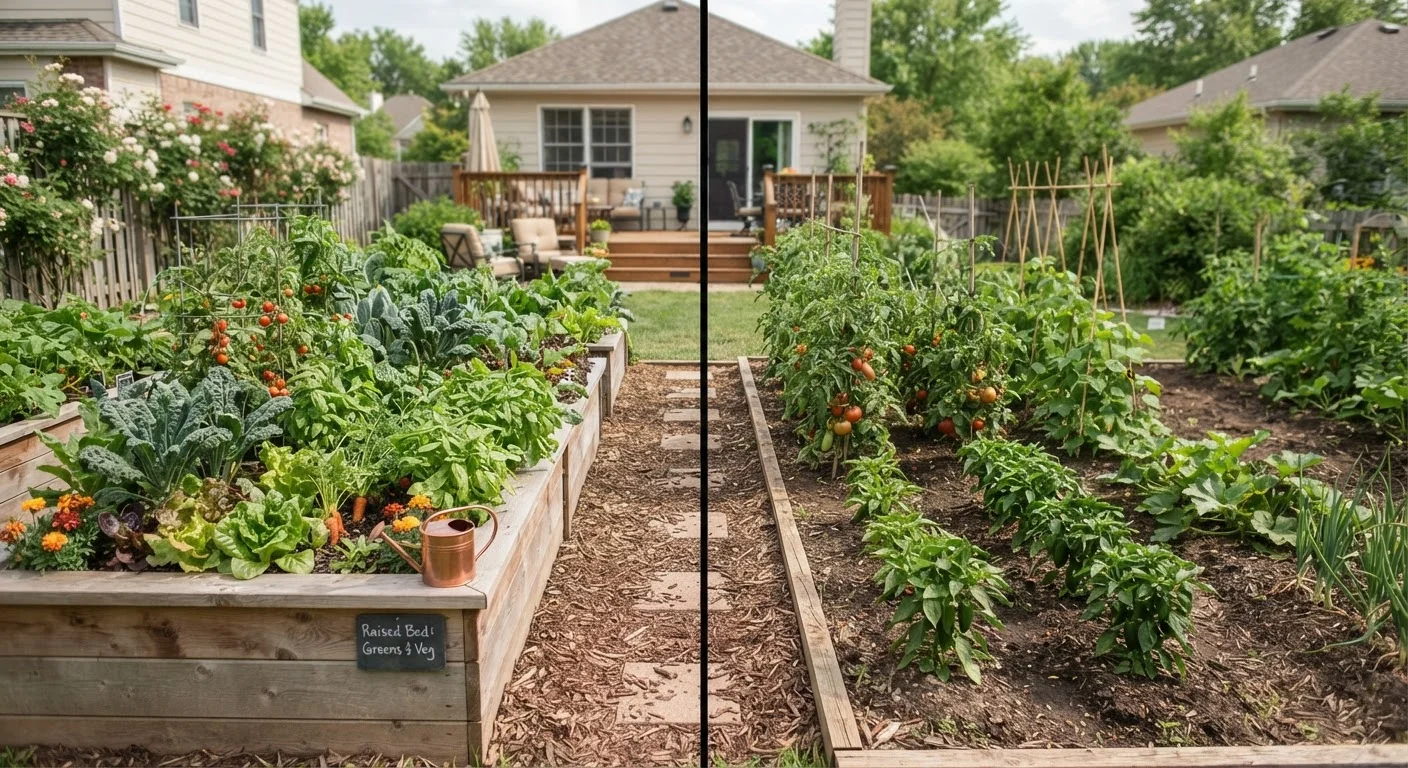
Option A
Raised Beds
The controlled, high-performance option for challenging yards.
Best for: Gardeners dealing with poor native soil, drainage problems, or physical limitations who want precise growing conditions.
Option B
In-Ground Planting
The traditional, low-barrier approach for gardeners with good soil.
Best for: Homeowners with workable native soil who want to grow at scale without significant upfront investment.
How Each Method Actually Works
A raised bed is a contained growing structure - typically built from wood, galvanized metal, or composite lumber - filled with a custom soil mix sitting above the native ground. Depths commonly range from 6 to 24 inches depending on what you plan to grow. In-ground planting means cultivating directly in your yard's native soil, amended as needed with compost or other organic matter.
Both methods grow vegetables, herbs, and flowers successfully. The differences lie in setup, cost, maintenance patterns, and how well each works given your specific yard conditions. If you're still in the early planning stages, our guide to starting a vegetable garden from scratch walks through the foundational decisions before you commit to either format.
| Criterion | Raised Beds | In-Ground Planting |
|---|---|---|
| Upfront cost | Moderate to high | Low |
| Soil control | Complete - you fill it yourself | Depends on native soil quality |
| Drainage | Excellent by design | Varies with soil type |
| Season length | Longer - soil warms faster | Standard for your climate |
| Physical accessibility | High - less bending required | Lower - ground-level work |
| Scalability | Limited by material cost | Easy to expand |
| Deep-rooted crops | Requires tall beds (18"+ depth) | Naturally accommodated |
| Weed pressure | Lower, especially early on | Higher without consistent mulching |
Soil Control and Drainage
This is where raised beds offer their clearest advantage. When you fill a raised bed, you choose the exact composition - typically a blend of topsoil, compost, and an aerating material like perlite. The result is loose, nutrient-rich growing medium that drains well and rarely compacts under foot traffic (since you never step inside the bed).
In-ground gardening works with whatever soil nature gave you. Sandy soil drains too fast and holds few nutrients; dense clay drains poorly and can suffocate roots. Both can be improved with consistent compost additions over multiple seasons, but the improvement is gradual. If your native soil is in reasonably good shape - loamy, not waterlogged, with a workable pH - in-ground planting can be just as productive with far less upfront effort.
For both methods, mulching conserves moisture and suppresses weeds. Understanding your options helps: mulch types and when to use each one breaks down the differences between wood chips, straw, and other materials.
6-8°F
Warmer soil temperature in raised beds vs. in-ground
Raised bed soil typically warms several degrees faster in spring, according to general horticultural guidance from university extension services.
30-50%
Less water lost to runoff in well-amended in-ground beds
Properly mulched and composted in-ground soil can retain significantly more water than untreated native soil, reducing irrigation needs.
4×8 ft
Most common raised bed size recommended for home gardeners
This size allows you to reach the center from either side without stepping in, minimizing soil compaction - a widely cited guideline from cooperative extension programs.
Cost, Setup, and Long-Term Effort
Raised beds carry a real upfront cost. Materials for a single 4×8-foot bed - lumber or metal, hardware, and enough quality soil mix to fill it - can range from roughly $100 to several hundred dollars depending on materials chosen and local prices. Filling multiple beds adds up quickly.
In-ground beds are significantly cheaper to start. The main investments are labor and soil amendments like compost or aged manure. Over time, though, in-ground soil may need more frequent amendment to maintain fertility and structure, particularly in heavy-use vegetable plots. Raised bed soil, while costly initially, tends to hold its structure longer because it doesn't get walked on and compacted.
Watering patterns also differ. Raised beds drain faster, so they may need more frequent irrigation during dry spells - a consideration worth thinking through alongside broader water-use strategies. For yards in drier regions, landscaping for drought offers practical guidance on designing for lower water demand.
Plant Types and Garden Scale
Most vegetables, herbs, and annual flowers thrive in raised beds. Leafy greens, tomatoes, peppers, carrots, and herbs are particularly well-suited because they benefit from the loose, warm soil. Shallow-rooted crops can even be grown in beds as shallow as 6 inches.
In-ground planting handles a broader range of plants more easily, especially those with extensive root systems. Corn, full-size pumpkins, potatoes, and perennial shrubs generally do better with unrestricted root depth and access to the natural soil ecosystem. In-ground plots are also easier to scale - adding 50 square feet of growing space costs almost nothing compared to building and filling another raised bed.
Whichever method you use, thinking about which plants grow well together pays off. Companion planting - pairing crops strategically - improves pest control and space efficiency in both raised beds and in-ground plots.
Soil Testing Is Worth the Small Investment
Before committing to either method, consider getting a basic soil test from your local cooperative extension office. Tests typically cost under $20 and reveal pH, nutrient levels, and sometimes contaminant data. If your native soil tests well, in-ground planting may serve you just as well as a raised bed. If results are poor or uncertain, raised beds offer a practical workaround without needing to remediate the native ground.
The content on this site is provided for informational purposes only and should not be considered a substitute for professional advice. While we strive to provide accurate and up-to-date information, we make no guarantees regarding its completeness or accuracy. Always consult a qualified professional for advice specific to your circumstances before making any decisions.