

Our Verdict
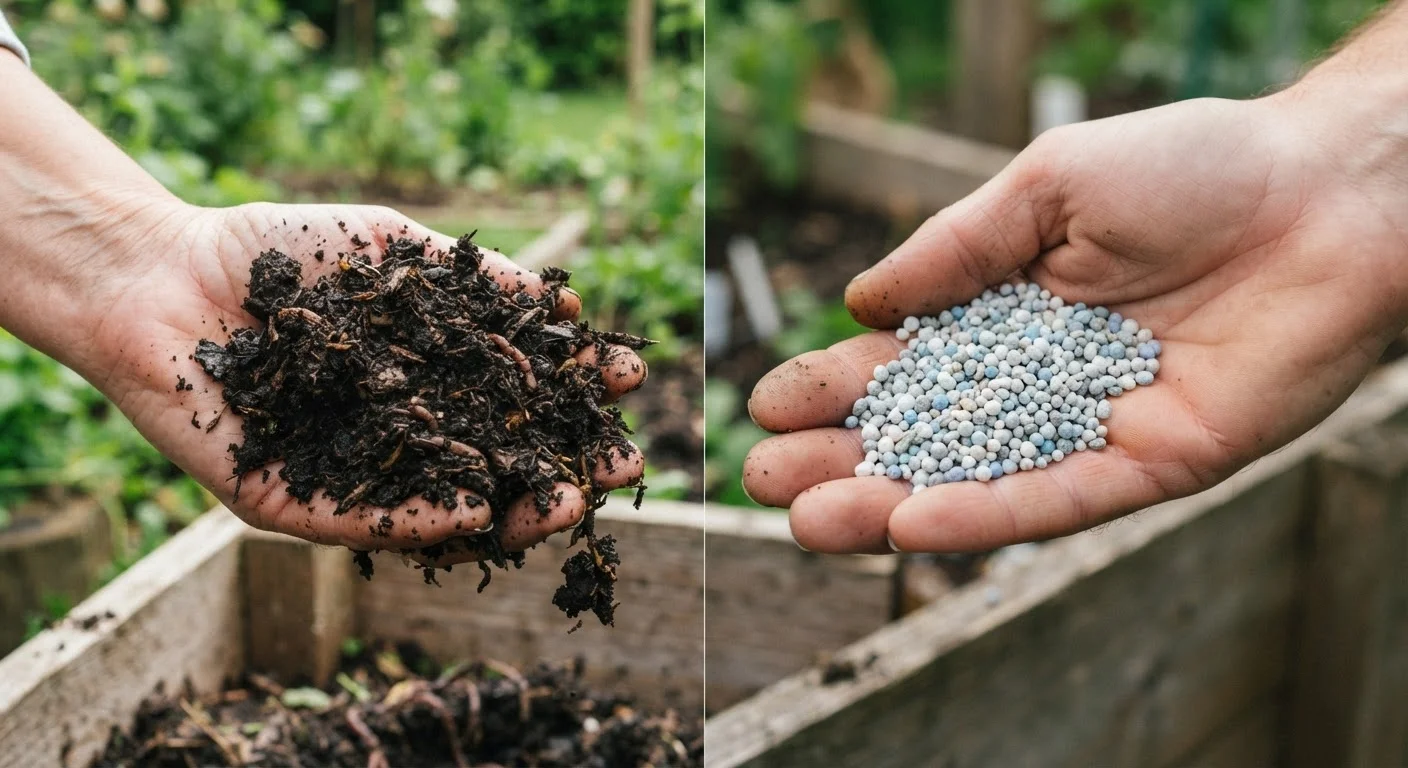
Organic fertilizers build healthier soil over time and carry a lower risk of chemical runoff, making them well-suited for long-term garden health. Synthetic fertilizers act faster and allow more precise nutrient control, which can be valuable when plants show clear deficiencies or when quick results are needed. Most experienced gardeners find value in understanding both rather than committing to one exclusively.
| Best for | Recommended |
|---|---|
| Gardeners focused on long-term soil improvement | Organic fertilizers |
| Those correcting a diagnosed nutrient deficiency quickly | Synthetic fertilizers |
| New gardeners who want a forgiving, lower-risk approach | Organic fertilizers |
| High-production vegetable growers needing precise nutrient ratios | Synthetic fertilizers |
What Fertilizers Actually Do
Plants need a range of nutrients to grow, but three matter most: nitrogen (N), phosphorus (P), and potassium (K). You'll see these listed as an N-P-K ratio on any fertilizer label - for example, 10-10-10. The difference between organic and synthetic fertilizers isn't really about which nutrients they contain; it's about how those nutrients get delivered to plant roots.
Before choosing any fertilizer, it's worth understanding your soil first. As we explain in our guide to soil health, what's already in your soil matters more than any product you add to it. A soil test - available through most cooperative extension offices - tells you what nutrients are lacking, which prevents you from applying something your garden doesn't actually need.
How Organic Fertilizers Work
Organic fertilizers come from once-living materials: composted plant matter, bone meal, blood meal, fish emulsion, kelp, and aged manure are common examples. They don't feed plants directly. Instead, they feed the microbial life in your soil - bacteria, fungi, and other organisms that break organic matter down into forms plant roots can absorb.
This process takes time, which is the main trade-off. You won't see overnight results. But because nutrients release gradually, organic fertilizers are far less likely to cause fertilizer burn - the scorching of roots and foliage that happens when too much concentrated nutrient solution contacts plant tissue. They also tend to improve soil structure over time, increasing its ability to hold moisture and support beneficial organisms.
Start With a Soil Test
Before buying any fertilizer, invest in a basic soil test. Most cooperative extension services offer them affordably, and results tell you exactly which nutrients your soil lacks. This single step prevents wasted spending and protects your plants from nutrient overload - which is just as damaging as a deficiency.
If you're growing vegetables in a raised bed, organic options pair well with the controlled soil environment. See how soil management fits into the broader decision in our article on raised beds vs. in-ground planting.
How Synthetic Fertilizers Work
Synthetic (also called chemical or conventional) fertilizers are manufactured to provide nutrients in forms that dissolve readily in water and become immediately available to plant roots. Because there's no microbial middleman, plants can begin absorbing them within days. This speed is their defining advantage.
Synthetic fertilizers also allow precise control over nutrient ratios. If a soil test shows a specific phosphorus deficiency, you can apply a product formulated exactly for that gap. This precision is difficult to achieve with organic sources, which have variable nutrient concentrations depending on their origin.
The downsides are real, though. Synthetic fertilizers don't contribute to soil organic matter or microbial health. Overapplication is easy - excess nutrients, especially nitrogen, can leach into groundwater or run off into storm drains, raising concerns about local water quality. Always follow label rates.
| Organic Fertilizers | Synthetic Fertilizers | |
|---|---|---|
| Nutrient release speed | Slow, gradual over weeks or months | Fast, often within days |
| Soil health impact | Builds organic matter and microbial life | Minimal to no benefit for soil biology |
| Risk of fertilizer burn | Low - gentle, buffered release | Higher if overapplied |
| Nutrient precision | Variable; hard to target specific ratios | Precise; exact N-P-K ratios available |
| Environmental runoff risk | Generally lower | Higher with overapplication |
| Cost and availability | Often lower cost; widely available | Generally affordable; widely available |
| Best use case | Long-term soil building | Correcting specific, confirmed deficiencies |
Making the Right Choice for Your Garden
The honest answer is that most home gardens benefit from a practical, flexible approach. If your soil is depleted and you're thinking about long-term garden health, organic amendments applied consistently over several seasons will do more good than any quick fix. If a plant is visibly struggling mid-season from a confirmed nutrient deficiency, a targeted synthetic application can rescue it while your organic program catches up.
Consider your broader garden system too. If you use companion planting strategies, you're already working with natural plant relationships - organic fertilizers tend to complement that approach. Similarly, the mulch you use affects how nutrients move through your soil; our guide to mulch types covers how different materials interact with soil over time.
Whatever you choose, more is not better. Overfertilizing - with either type - stresses plants, harms beneficial soil life, and wastes money. Start with a soil test, apply conservatively, and observe how your plants respond before adding more.
The content on this site is provided for informational purposes only and should not be considered a substitute for professional advice. While we strive to provide accurate and up-to-date information, we make no guarantees regarding its completeness or accuracy. Always consult a qualified professional for advice specific to your circumstances before making any decisions.