

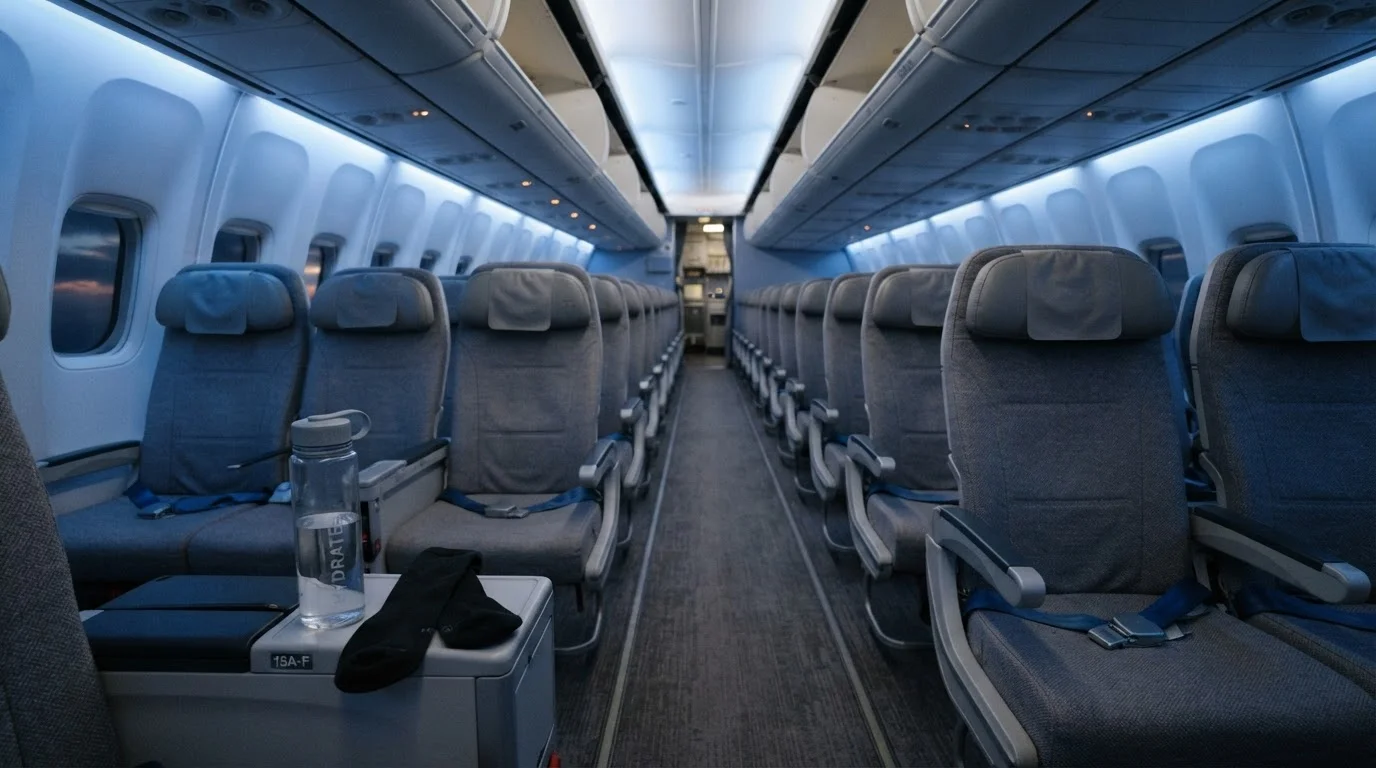
What the Cabin Environment Actually Does to Your Body
Step onto a long-haul flight and you've entered a carefully engineered but physiologically challenging environment. Aircraft cabins are pressurized to simulate an altitude of roughly 6,000 to 8,000 feet - not sea level. At that pressure, the air contains less oxygen than you're used to at home, and most healthy travelers experience a subtle drop in blood oxygen saturation. For the vast majority, this causes nothing more dramatic than mild fatigue. But it's the foundation of why everything else on this list compounds.
Cabin humidity is the other big factor. Outside air at cruising altitude is extremely dry, and even after conditioning, cabin humidity typically sits below 20% - far lower than the 30-50% most people experience indoors. Your respiratory tract, eyes, and skin all lose moisture faster than you'd expect, and the absence of sweat means you can become meaningfully dehydrated without any obvious physical cue. That sluggish, foggy feeling on arrival? Dehydration is a significant contributor.
Healthy Travelers vs. Those With Existing Conditions
The physiological effects described here are generally mild and manageable for healthy adults. However, travelers with cardiovascular conditions, respiratory diseases, anemia, recent surgery, or clotting disorders may experience these effects more acutely. If you have an existing health condition, discuss your flight plans with a healthcare provider before booking - this is general information, not personal medical guidance.
Circulation: Why Sitting Still Is the Real Problem
Your leg muscles act as a secondary pump for your circulatory system - every time they contract, they squeeze blood upward through your veins toward the heart. Sit motionless in a narrow seat for eight or ten hours, and that pump essentially stops. Blood pools in the lower legs and feet, causing the puffiness and heaviness most long-haul travelers know well.
More importantly, slowed circulation is a recognized contributor to deep vein thrombosis (DVT) - a blood clot that forms in a deep vein, most often in the legs. DVT risk on flights is real, though it remains relatively low for healthy individuals. Risk increases with factors like recent surgery, pregnancy, a history of clotting disorders, or very long flight durations. If any of those apply to you, a conversation with your healthcare provider before departure is genuinely worthwhile - not alarmist, just practical.
For most travelers, the countermeasures are straightforward: get up and walk the aisle every hour or two, do ankle circles and calf raises in your seat, and consider compression socks. The same micro-movement logic that helps desk workers applies directly to the airplane seat.
Compression Socks Are Not Just for Older Travelers
Graduated compression socks - which apply more pressure at the ankle than the calf - are widely recommended by travel medicine professionals for long-haul flights regardless of age. They help counteract venous pooling and reduce swelling. Look for ones labeled with a compression level (typically 15-20 mmHg for travel) and put them on before boarding, not after swelling has already started.
Hydration: Drinking More Than You Think You Need
Dehydration on flights is sneaky precisely because you don't feel it the same way you do after exercise. The dry cabin air constantly draws moisture from your skin, eyes, and airways. Your body manages this quietly until symptoms become noticeable - headache, dry mouth, fatigue, difficulty concentrating - all of which you might attribute to travel stress instead.
Alcohol and caffeine both have diuretic properties, meaning they increase fluid loss. At altitude, where you're already losing fluid faster than usual, their dehydrating effects combine with the cabin environment rather than simply adding to it. This is why a drink or two at 35,000 feet can feel more significant than the same amount on the ground.
Practical guidance: sip water consistently throughout the flight rather than waiting until you're thirsty. Bring an empty water bottle through security and fill it before boarding - it gives you independence from the cart service. If you're traveling on a carry-on strategy, that reusable bottle is one of the highest-value items in your bag.
<20%
Typical cabin relative humidity during flight
General aviation physiology sources note that commercial cabin humidity regularly falls below 20%, compared to the 30-50% typical in most indoor environments.
6,000-8,000 ft
Equivalent altitude of pressurized cabin
Most commercial aircraft maintain cabin pressure equivalent to this elevation range, where oxygen availability is measurably lower than at sea level.
~1-3%
Typical drop in blood oxygen saturation at cabin altitude
Research in aviation medicine suggests healthy travelers commonly experience a modest reduction in SpO2 at cruising altitude without clinically significant symptoms.
Cabin Air Quality: Filters, Recirculation, and What Actually Spreads
A persistent travel myth is that airplane air is a germ soup pumped back into the cabin endlessly. The reality is more nuanced. Modern commercial aircraft mix fresh outside air with recirculated cabin air, and the recirculated portion passes through HEPA (High Efficiency Particulate Air) filters comparable to those used in hospital operating rooms. These filters capture the vast majority of airborne bacteria and viruses.
The genuine concern isn't the filtration system - it's proximity. You're seated close to other people for many hours, and droplet transmission from a nearby passenger is a real vector regardless of how well the air is filtered. The dry air also dries out the mucous membranes lining your nose and throat, which normally serve as a first line of defense against pathogens. Staying hydrated helps maintain that barrier. For more on separating travel health fact from fiction, see common travel health myths.
Light exposure during and after a long flight also interacts with how your body resets. If you're crossing multiple time zones, understanding the biology of that process matters separately - jet lag is a biology problem, not a matter of willpower, and the strategies for handling it are evidence-grounded.
This article provides general health and travel information for educational purposes only and is not a substitute for personalized medical advice. Consult a qualified healthcare professional regarding any health concerns before traveling, particularly if you have an existing medical condition.
Frequently Asked Questions
Sitting still for hours reduces the pumping action of your leg muscles, which normally help push blood back up toward the heart. Fluid pools in the lower legs and feet as a result. Moving your ankles in circles, walking the aisle occasionally, and wearing compression socks all help counteract this.
Modern commercial aircraft use a mix of fresh outside air and recirculated cabin air, with the recirculated portion passing through HEPA filters that capture the vast majority of airborne particles including bacteria and viruses. The bigger concern for most passengers is the dry air itself and close proximity to other travelers, not unfiltered recirculation.
There is no single universal recommendation, but general guidance from travel medicine experts suggests drinking more water than you would on the ground - roughly 8 ounces per hour of flight is a commonly cited benchmark. Avoid waiting until you feel thirsty, as thirst is a late signal of dehydration, especially at altitude.
Prolonged immobility on any long journey - including flights - is a recognized risk factor for deep vein thrombosis (DVT). The risk is generally low for healthy individuals but increases with additional factors such as recent surgery, clotting disorders, or very long flight durations. Anyone concerned about their personal risk should speak with a healthcare provider before flying.
The alcohol itself metabolizes at roughly the same rate at altitude as on the ground, but the already-dehydrating cabin environment compounds alcohol's dehydrating effects. Many travelers perceive alcohol affecting them more noticeably, likely because both the dry air and alcohol are depleting fluids simultaneously.
Flight fatigue is real and distinct from jet lag. The mild reduction in blood oxygen, dehydration, sustained low-grade stress, noise, poor sleep posture, and disrupted meal timing all contribute. Arriving well-hydrated, having moved during the flight, and getting normal sleep afterward typically speeds recovery.
The content on this site is provided for informational purposes only and should not be considered a substitute for professional advice. While we strive to provide accurate and up-to-date information, we make no guarantees regarding its completeness or accuracy. Always consult a qualified professional for advice specific to your circumstances before making any decisions.