

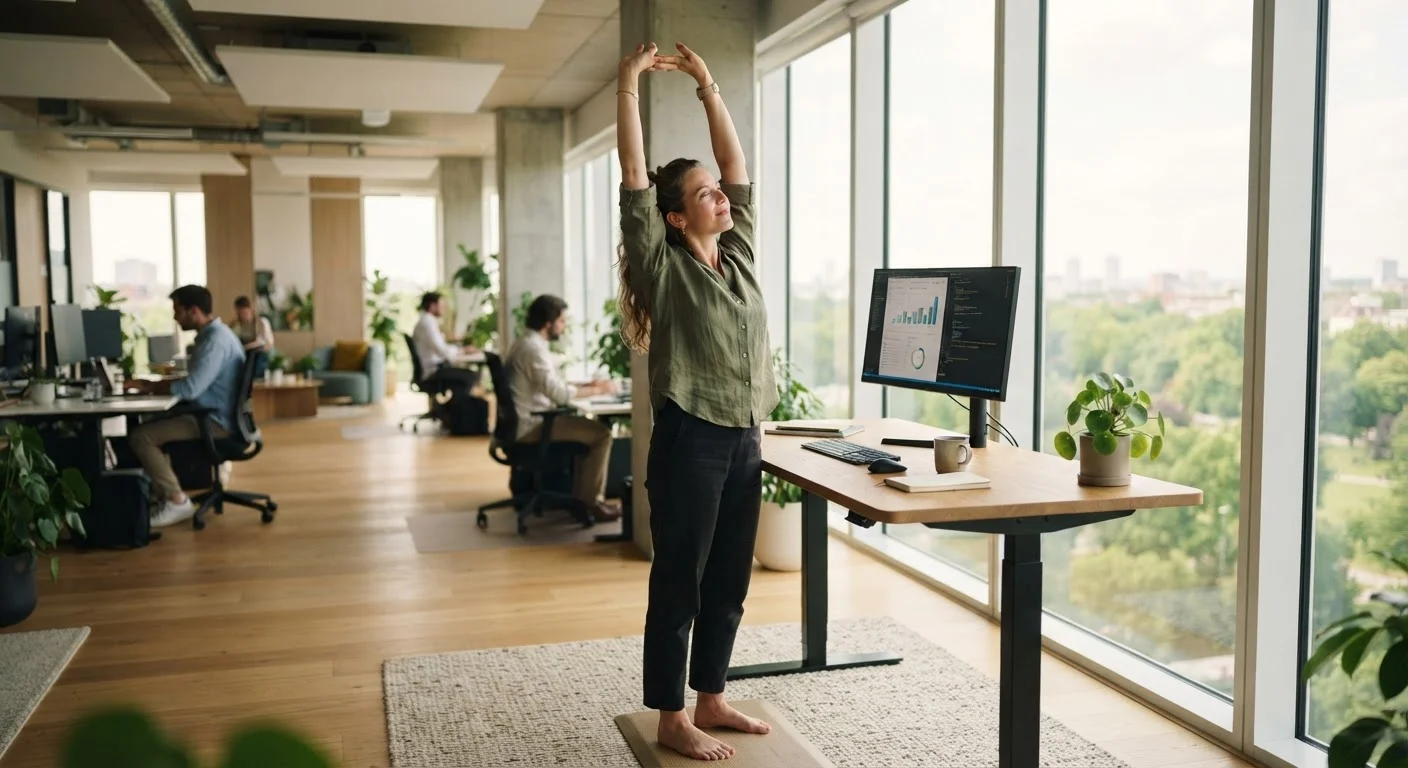
Why Sitting All Day Is Its Own Problem
For millions of Americans, a workday means eight or more hours at a desk - and research consistently links prolonged sitting to elevated risks for cardiovascular concerns, metabolic changes, and musculoskeletal discomfort. What surprises many people is that a dedicated gym session doesn't fully cancel out the effects of sitting most of the rest of the day. Movement frequency matters, not just total weekly exercise volume.
The good news: you don't need long exercise blocks to make a difference. Spreading smaller movement moments across the workday - what researchers sometimes call "breaking up sedentary time" - has its own measurable benefits for blood sugar regulation, circulation, and energy levels. The strategies below are realistic for most desk workers, require little or no equipment, and compound over time. If you're thinking about how to make these habits stick beyond the workweek, our article on building lasting exercise habits offers useful framing.
Start with just one change
If the list ahead feels like too much to tackle at once, pick one strategy and repeat it for two weeks before adding another. Behavior change research consistently shows that small, anchored habits are more durable than sweeping overhauls. For more on this approach, see our piece on why people abandon routines and what works instead.
Practical Moves You Can Start Today
Set a movement reminder every 45-60 minutes
One of the most effective desk-job strategies is also the simplest: use a timer or calendar alert to prompt you to stand up at regular intervals. Most smartphones and smartwatches support recurring reminders, and many people find that an hourly cue is the nudge they need to actually leave their chair. Even standing for two minutes and walking to a window or the water cooler counts as a meaningful break from static posture.
The goal isn't to exercise during this time - it's to interrupt the continuous sitting pattern your body dislikes. Consistency across the day matters more than intensity.
Interrupting sitting every hour is more impactful than its simplicity suggests.
Take walking meetings when the format allows
Not every meeting requires a screen. Phone calls, one-on-ones, and informal check-ins are strong candidates for a walking format - inside an office hallway or outside the building. Walking while talking adds steps without requiring any separate exercise time, and many people report feeling sharper and more relaxed during walking conversations than seated ones.
If your role involves video calls, consider stepping away from the camera for audio-only portions or scheduling deliberate screen-free calls when appropriate.
Walking meetings turn routine conversations into low-effort movement opportunities.
Use a standing desk or improvised alternative
Standing desks - both full and converter-style - allow you to alternate between sitting and standing throughout the day. Research suggests that alternating postures is more beneficial than standing all day, so the goal is variety rather than elimination of sitting entirely. If a standing desk isn't accessible, a stable stack of books, a sturdy box, or a kitchen counter can serve as a temporary raised surface for a laptop during calls.
Standing alone won't replace movement, but it changes your posture, shifts muscle activation, and makes it easier to step away briefly when needed.
Alternating between sitting and standing is more beneficial than either posture alone.
Add micro-stretches targeting common desk tension spots
Desk workers frequently develop tightness in the hip flexors, shoulders, neck, and lower back - areas that hold tension during prolonged sitting. Simple, 30-to-60-second stretches targeting these zones can reduce discomfort and serve as natural movement breaks. Chest openers, neck rolls, seated spinal twists, and standing hip flexor stretches are commonly recommended by physical therapists for office settings.
These don't need to be performed all at once. Rotating through one or two at each movement break keeps the routine varied and sustainable.
Targeting hip flexors and shoulders with brief stretches addresses desk work's most common tension points.
Walk during your lunch break - even briefly
A 10-to-15 minute walk at midday delivers meaningful cardiovascular benefit, resets mental focus, and provides light exposure that supports mood and alertness. It doesn't need to be brisk to be worthwhile. Walking has its own distinct health profile and is one of the most accessible, low-barrier forms of daily movement available.
If you tend to eat lunch at your desk, scheduling the walk before or after eating can help establish it as a consistent habit rather than an occasional one.
A midday walk, even a short one, resets focus and adds meaningful daily movement.
Rethink convenience at the office
Small friction can be your friend. Choosing the farther restroom, taking stairs instead of elevators, parking a few rows back, or placing your printer across the room are low-effort ways to accumulate steps without blocking out extra time. These "activity snacks" aren't dramatic, but research on non-exercise activity thermogenesis (NEAT) - the calories burned through everyday movement - suggests they add up meaningfully over the course of a day and a career.
Deliberately choosing inconvenient options builds step counts without requiring extra workout time.
These strategies work best when stacked with each other rather than used in isolation. Even two or three adopted consistently can produce a noticeable shift in how you feel by the end of the workday. For desk workers who also want to think about how movement interacts with energy and mood, it's worth reading about everyday habits that shape your mood - the connection between physical activity and mental state is well-supported by research.
If you're returning to movement after a break
If desk-bound habits have left you largely sedentary for months or longer, starting gradually is important. Overdoing activity too quickly can lead to soreness or injury that derails progress. Our article on restarting exercise safely after a long break walks through a thoughtful approach. As always, consult your healthcare provider if you have any health conditions that could affect your activity level.
This article is for general informational purposes only and is not a substitute for professional medical advice. Speak with a qualified healthcare provider before making changes to your activity level, particularly if you have an existing health condition.
The content on this site is provided for informational purposes only and should not be considered a substitute for professional advice. While we strive to provide accurate and up-to-date information, we make no guarantees regarding its completeness or accuracy. Always consult a qualified professional for advice specific to your circumstances before making any decisions.