

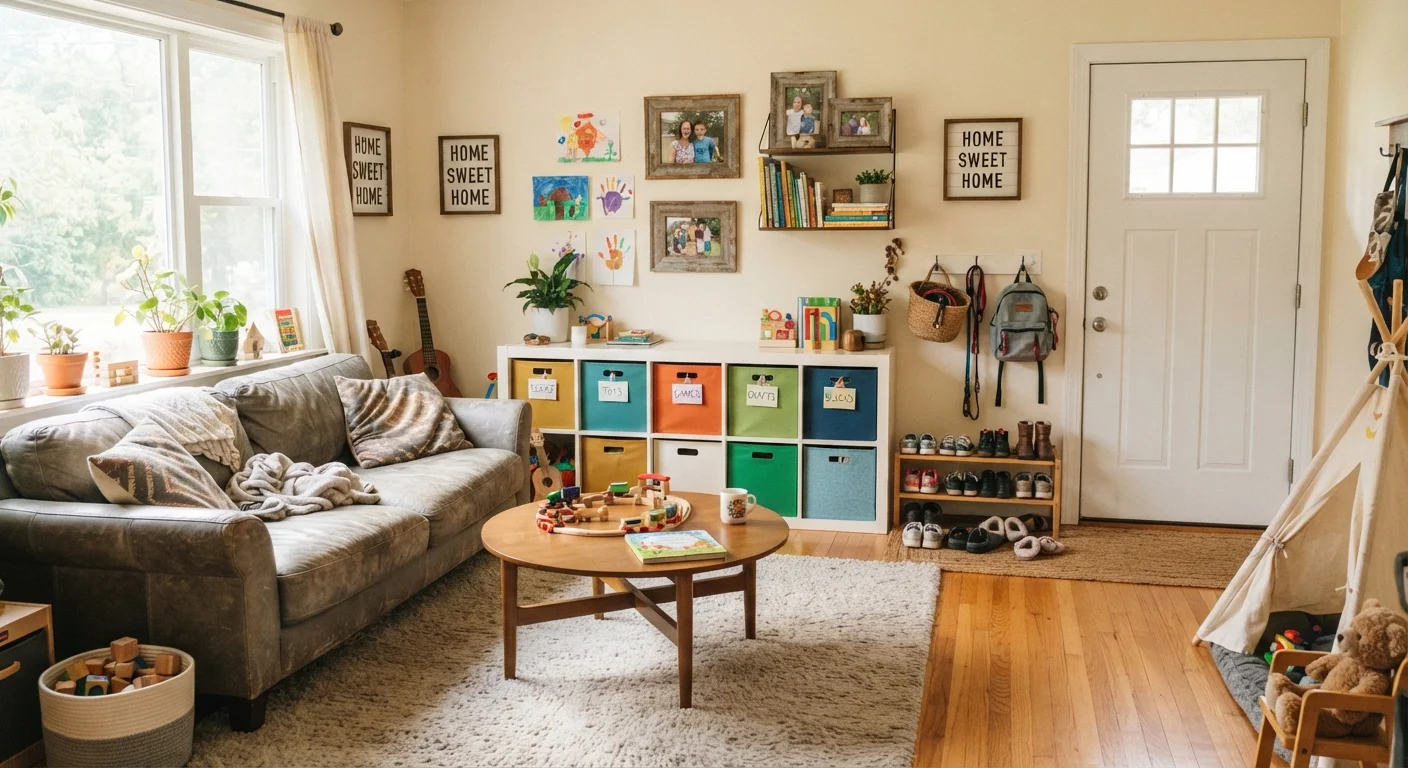
Why Standard Organization Advice Fails Families
Most home organization guides assume a stable, adult-managed environment. But households with children operate differently - belongings multiply, routines shift seasonally, and yesterday's perfect system gets dismantled by Tuesday afternoon. If you've tried color-coded bins or elaborate toy rotations and abandoned them within weeks, the system probably wasn't designed for how your family actually lives.
The goal isn't a magazine-ready home. It's a home where things have predictable places, kids can participate in maintaining it, and recovering from a messy day takes minutes rather than hours. If you're still figuring out where to begin, starting with the basics of home organization can help you set realistic priorities before adding family-specific layers.
Design storage systems at children's eye and hand level
Kids are far more likely to put things away when they can physically reach the storage without asking for help. Adult-height shelving or deep cabinets with lids create invisible barriers to independence. Low, open bins remove the friction entirely.
Use picture labels, not just word labels, for storage containers
Pre-readers can't act on written labels, which means they either guess wrong or give up and dump things wherever. A photo or simple drawing of the contents makes the expectation clear and removes the need for parental direction every time.
Limit the total volume of toys and supplies in circulation
More items mean more to put away and more opportunities for disorder. Research in child development consistently suggests children play more creatively and for longer with fewer, better-chosen options. Rotation - keeping some toys stored out of sight and swapping periodically - maintains interest without increasing clutter.
Assign age-appropriate tidying tasks with clear, observable outcomes
Vague instructions like 'clean your room' are hard for children to act on. Specific, visible tasks - 'put your books on the shelf' or 'put all the stuffed animals in the basket' - give kids a concrete finish line and build genuine competence over time.
Build a daily reset routine rather than expecting constant tidiness
Asking children (and yourself) to maintain continuous order is unrealistic and sets everyone up for frustration. A predictable short reset at the same time each day is psychologically easier to sustain and prevents mess from compounding.
Create a single landing zone for each child's daily essentials
Backpacks, shoes, jackets, and lunchboxes generate enormous daily friction when they have no fixed home. A dedicated hook, shelf, or cubby per child near the entry eliminates the morning scramble and teaches location habits naturally.
Practical Systems That Actually Hold
The systems that last in family homes share a few things: they require minimal steps to use, they're forgiving when skipped for a day, and children can operate them without adult help. Here's how to build that into your home:
One of the biggest contributors to household clutter is paper - school forms, permission slips, and art projects arrive constantly. Building a simple paper triage spot near the entry point reduces pile-ups. For a deeper approach, see our guide on managing paper clutter in busy households.
Maintaining the System Over Time
Even well-designed systems drift without a maintenance habit. With kids, the most reliable approach is a short, consistent daily reset - five to ten minutes at the same time each day, often before dinner or at bedtime. This prevents the slow accumulation that turns manageable mess into an overwhelming weekend project.
Adjust Systems as Kids Grow
What works for a preschooler will frustrate a middle schooler. Organizational systems need periodic review - not because they failed, but because your child's needs, interests, and capabilities genuinely changed. A good checkpoint is the start of each new school year. Involve your child in redesigning their own storage; ownership of the system dramatically improves follow-through.
As your children grow, their organizational needs change. A bin system that works for a five-year-old won't suit a ten-year-old who has more complex interests and belongings. Plan to revisit and adjust your systems at the start of each school year. The one-in-one-out rule is one habit that scales well at any age - when something new comes in, something goes out. Pair it with seasonal toy edits to keep volume manageable. And if clutter tends to migrate to catch-all spots, our junk drawer guide offers strategies for containing it without starting over from scratch.
The content on this site is provided for informational purposes only and should not be considered a substitute for professional advice. While we strive to provide accurate and up-to-date information, we make no guarantees regarding its completeness or accuracy. Always consult a qualified professional for advice specific to your circumstances before making any decisions.