

Start here
Shifting Your Mindset Before You Touch a Single Drawer
Next
Choosing Where to Start (and Why It Matters)
Then
The Sort-Decide-Place Method
Apply it
Building Habits That Keep Order Without Extra Effort
When you're ready
When Life Gets in the Way: Staying Realistic
Shifting Your Mindset Before You Touch a Single Drawer
The biggest obstacle to an organized home usually isn't clutter - it's the belief that you have to do everything at once, or do it perfectly. Both are traps. Organization is not a one-time event. It's an ongoing practice, and it works best when approached incrementally.
Before you move a single item, take a few minutes to define what "organized" actually means to you. For one household, that might mean a clear kitchen counter every morning. For another, it's knowing exactly where the kids' backpacks live. A meaningful personal goal keeps you grounded when the work feels tedious.
Set a Timer, Not a Goal
Instead of telling yourself you'll "organize the kitchen," commit to working for 25 focused minutes. Timed sessions reduce dread and make starting easier. You'll often accomplish more than you expected - and stopping on time keeps the process feeling manageable rather than punishing.
If the mental weight of a cluttered home is affecting your mood or focus, you're not alone. Research consistently links physical environment to stress levels. For broader strategies on managing that mental load, journaling for mental clarity can be a useful companion habit to developing order at home.
Choosing Where to Start (and Why It Matters)
Where you begin shapes whether you'll continue. The best starting point is a space that causes daily friction - somewhere you interact with multiple times a day and find consistently frustrating. Common candidates: the entryway, the kitchen counter, a bathroom cabinet, or a cluttered dining table.
Avoid starting with sentimental areas like photo boxes or childhood keepsakes. These require emotional energy that slows momentum early on. Save them for after you've built confidence with lower-stakes zones.
Zoning
Dividing a room or space into dedicated areas based on how activities or items are grouped - for example, a "mail zone" near the front door for incoming papers.
Decanting
Transferring items from their original packaging into uniform containers to save space and make storage visually consistent and easier to access.
Dead space
Areas in a home that are underused or overlooked for storage, such as the space above cabinets, beneath beds, or behind doors.
One in, one out rule
A simple habit where every new item brought into the home is matched by removing one existing item, keeping total volume from creeping upward over time.
Relocation pile
Items removed from one space during sorting that belong in a different area of the home - to be put away before the organizing session ends.
Once you've identified your starting zone, set a realistic scope. A single drawer or one shelf is a complete, winnable project. A whole room is not - at least not in one session. Winning small convinces your brain that progress is possible, which is exactly the fuel you need to keep going.
The Sort-Decide-Place Method
A reliable process removes the guesswork in the moment. Use this three-step framework for any space you tackle:
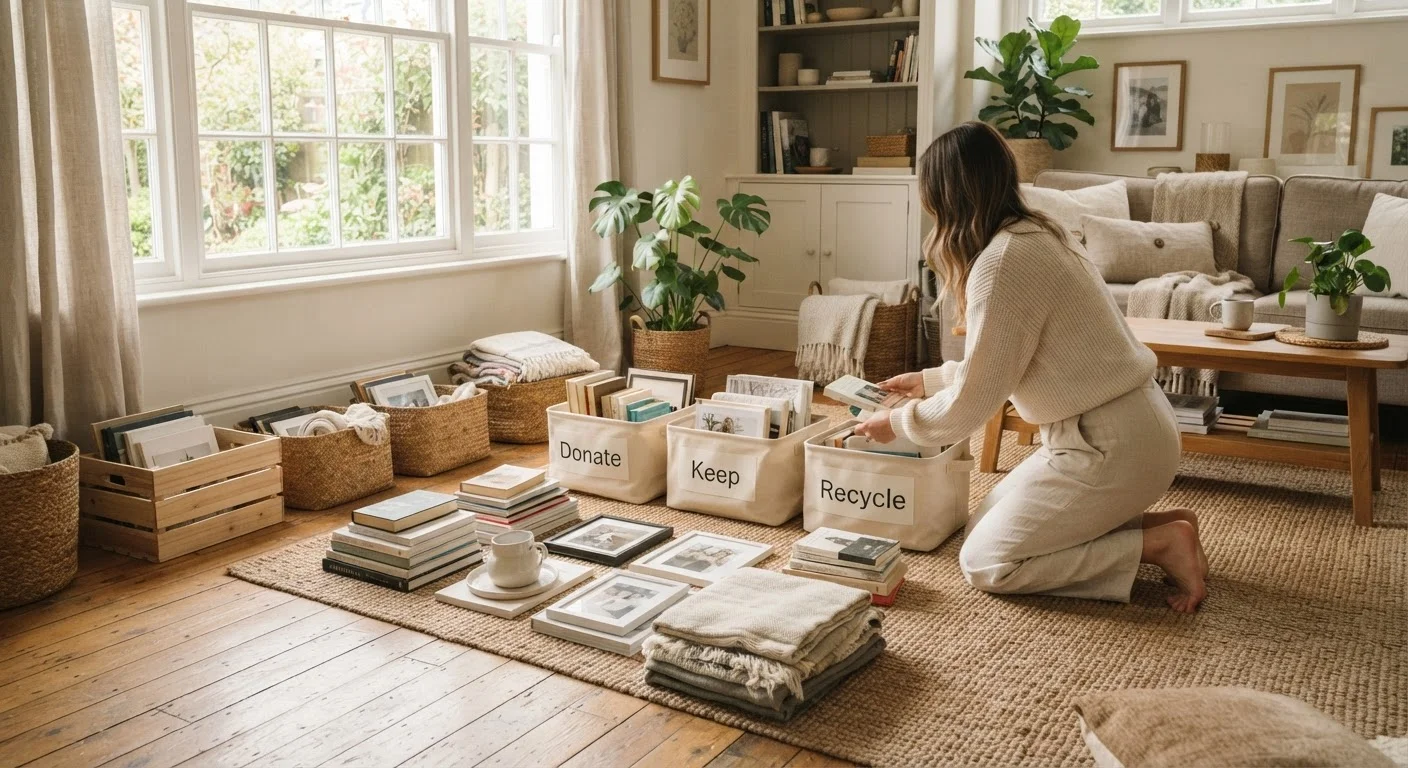
- Sort: Remove everything from the space and group like items together on a flat surface. This makes volume visible - often more than you expected.
- Decide: For each item, choose one of three outcomes - keep, donate/discard, or relocate. Be honest. If something hasn't been used in over a year and holds no practical or sentimental value, letting it go is a fair call.
- Place: Return only what you're keeping to the space, arranged so the most-used items are easiest to reach. Then find appropriate storage for relocated items before walking away.
For a deeper understanding of terms like zoning and decanting that professional organizers use, the home organization terminology guide is a useful reference. Resist purchasing any storage containers until after this process is complete - you need to know exactly what you're storing before you can buy the right containers.
Building Habits That Keep Order Without Extra Effort
Organization falls apart when maintenance depends on willpower alone. The goal is to design systems that make tidiness the path of least resistance. A few principles that actually hold in busy households:
- Give everything a home. If an item doesn't have a designated spot, it will end up wherever it lands. Assign locations intentionally.
- Use the "one in, one out" rule. When something new enters the home, something old leaves. This prevents gradual re-accumulation.
- Reset daily, not weekly. A five-minute evening tidy prevents the kind of pile-up that feels overwhelming. Frequency beats intensity.
If you have children at home, habits need to account for how kids actually move through a space. The article on organizing with kids at home offers systems designed around real family behavior, not idealized scenarios.
When Life Gets in the Way: Staying Realistic
Busy schedules, unexpected events, and the general chaos of everyday life will disrupt even the best organization systems. That's not failure - it's normal. What matters is how quickly you reset.
Think of organization like other household maintenance: it requires periodic attention, not perfection. Just as you budget money with a personal budget framework that accounts for irregular expenses, your organizational approach should account for irregular weeks. A missed reset doesn't erase your progress; it just means you do a slightly larger one when you're ready.
Don't Let "Organized Enough" Slide
Small relapses are normal, but skipping your monthly check-in repeatedly can quietly undo months of work. Clutter tends to return gradually and is easy to ignore until it's overwhelming again. Treat your maintenance routine as non-negotiable, even when life is busy.
Set a monthly check-in - 20 to 30 minutes to walk through your organized zones and make small corrections before things drift significantly. This is far easier than waiting until re-organization becomes a full project again. Progress compounds when you protect it consistently.
Frequently Asked Questions
Pick one small, high-frustration area - a kitchen counter, entryway table, or junk drawer - and work only there first. Completing a single visible space builds confidence and momentum. Don't try to tackle the whole home at once.
There's no universal timeline - it depends on the size of your home and how much you've accumulated. Most people make meaningful progress in short, consistent sessions of 20-45 minutes rather than marathon all-day efforts. Focus on steady progress, not speed.
Put uncertain items in a clearly labeled box and set a date - typically 30 to 90 days out. If you haven't needed or thought about an item by that date, it's a strong sign you can let it go. Avoid leaving boxes indefinitely unresolved.
No - and buying containers before you've sorted is a common mistake. First decide what you're keeping, then measure your space, and only then shop for storage that fits what you actually have. Bins and baskets don't create organization on their own.
Assign a permanent "home" to every item you keep, and make it easy to return things there. A few short daily resets - putting things back before bed or after meals - prevent clutter from rebuilding. Consistency beats intensity.
A professional organizer can offer personalized systems and hands-on help, which some people find invaluable. That said, most home organization tasks are absolutely manageable on your own with a clear process. Start with the methods in this guide before deciding whether outside help is needed.
The content on this site is provided for informational purposes only and should not be considered a substitute for professional advice. While we strive to provide accurate and up-to-date information, we make no guarantees regarding its completeness or accuracy. Always consult a qualified professional for advice specific to your circumstances before making any decisions.