

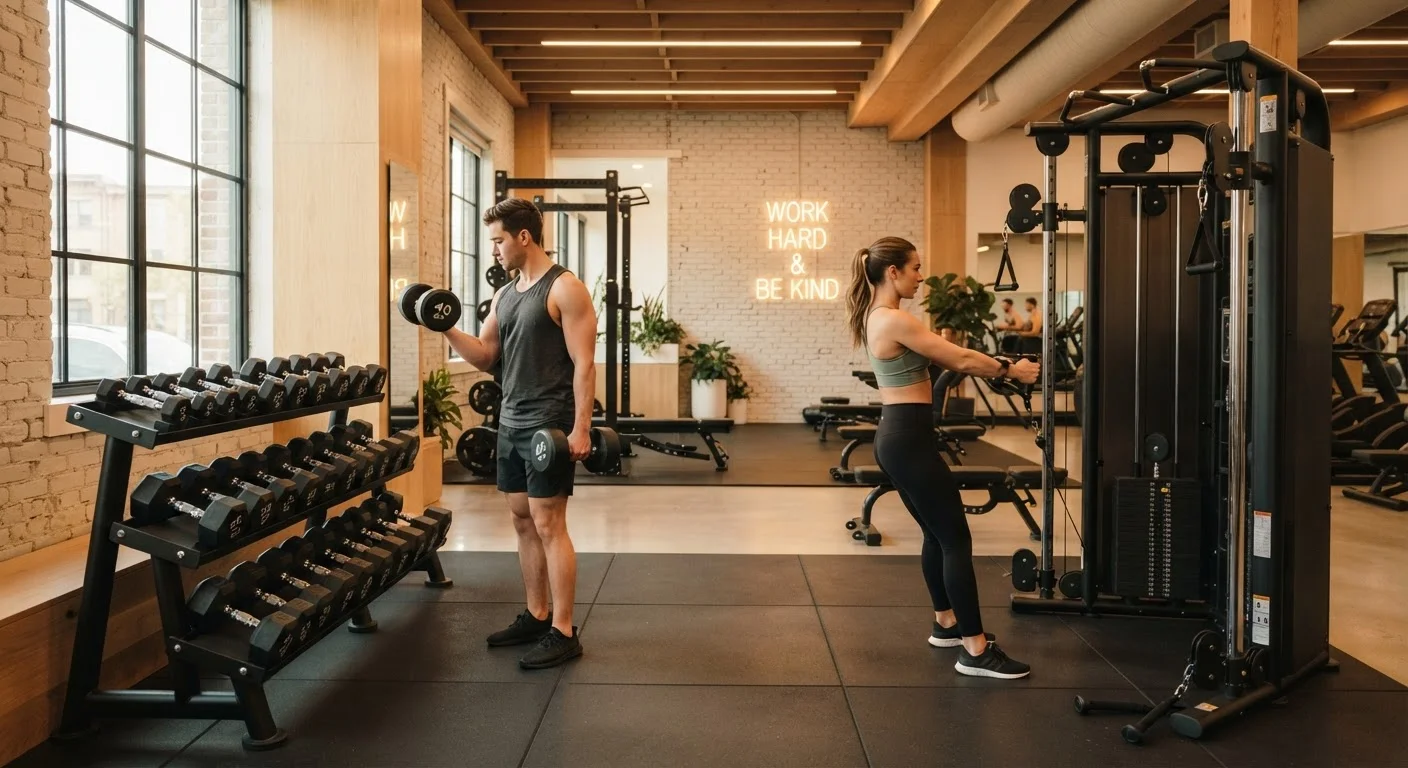
Option A
Free Weights
The versatile, skill-building classic.
Best for: Those who want to build functional strength, train multiple muscle groups at once, and have flexibility in their workouts.
Option B
Resistance Machines
The guided, controlled option for targeted training.
Best for: Those who want safer, more predictable movement patterns-especially beginners, people recovering from injury, or those isolating specific muscles.
What Sets Free Weights and Machines Apart
Free weights - including dumbbells, barbells, and kettlebells - require you to control the path and stability of every movement. That demand activates not just the primary muscles being trained, but also smaller stabilizer muscles throughout your joints and core. It's a higher-skill approach, which is both the challenge and the payoff.
Resistance machines, whether cable-based or selectorized (pin-and-stack), guide your movement along a predetermined track. This reduces the coordination demand and makes it easier to isolate a specific muscle group - say, the quadriceps or the lats - without worrying as much about form breakdown under load.
Understanding this core difference helps explain most of the practical trade-offs between the two. For a clear introduction to terms like progressive overload and isolation exercises, see the gym terminology guide for new gym-goers.
| Criterion | Free Weights | Resistance Machines |
|---|---|---|
| Muscle activation | Primary + stabilizer muscles | Primarily target muscle |
| Skill/technique required | Higher - form is critical | Lower - guided movement path |
| Injury risk for beginners | Higher without proper coaching | Lower due to fixed range of motion |
| Functional strength transfer | Strong transfer to daily movement | More limited transfer |
| Solo training safety | Requires caution at heavy loads | Generally safer without a spotter |
| Versatility | High - wide exercise variety | Moderate - limited by machine design |
| Suitability for rehabilitation | Varies - often lower priority | Frequently used in rehab settings |
| Space and cost (home use) | Compact and relatively affordable | Bulky and expensive for home setups |
The Real-World Case for Free Weights
Free weight exercises tend to mimic the types of movements humans do naturally - picking something up from the floor, pressing overhead, carrying uneven loads. Because of this, strength built with free weights often transfers more readily to daily life and athletic activity. Research generally supports the idea that compound free weight movements (think: squats, deadlifts, rows) recruit more total muscle mass than machine equivalents, which can make them more efficient for building overall strength.
They're also highly adaptable. One set of adjustable dumbbells can replace a wall of machines. This makes free weights the foundation of most home and minimalist workout setups, though bodyweight-only training is another viable route entirely.
The trade-off: free weights require more technique. Poor form under load can lead to injury. If you're brand new to lifting, investing time learning movement patterns - ideally with a qualified trainer - is strongly advisable before adding significant weight.
~58%
Adults who cite injury fear as barrier to lifting
A National Strength and Conditioning Association consumer survey found a majority of non-lifting adults listed fear of injury as a primary reason for avoiding weight training.
2x/week
Minimum resistance training frequency recommended
The U.S. Department of Health and Human Services Physical Activity Guidelines recommend adults engage in muscle-strengthening activities at least two days per week.
When Machines Make More Sense
Machines aren't just for beginners, though they do offer genuine advantages for people earlier in their fitness journey. The guided path removes guesswork, allowing someone to build a mind-muscle connection - that sense of consciously engaging the target muscle - before layering in coordination demands.
Machines are also frequently used in rehabilitation settings precisely because they allow targeted loading with reduced risk of compensatory movement. If you're returning to exercise after time away or managing a physical limitation, machines can serve as a useful bridge back to higher-demand training. Note: always consult your healthcare provider before resuming exercise following an injury or health event.
Older adults may also find machines particularly valuable. After 50, joint health and injury prevention become increasingly important considerations alongside strength maintenance. Fitness needs shift with age, and for some people, machines offer a more sustainable path to consistent training.
Building a Practical Approach
For most people, the most effective answer isn't choosing one over the other - it's using both strategically. A common approach: build the session around one or two compound free weight movements, then use machines for accessory or isolation work. This balances neuromuscular demand with volume and reduced injury exposure.
If you only have access to one type - perhaps you train at home with dumbbells, or your gym is heavily machine-based - don't let that stop you. Both formats can produce meaningful strength gains when applied consistently with progressive overload (gradually increasing the challenge over time). What matters most is showing up regularly, training with sound technique, and adjusting as your body and goals evolve.
This article is for general informational purposes only and does not constitute medical or exercise advice. Consult a qualified healthcare professional or certified fitness professional before beginning any new exercise program, particularly if you have a health condition or injury history.
The content on this site is provided for informational purposes only and should not be considered a substitute for professional advice. While we strive to provide accurate and up-to-date information, we make no guarantees regarding its completeness or accuracy. Always consult a qualified professional for advice specific to your circumstances before making any decisions.