

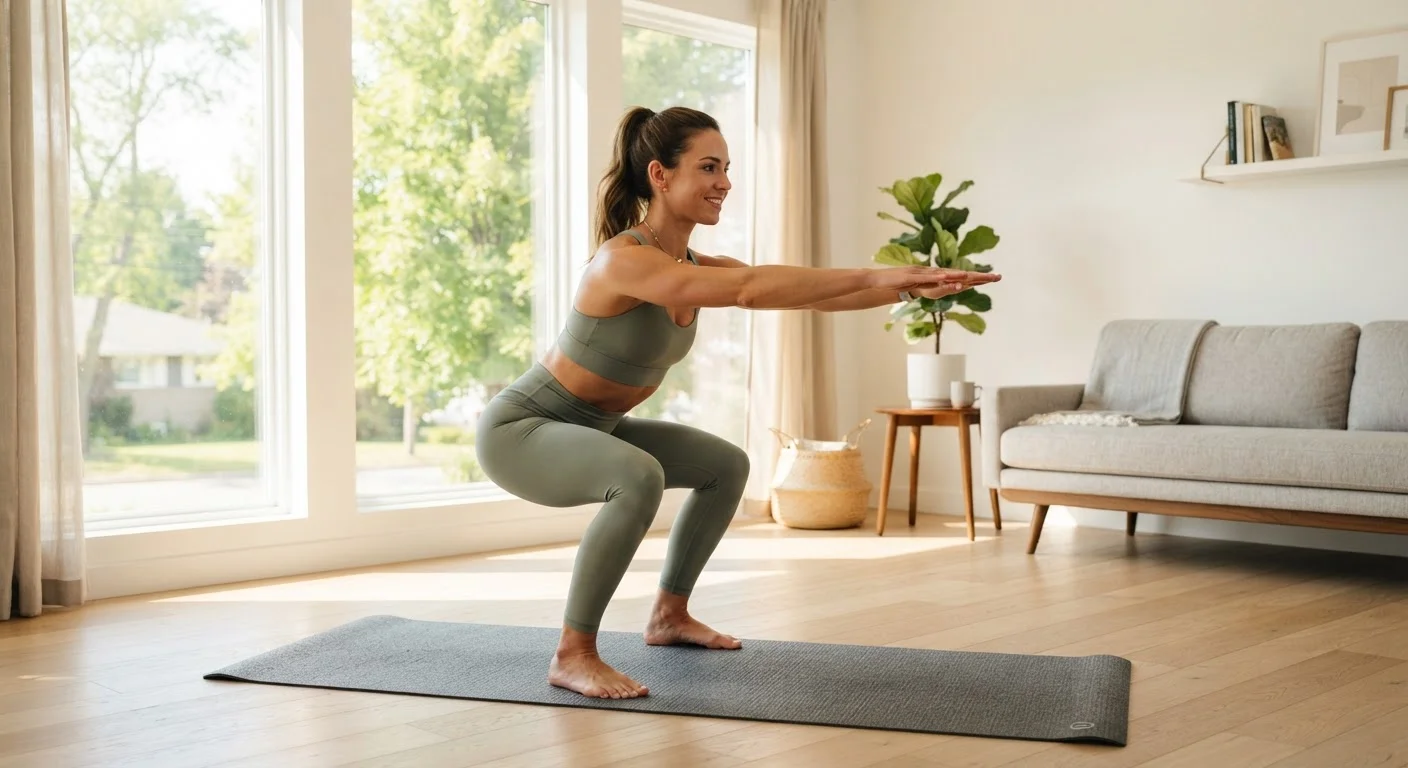
Why Bodyweight Training Works
Bodyweight training uses your own mass as resistance to challenge muscles, build cardiovascular fitness, and improve mobility-all without a gym membership or a single piece of equipment. Research consistently shows that resistance training using bodyweight exercises can produce meaningful gains in muscular strength and endurance, particularly for those new to structured fitness.
The accessibility of home training removes two of the most common barriers to exercise: cost and travel time. When your workout space is wherever you happen to be standing, the threshold for starting a session drops dramatically. This matters more than it might sound-convenience is one of the strongest predictors of exercise consistency.
Bodyweight training is also highly scalable. Every major exercise has a beginner-friendly variation and a significantly harder progression, which means the same framework can serve someone on their first week of exercise and someone who has been training for years. The key is applying the right level of challenge at the right time.
What you will need
Tools That Help (None Are Required)
One of the genuine advantages of this training style is that you need almost nothing to get started. That said, a few low-cost items can improve comfort and help you stay consistent:
Exercise or yoga mat
Provides cushioning for floor-based movements like push-ups, planks, and stretching.
Phone or timer
Used to track work intervals, rest periods, and total workout duration.
Notebook or fitness app
Helps log exercises, repetitions, and progress over time so you can apply progressive overload.
If you decide later that you want to expand your home setup with free weights or other equipment, our overview of free weights versus machines can help you understand the tradeoffs before investing.
Step-by-Step: Building Your Routine
Follow the steps below in order. Each one builds on the last, so skipping ahead tends to create gaps that make the routine harder to sustain. Before you begin, you may also want to run through our fitness readiness checklist to confirm you're prepared to start safely.
Assess your current fitness baseline
Before structuring any routine, spend five minutes honestly gauging where you are. How many push-ups can you complete with good form? Can you hold a plank for 20 seconds? Can you perform 10 bodyweight squats without discomfort? These simple tests tell you where to start-not where you think you should be. There is no wrong answer; the baseline exists so you can measure progress, not judge yourself. If you're returning from a break or a health event, see our guide to restarting exercise safely before proceeding.
Choose a simple weekly schedule
Three days per week of structured bodyweight training is a realistic and evidence-supported starting point for most beginners. Aim for a pattern like Monday/Wednesday/Friday or Tuesday/Thursday/Saturday so you always have at least one rest day between sessions. Rest days are not optional-muscle tissue repairs and strengthens during recovery, not during the workout itself. Mark your chosen days in a calendar or phone reminder before moving to the next step.
Build your session structure
Each session should follow a consistent format: a 5-minute warm-up, 20-30 minutes of bodyweight exercises, and a 5-minute cool-down. For the warm-up, focus on dynamic movements-arm circles, leg swings, and a light march in place. For the workout itself, select exercises that cover the major movement patterns: a push (push-ups), a pull substitute (door-frame rows or a reverse table hold), a squat (bodyweight squat or split squat), a hinge (glute bridge), and a core exercise (plank or dead bug). Cool down with gentle static stretches held for 20-30 seconds each.
Set reps, sets, and rest periods
Start with 2-3 sets of each exercise. Use a rep range that feels challenging but allows you to maintain clean form throughout-for many beginners this might be 8-12 repetitions, or a timed hold of 20-30 seconds for isometric exercises like the plank. Rest 60-90 seconds between sets. If an exercise feels too easy by the third set, make a note-that's your cue to progress next week, not to push to exhaustion today.
Apply progressive overload week by week
Progressive overload-gradually increasing the challenge-is the principle that drives all fitness adaptations, with or without equipment. For bodyweight training, progression doesn't mean doing more reps indefinitely. Instead, work through a hierarchy: first improve form, then add reps, then add sets, then slow the tempo, then move to a harder variation (e.g., elevate your feet during push-ups, or progress from a standard squat to a Bulgarian split squat). Aim to make one small adjustment per exercise per week rather than changing everything at once. This introduction to strength training principles explains how this same concept applies when you eventually add external resistance.
Track your sessions and adjust monthly
After each workout, spend 60 seconds logging what you did: exercises, sets, reps, and how the session felt on a simple 1-5 scale. At the end of each month, review your notes. Did you hit your planned sessions? Did certain exercises plateau? Use that information to swap in a harder variation or add a fourth training day if recovery is consistently good. Patterns in your log reveal what's working far more reliably than memory alone. If you find motivation slipping, the strategies in our article on why people quit working out-and what to do instead are worth reading before making big changes to your plan.
Start Shorter Than You Think You Need To
Many beginners overestimate how much volume they need in early sessions and underestimate how challenging basic movements become when performed with focus and proper form. A 20-minute session done well is more productive-and more sustainable-than a 60-minute session done poorly. Build the habit first; increase duration and intensity gradually as it becomes routine.
Staying Consistent Over Time
The structure you've built above is only valuable if you return to it regularly. Consistency-not intensity-is the variable that produces lasting results in any fitness routine. A moderate workout completed three times a week for three months will outperform an intense program abandoned after two weeks.
If you hit a week where life gets in the way, that's normal. A single missed session is not a failure-it's part of a realistic long-term approach. What matters is the next session, not the one you missed. If you find yourself missing more than one week at a time, revisit your schedule and ask honestly whether it fits your life as it actually is, not as you'd like it to be.
This article is for general informational purposes only and does not constitute medical advice. Consult a qualified healthcare professional before beginning a new exercise program, especially if you have an existing health condition, injury, or have been inactive for an extended period.
The content on this site is provided for informational purposes only and should not be considered a substitute for professional advice. While we strive to provide accurate and up-to-date information, we make no guarantees regarding its completeness or accuracy. Always consult a qualified professional for advice specific to your circumstances before making any decisions.