

Option A
Fiber Internet
The symmetrical, congestion-resistant connection.
Best for: Households with heavy uploaders, remote workers, and multi-device streaming who need consistent speeds at any hour.
Option B
Cable Internet
The widely available, high-download workhorse.
Best for: Everyday browsing, streaming, and gaming households where fiber isn't yet available in their area.
How the Two Technologies Actually Work
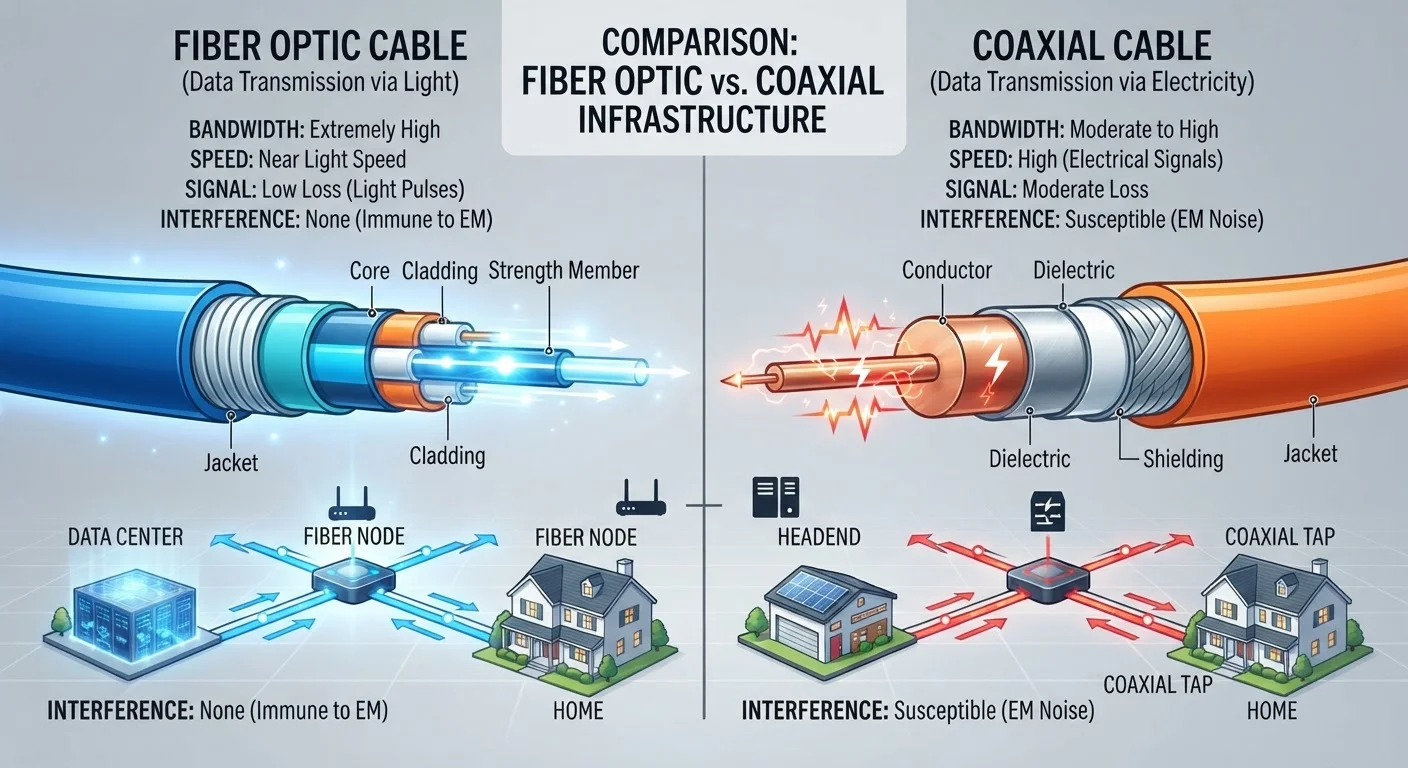
Fiber internet transmits data as pulses of light through thin glass or plastic strands. Each household on a fiber network typically gets a dedicated line running directly to their home - a setup often called FTTP (Fiber to the Premises). Because light signals don't degrade over distance the way electrical signals do, fiber delivers remarkably consistent performance regardless of how far you are from the provider's equipment.
Cable internet, by contrast, travels over coaxial copper cables - the same infrastructure originally built for cable TV. Providers share this bandwidth among clusters of nearby subscribers. When many households in your area are online simultaneously, that shared capacity gets divided, which is why you may notice slower speeds on weekday evenings. For a plain-language breakdown of the speed terms involved, see our internet speed glossary - it clarifies exactly what Mbps, latency, and bandwidth mean in practice.
| Criterion | Fiber Internet | Cable Internet |
|---|---|---|
| Infrastructure | Dedicated fiber optic lines | Shared coaxial copper cables |
| Typical download speeds | 300 Mbps - 2+ Gbps | 100 Mbps - 1.2 Gbps |
| Typical upload speeds | Symmetrical (matches download) | 20-50 Mbps (asymmetrical) |
| Latency (wired) | Under 10 ms typical | 15-35 ms typical |
| Peak-hour congestion risk | Low (dedicated lines) | Moderate to high (shared node) |
| U.S. availability | ~30-35% of households | ~85-90% of households |
| Distance sensitivity | Minimal signal degradation | Performance drops farther from node |
The Real-World Speed Gap: Upload, Download, and Latency
ISP marketing leads with download speeds, but that's only half the picture. Upload speed - how fast your connection sends data outward - matters enormously for video calls, cloud backups, gaming, and sharing large files. Fiber plans routinely offer symmetrical speeds, meaning a 500 Mbps plan delivers 500 Mbps in both directions. Most cable plans are asymmetrical: a plan marketed as 500 Mbps down may offer only 20-50 Mbps up.
Latency - the round-trip time for a data packet to travel to a server and back - is another area where fiber tends to hold an edge. Fiber connections commonly register latency under 10 milliseconds on a wired connection, while cable typically falls in the 15-35 ms range. For competitive online gaming or real-time video conferencing, that difference is perceptible. If your speeds feel slower than your plan promises even after switching, the issue may be inside your home - our article on why home Wi-Fi feels slow explains what's actually happening.
~33%
U.S. households with fiber access
FCC broadband deployment data indicates fiber-to-the-premises availability covers roughly one-third of American homes, with ongoing expansion.
10-35 ms
Typical latency range: fiber vs. cable
Industry benchmarking consistently shows fiber connections averaging under 10 ms latency, while cable typically ranges from 15 to 35 ms under normal conditions.
5-10x
Upload speed advantage on fiber
A symmetrical fiber plan commonly offers upload speeds five to ten times higher than a cable plan marketed at the same download tier.
Peak-Hour Congestion: Where Cable Falls Short
The most practical difference between fiber and cable isn't measured in a speed test at noon - it shows up at 8 p.m. on a Tuesday. Because cable subscribers in a neighborhood share a node's bandwidth, heavy simultaneous usage causes congestion. Providers can and do upgrade their infrastructure to manage this, but the underlying architecture means congestion risk is always present.
Fiber networks are less susceptible to this problem. With dedicated lines and optical infrastructure that carries far more data capacity than copper, fiber providers rarely experience the same neighborhood-level slowdowns. That said, fiber isn't immune to network-level congestion occurring further upstream on the provider's backbone - no technology eliminates every bottleneck.
If neither fiber nor cable is available where you live, the comparison changes entirely. Our overview of DSL vs. fixed wireless covers the next-best options for underserved areas.
Availability and the Practical Choice
Fiber's performance advantages are clear, but its geographic footprint remains limited. As of recent industry data, fiber reaches roughly one-third of U.S. households, concentrated in urban and suburban areas with newer infrastructure investments. Rural and many suburban communities still rely primarily on cable - or slower options like DSL and fixed wireless.
This means the fiber-vs.-cable debate is sometimes theoretical for a large portion of American households. If your address only has cable available, it's worth verifying periodically whether fiber has expanded to your area, since buildout is ongoing. When neither option exists, consider reading about satellite internet trade-offs as a last-resort alternative with its own limitations.
Before choosing any plan, test your current speeds at different times of day using a reputable speed-testing tool. A single mid-morning test won't reveal peak-hour congestion - the measurement that matters most for your actual daily experience.
The content on this site is provided for informational purposes only and should not be considered a substitute for professional advice. While we strive to provide accurate and up-to-date information, we make no guarantees regarding its completeness or accuracy. Always consult a qualified professional for advice specific to your circumstances before making any decisions.