

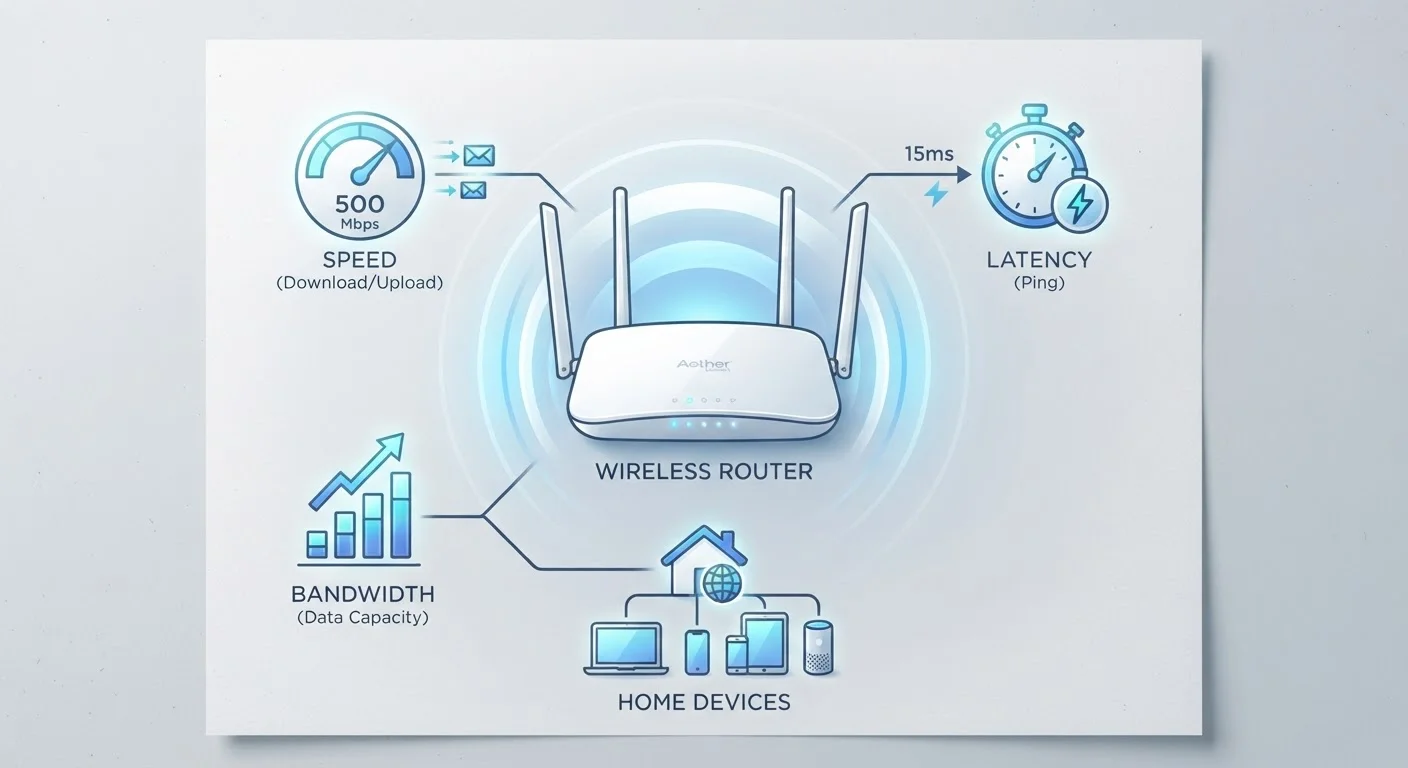
Why ISP Terminology Matters
Internet service providers (ISPs) routinely advertise speeds in terms most households have never had formally explained - Mbps, Gbps, latency, bandwidth. These aren't just technical footnotes. They directly affect whether your video call freezes, your streaming buffers, or your household hits a wall during peak evening hours.
This glossary cuts through the marketing language to give you plain, accurate definitions. Once you understand what these terms actually measure, you'll read any plan description - or any ISP advertisement - with far more confidence. For a broader look at how connection technology shapes performance, see our guide to home internet connection types.
| Common residential download speeds | 100 Mbps - 1 Gbps (Typical range for cable and fiber plans in the U.S.) |
| Low-latency threshold (gaming/video calls) | Under 30ms (Generally accepted benchmark for real-time applications) |
| 1 Gbps equals | 1,000 Mbps |
| Bits vs. bytes | 8 bits = 1 byte (Plans are sold in Mbps (bits); file sizes are listed in MB or GB (bytes)) |
| Satellite internet typical latency | 20ms-40ms (low-orbit); 600ms+ (traditional) (Varies significantly by satellite network generation) |
| Acceptable jitter for video calls | Under 30ms (Cisco and general networking guidance) |
Core Speed and Data Terms Defined
The following definitions cover the terms you'll encounter most often when shopping for or troubleshooting a home internet plan.
Mbps (Megabits per second)
The most common unit for measuring internet speed. One megabit equals one million bits of data. A plan rated at 100 Mbps can transfer up to 100 million bits of data every second under ideal conditions.
Gbps (Gigabits per second)
Equal to 1,000 Mbps. Gbps plans are marketed as 'gigabit' internet and are typically offered over fiber connections. For most households, 1 Gbps represents more capacity than current daily usage requires.
Bandwidth
The maximum amount of data that can flow through your connection at one time - think of it as the width of a pipe. Higher bandwidth means more data can move simultaneously, which matters when multiple devices are active at once.
Download speed
How quickly data travels from the internet to your device. This governs how fast pages load, videos stream, and files transfer to your computer or phone.
Upload speed
How quickly data travels from your device to the internet. Upload speed is critical for video calls, live streaming, cloud backups, and sending large files. Most residential plans have significantly lower upload than download speeds.
Latency
The time it takes for a data signal to travel from your device to a server and back, measured in milliseconds (ms). Low latency (under 30ms) is important for real-time activities like video calls and online gaming; high latency causes noticeable delays.
Ping
A practical measurement of latency, typically run by sending a small data packet to a server and timing the round trip. Ping and latency are often used interchangeably in consumer contexts.
Throughput
The actual data transfer rate your connection achieves in practice, as opposed to the theoretical maximum (bandwidth). Throughput is what a speed test measures and is usually lower than the advertised plan speed.
Jitter
Inconsistency or variability in latency over time. High jitter means your connection's delay fluctuates unpredictably, which causes choppy audio and video in calls even when average latency looks acceptable.
Asymmetric connection
A connection where download and upload speeds differ - typically download is much faster. Cable and DSL plans are almost always asymmetric. Fiber plans are more often symmetric (equal speeds in both directions).
Data cap
A monthly limit on how many gigabytes (GB) of data you can transfer before the ISP throttles your speed or charges overage fees. Not all plans have data caps, but many cable and DSL plans do.
Throttling
A deliberate reduction of your connection speed by the ISP, often triggered after you exceed a data cap or during network congestion. Throttled speeds can be dramatically lower than the plan's advertised rate.
One common misconception worth flagging: advertised speeds are almost always the maximum a plan can deliver under ideal conditions, not a guaranteed minimum. Network congestion, router placement, and the type of connection all affect real-world performance. Our article on home internet myths that cost households money explores how marketing figures can diverge from everyday experience.
How These Terms Work Together in Practice
Speed metrics don't exist in isolation. A plan advertising 500 Mbps of bandwidth may still feel sluggish for gaming if latency is consistently above 80ms. Meanwhile, a household of two that primarily browses and streams standard video may be perfectly satisfied on 100 Mbps - so long as latency stays low and the connection is stable.
The right balance depends on what your household actually does online. Streaming 4K video, video conferencing, and online gaming each have different sensitivity to latency versus raw throughput. Sizing your plan to your household's real activity is a more useful exercise than simply chasing the highest Mbps number available.
It's also worth understanding that upload and download speeds are not the same thing. Most residential plans are asymmetric - meaning download speeds are far higher than upload speeds. This was fine when households mostly consumed content, but remote work and video calls make upload speed much more important than it once was.
For a direct look at how two common technologies handle these metrics under pressure, see how fiber and cable internet differ in everyday use. If you want to understand wireless carrier speed terms alongside home internet jargon, our wireless carrier jargon decoder covers mobile-specific terms in the same plain-language style.
The content on this site is provided for informational purposes only and should not be considered a substitute for professional advice. While we strive to provide accurate and up-to-date information, we make no guarantees regarding its completeness or accuracy. Always consult a qualified professional for advice specific to your circumstances before making any decisions.