

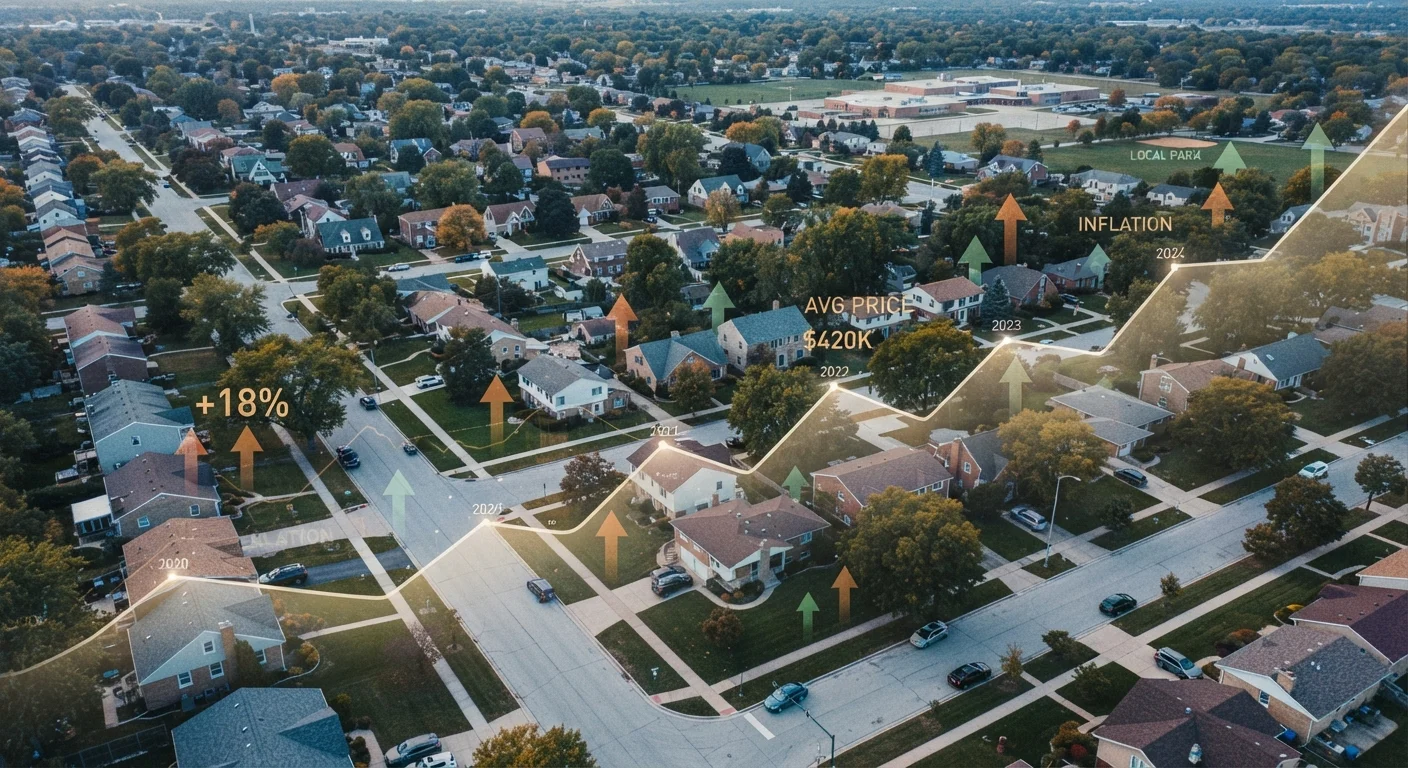
The Inflation-Housing Connection, Explained
Inflation and the housing market don't simply move in parallel - they interact in multiple, sometimes contradictory ways. Rising inflation can simultaneously push home values up (by raising replacement costs) and make homes harder to afford (by triggering higher mortgage rates). Understanding each channel separately is the clearest path to making sense of the relationship.
To understand the broader structure of how these forces interact, it helps to start with how the housing market actually works - including how buyers, sellers, lenders, and economic signals all converge to set prices.
~33%
Share of CPI represented by shelter costs
According to the U.S. Bureau of Labor Statistics, shelter - including rent and owners' equivalent rent - makes up approximately one-third of the Consumer Price Index weighting.
2x+
Mortgage rate increase during 2022-2023 tightening
The Federal Reserve's rate-hiking cycle from early 2022 into 2023 corresponded with 30-year fixed mortgage rates more than doubling from historic lows near 3% to over 7%, according to Freddie Mac survey data.
~40%
Rise in residential construction costs since 2020
The National Association of Home Builders has reported that builder costs - including materials and labor - rose sharply in the post-pandemic period, significantly affecting new home pricing.
How Inflation Raises the Cost of Building Homes
One of the most direct effects of inflation on housing is its impact on construction costs. When the general price level rises, so do the prices for lumber, steel, concrete, roofing materials, and skilled labor - all essential inputs for new home construction.
As building costs climb, developers either pass those expenses to buyers through higher asking prices or scale back the number of units they bring to market. Both outcomes constrain housing supply at a time when demand may still be strong. This dynamic is a key reason why inflation can worsen housing affordability even before a single mortgage rate changes.
Tight supply conditions have a compounding effect on prices. Supply and demand in real estate explains why inventory shortfalls can amplify price pressures well beyond what inflation alone would cause.
Watch Local Supply Conditions Alongside Inflation
Inflation's effect on your specific housing market depends heavily on local inventory levels. In markets with very low supply, inflationary cost pressures tend to sustain or raise prices even when demand cools. In markets with more inventory, the same inflation can produce softer prices. Always consider both the macro economic environment and your local market data.
The Federal Reserve, Mortgage Rates, and What It Means for Buyers
When inflation accelerates, the Federal Reserve typically responds by raising its benchmark interest rate - a tool designed to cool economic activity and bring price growth under control. Mortgage rates don't directly mirror the federal funds rate, but they tend to move in the same direction, often rising substantially during periods of tightening monetary policy.
Higher mortgage rates have a direct and immediate impact on affordability. A one-percentage-point increase in a 30-year fixed mortgage rate can meaningfully increase monthly payments on a median-priced home, pricing some buyers out of the market entirely. As demand softens, sellers may face longer listing times and less negotiating leverage - though widespread price drops require more severe demand shocks than rate increases alone typically produce.
For a deeper look at this mechanism, see the connection between mortgage rates and the housing market.
What Inflation Means for Existing Homeowners
While inflation creates challenges for buyers, existing homeowners - particularly those with fixed-rate mortgages - often occupy a more favorable position. As general price levels rise, property values and replacement costs tend to rise alongside them, growing the homeowner's equity over time.
Simultaneously, a fixed-rate mortgage means monthly payments remain unchanged even as wages and prices increase. In practical terms, homeowners repay their debt with dollars that are worth less in real terms than when they borrowed - a subtle but meaningful financial advantage during sustained inflationary periods. This is one reason real estate has historically been viewed as a partial inflation hedge, though this is general information and not personalized financial advice.
A homeowner who purchased a property in 2018 with a 30-year fixed mortgage at 4.5% sees their home's market value increase significantly during an inflationary period - while their monthly payment remains exactly the same.
A couple looking to buy their first home in 2022 finds that the same monthly budget buys them considerably less house than it would have two years earlier, despite their income remaining roughly stable.
A regional homebuilder pauses two planned subdivisions after lumber and labor costs rise sharply, determining that homes cannot be sold at a price the local market will bear while still generating a viable return.
Inflation's role in home values is one piece of a larger pricing puzzle. What drives home prices up - and what pulls them down covers the full range of forces that shape what a home is worth at any given time.
Affordability: The Compounding Problem
Inflation creates a particularly difficult environment for first-time buyers and moderate-income households. Rising sticker prices, elevated mortgage rates, higher insurance premiums, and increased property taxes can converge at once - each individually manageable, but collectively overwhelming.
This compounding effect is why affordability analysis cannot rely on home prices alone. Why housing affordability has become so complicated explores how wages, interest rates, insurance, and inventory interact to define what a household can realistically afford - a picture that looks very different depending on the inflationary climate.
Inflation's Effects Are Not Uniform Across Markets
National inflation figures describe broad trends but mask significant local variation. A market with strong job growth and tight housing supply may see sustained price increases during inflation, while a market with weak demand and rising inventory may experience flat or declining prices. Local economic conditions remain the most important lens through which to interpret national inflation data.
This article is for general informational and educational purposes only and does not constitute financial, investment, or real estate advice. Readers should consult a qualified financial adviser or real estate professional before making decisions based on their individual circumstances.
Frequently Asked Questions
Not necessarily. While inflation raises construction and material costs - which can support higher home prices - it also prompts higher mortgage rates, which reduce buyer demand. The net effect on prices depends on local inventory, employment conditions, and how aggressively interest rates respond to inflation.
When inflation rises, the Federal Reserve typically increases the federal funds rate to cool the economy. Mortgage rates - especially for 30-year fixed loans - tend to move in the same direction, making borrowing more expensive for homebuyers. This relationship is covered in detail in related resources on mortgage rate dynamics.
Homeownership has historically offered some protection against inflation, since property values and rents tend to rise over time. However, this is general educational information - individual outcomes depend on location, timing, financing terms, and broader market conditions. Consult a qualified financial adviser before making any investment decision.
Rents generally rise during inflationary periods as landlords face higher operating and maintenance costs. When home purchase affordability declines due to high mortgage rates, more households rent rather than buy, increasing rental demand and further pushing rents upward.
Existing homeowners with fixed-rate mortgages can benefit in two ways: their home's market value may increase while their monthly payment stays the same. This effectively means they repay their loan with dollars worth less than when they borrowed - a dynamic that works in the borrower's favor during sustained inflation.
Builders face rising costs for lumber, concrete, appliances, and labor during inflationary periods, making projects more expensive to complete profitably. At the same time, higher mortgage rates reduce the pool of buyers who can afford new homes, prompting builders to scale back projects or pause development.
The content on this site is provided for informational purposes only and should not be considered a substitute for professional advice. While we strive to provide accurate and up-to-date information, we make no guarantees regarding its completeness or accuracy. Always consult a qualified professional for advice specific to your circumstances before making any decisions.