

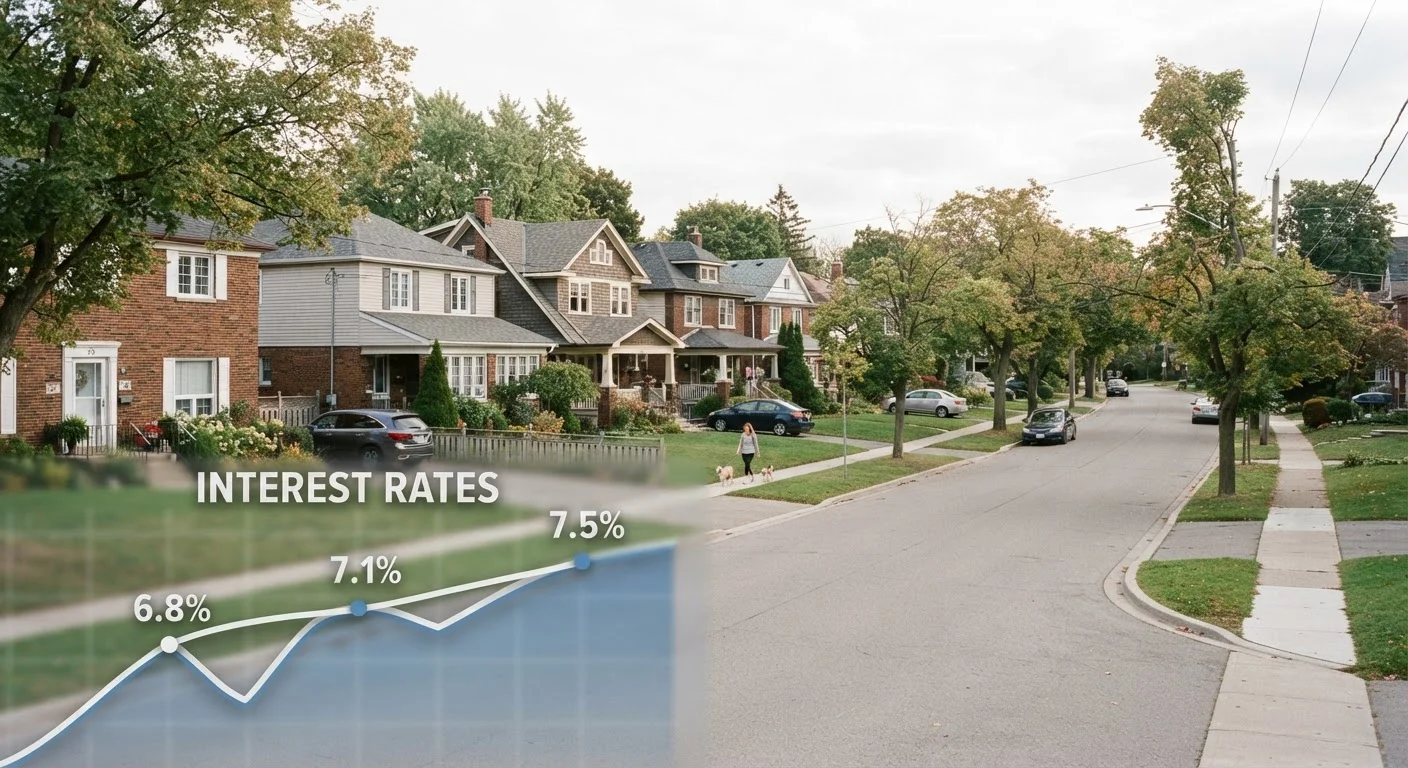
Why Mortgage Rates Are a Market Force, Not Just a Personal Finance Number
Most people encounter mortgage rates as a personal calculation - what will my monthly payment be? But rates function as a throttle for the entire housing market. When a lender quotes you 7% versus 5% on a 30-year loan, the difference on a $400,000 mortgage is roughly $530 per month. Multiply that dynamic across millions of households simultaneously, and you begin to see how rate shifts ripple outward.
Think of affordability as a pipeline. When rates are low, more buyers fit through - they can borrow more without their monthly payment exceeding what their budget allows. That swells the pool of active buyers. When rates climb, the pipeline narrows. Fewer households qualify, and those who do qualify for smaller loan amounts. Seller expectations and market activity adjust accordingly.
For a fuller picture of the forces at play, see how the housing market actually works.
~10%
Purchasing power lost per 1-point rate increase
Housing economists broadly estimate that each 1-percentage-point rise in mortgage rates reduces a buyer's purchasing power by approximately 10%, holding income and down payment constant.
$500+
Monthly payment difference on a $400K loan
A 2-percentage-point rate increase on a 30-year fixed $400,000 mortgage adds more than $500 to the monthly payment, a significant shift for median-income households.
Millions
U.S. homeowners estimated to be rate-locked
Industry analysts estimate that millions of U.S. homeowners hold mortgages with rates well below prevailing levels, making them reluctant to sell and contributing to historically low resale inventory.
The Demand Side: How Rate Shifts Move Buyers In and Out of the Market
Demand in real estate isn't a fixed number - it's elastic, responding to how affordable financing is at any given moment. When rates fall, households that were priced out suddenly qualify. Bidding wars intensify, days-on-market shrink, and sellers gain negotiating leverage. When rates rise sharply, the reverse occurs: buyers pause, listings accumulate, and sellers often have to reduce asking prices to attract offers.
This relationship is captured in mortgage application data. The Mortgage Bankers Association tracks weekly purchase application volumes, which historically fall within weeks of a meaningful rate increase and rise when rates ease. These application figures often foreshadow closed-sale statistics by 30 to 60 days, making them a useful leading indicator of where the market is heading.
Demand, however, doesn't exist in a vacuum. Supply and demand dynamics in your specific local market can amplify or dampen rate-driven demand swings considerably.
A family in suburban Ohio is pre-approved for a $350,000 mortgage when rates are at 5%. Six months later, rates climb to 7%, and their pre-approval drops to around $300,000.
A homeowner in Austin, Texas purchased in 2021 with a 3% fixed-rate mortgage. In 2024, comparable homes in her area require new buyers to borrow at 7%. She decides not to sell.
A landlord notices his rental vacancies have dropped and he can raise rents after mortgage rates surged past 7%.
The Supply Side: The Lock-In Effect Nobody Talks About Enough
Here is the connection most people miss: mortgage rates don't just affect buyers - they profoundly influence how many homes come onto the market. Many American homeowners locked in 30-year fixed rates between 2020 and 2022, when rates hovered between 2.5% and 3.5%. When prevailing rates subsequently rose above 6%, selling and reborrowing became financially painful. The result is a market with compressed inventory even when buyer demand softens.
This phenomenon - economists call it the rate lock-in effect - means that high rates create a double bind: they reduce buyer purchasing power while simultaneously restricting the supply of homes for sale. In theory, reduced demand should lower prices; in practice, reduced supply can keep prices stubbornly elevated. It's a key reason why housing affordability has become so complicated in recent years.
This article provides general educational information about real estate market dynamics and is not financial, investment, or legal advice. Consult a licensed professional for guidance specific to your circumstances.
What This Means for Home Prices - and Your Decisions
Rates are one of several major drivers of home values. Employment levels, local inventory, population growth, and construction costs all contribute. But because rates affect virtually every financed transaction, they occupy an outsized role. A range of economic and local factors drive prices in combination, and rates accelerate or dampen those forces.
For buyers, understanding this relationship helps contextualize what you're seeing in the market. A home that feels overpriced in a 7% rate environment might reflect a seller anchored to valuations from a 3% era - or it might reflect genuine scarcity. For sellers, rate-driven demand shifts mean the pool of qualified buyers can shrink quickly; pricing strategy matters more when financing costs are high.
Whether you're currently renting and considering ownership, or you already own and are evaluating a move, keeping an eye on rate trends - alongside inventory and local job market data - gives you a more complete picture than price tags alone. Explore guidance for navigating the home purchase process to understand how these forces apply when you're actively in the market.
“Interest rates are to asset prices what gravity is to matter. When rates are low, there is a very low gravitational pull on asset prices. When rates are high, gravity increases.”
— Warren Buffett, Investor and Chairman of Berkshire Hathaway
Frequently Asked Questions
Lower rates generally expand buyer purchasing power, increasing competition and pushing prices up. However, if inventory also increases significantly or the broader economy weakens, prices may not rise despite falling rates. Multiple forces shape home prices simultaneously.
The market typically responds within one to three months of a notable rate shift. Buyers adjust pre-approval budgets quickly, but seller pricing and completed sale data take longer to reflect the change. Leading indicators like pending sales and mortgage applications respond fastest.
Predicting future rate movements is difficult even for professional economists. Waiting can mean missing a suitable home, continued rent payments, or a rate spike instead of a drop. Consulting a licensed financial or mortgage professional about your specific situation is strongly advisable before making any timing decision.
The lock-in effect describes how homeowners with low fixed-rate mortgages from prior years often choose not to sell because doing so would require taking out a new loan at a much higher rate. This reduces the number of homes available for sale, which can keep prices elevated even when demand softens.
Yes. When rates are high, fewer renters can afford to buy, keeping more people in the rental market and often pushing rents higher due to sustained demand. Conversely, lower rates can draw renters into homeownership, easing rental competition over time.
The content on this site is provided for informational purposes only and should not be considered a substitute for professional advice. While we strive to provide accurate and up-to-date information, we make no guarantees regarding its completeness or accuracy. Always consult a qualified professional for advice specific to your circumstances before making any decisions.