

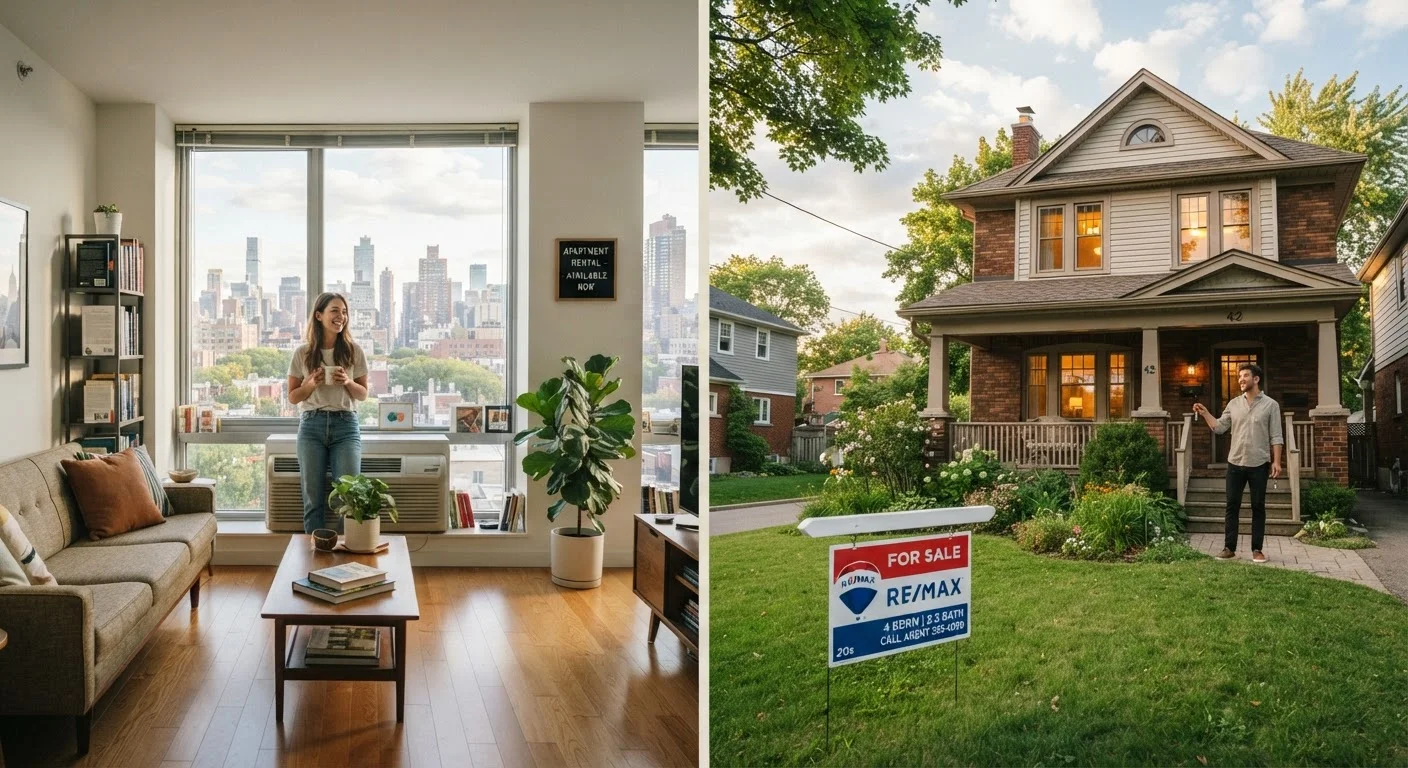
Our Verdict
Both renting and buying can be financially sound choices depending on individual circumstances. Buying tends to reward those with stable finances, a long time horizon, and roots in a community, while renting suits those prioritizing flexibility, lower upfront costs, or living in high-priced markets where ownership economics are unfavorable. There is no universally correct answer - only the right fit for a specific situation.
| Best for | Recommended |
|---|---|
| Those planning to stay in one location for five or more years with stable income | Buying |
| Those who value mobility, lower upfront costs, or are early in their careers | Renting |
| Those in markets where price-to-rent ratios make ownership economically unfavorable | Renting |
| Those seeking long-term wealth building through forced savings and home equity | Buying |
The Real Cost of Each Path
When comparing renting and buying, the instinct is to frame ownership as the financially responsible choice and renting as throwing money away. Neither framing holds up to scrutiny.
Buying a home comes with costs that stretch well beyond the mortgage payment. Buyers typically need a down payment of 3-20% of the purchase price, plus closing costs that commonly run 2-5% of the loan amount. Once in the home, property taxes, homeowner's insurance, HOA fees (where applicable), and maintenance - often estimated at 1-2% of the home's value annually - add up. Fixer-upper purchases can carry even steeper hidden costs once renovation estimates arrive.
Renting, by contrast, transfers most of those unpredictable costs to the landlord. A renter's monthly payment is largely fixed for the lease term, and while rent increases at renewal are common, renters avoid capital exposure if property values decline. The trade-off is that rent payments don't build equity.
| Renting | Buying | |
|---|---|---|
| Upfront Costs | First/last month + security deposit | Down payment + closing costs (5-25% of price) |
| Monthly Predictability | Fixed for lease term | Mortgage fixed; taxes/maintenance vary |
| Equity Building | None | Yes, through mortgage paydown and appreciation |
| Maintenance Responsibility | Landlord handles most repairs | Owner bears all costs |
| Flexibility to Move | High - exit at lease end | Low - selling takes time and money |
| Customization | Limited by landlord rules | Full control as owner |
| Market Risk Exposure | Minimal - no price exposure | Significant - values can fall |
Flexibility vs. Stability: A Lifestyle Dimension
Financial math alone doesn't resolve this decision. Lifestyle priorities carry equal weight for most households.
Renting offers a degree of geographic flexibility that ownership doesn't. A one-year lease creates a natural exit point - useful for those whose careers, relationships, or preferences may shift. Navigating the rental market has its own learning curve, but the commitment level is lower. For those uncertain about a neighborhood, a city, or a life stage, renting functions as a lower-stakes trial.
Homeownership, meanwhile, provides a form of stability that renting cannot replicate. Owners can modify their space, stay as long as they choose without landlord approval, and build community ties on a longer timeline. For families with school-age children or those rooted in a specific area, that permanence often carries real value. The balance between renting and buying shifts meaningfully depending on where you are in life.
Run the Numbers for Your Specific Market
National averages rarely tell the full story. Before deciding, compare the monthly cost of a mortgage on a comparable home - including taxes, insurance, and estimated maintenance - against local rental rates for the same space. If you're uncertain how to model this, a licensed real estate agent or HUD-approved housing counselor can walk through the calculations with you at no cost.
How Market Conditions Change the Equation
Local housing market dynamics can flip the math entirely. In high-cost metros where median home prices are several times the local median income, the monthly cost of ownership - even with a standard mortgage - can far exceed what a comparable rental costs. In those markets, renting and investing the difference may generate stronger returns than ownership, though outcomes are never guaranteed and depend on individual behavior and investment choices.
In more affordable markets or areas with rising home values, buyers who stay long enough often benefit from appreciation that renters do not share. The common benchmark used by economists and housing analysts is the price-to-rent ratio: dividing a home's purchase price by its annual rental equivalent. Ratios above 20 generally favor renting; ratios below 15 tend to favor buying. Most US markets fall somewhere in between, making the answer genuinely market-specific.
For a broader look at how these trade-offs play out across different contexts, see the full financial and lifestyle comparison in our housing market basics section.
~5 years
Typical break-even point for homebuyers
Housing analysts generally estimate buyers need at least five years of ownership to recoup transaction and upfront costs through equity and appreciation.
8-10%
Combined buy-and-sell transaction costs
When purchasing and later selling a home, combined costs including agent commissions, closing fees, and repairs commonly total 8-10% of the home's value.
1-2%
Annual maintenance cost estimate for owners
A widely cited rule of thumb suggests homeowners budget 1-2% of a property's value each year for routine maintenance and repairs.
The Time Horizon Factor
One of the clearest predictors of whether buying makes financial sense is how long you intend to stay. The upfront costs of purchasing a home - down payment, closing costs, moving expenses - take years to recoup through equity buildup and appreciation. Most analysts suggest a minimum five-year horizon before those costs are likely offset, though this varies by market and mortgage terms.
Renters who move frequently avoid the friction costs of buying and selling, which typically run 8-10% of the home's value when combined (agent commissions, closing costs, staging, and repairs). A renter who moves every two to three years may come out ahead financially compared to a buyer who repeatedly incurs those transaction costs.
Understanding which structure suits your timeline also applies beyond housing. The same logic appears in common renter decisions across many financial categories - whether for housing, vehicles, or equipment.
This article is for general informational and educational purposes only and does not constitute financial, investment, or legal advice. Readers should consult a qualified financial adviser or real estate professional before making decisions based on their specific circumstances.
The content on this site is provided for informational purposes only and should not be considered a substitute for professional advice. While we strive to provide accurate and up-to-date information, we make no guarantees regarding its completeness or accuracy. Always consult a qualified professional for advice specific to your circumstances before making any decisions.