

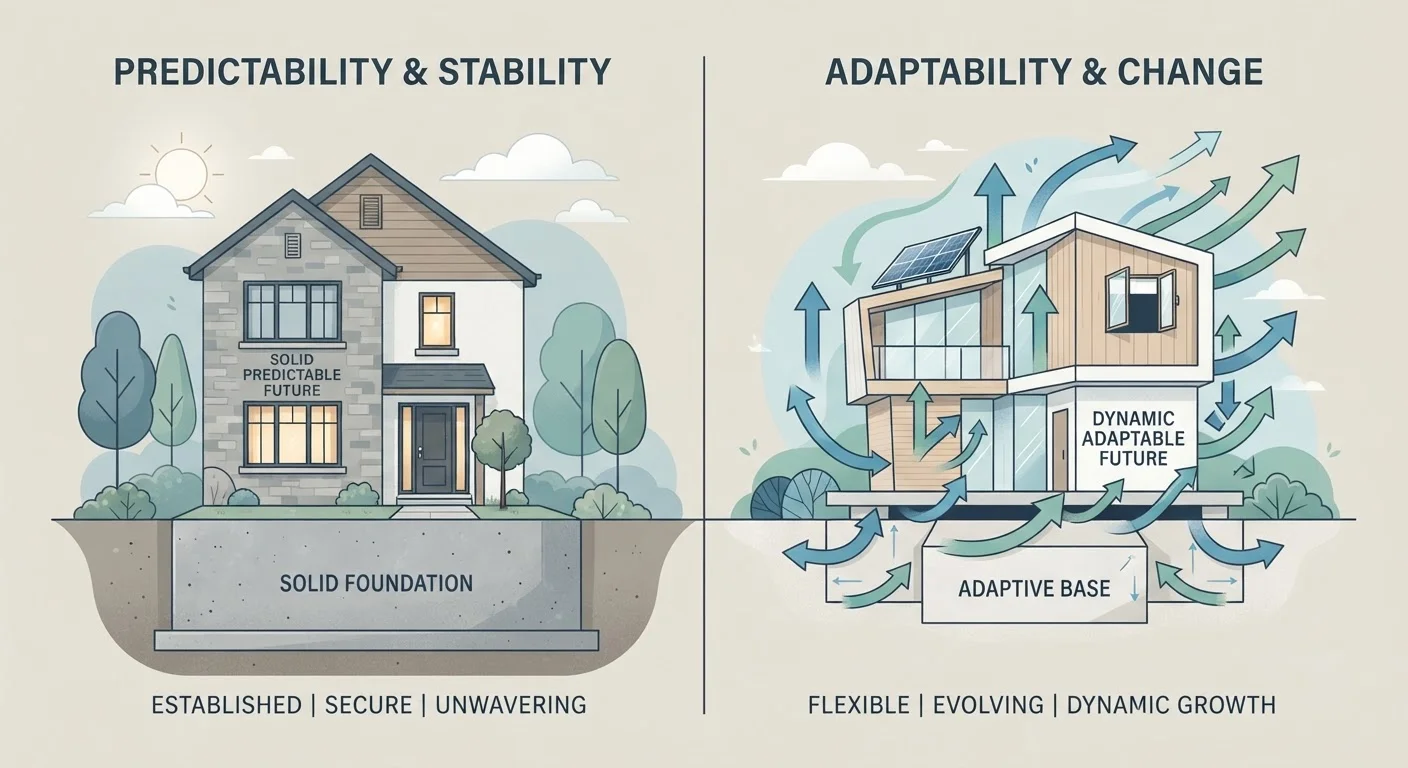
Option A
Fixed-Rate Mortgage
The predictable, stable long-term commitment.
Best for: Buyers who plan to stay in their home long-term and want consistent monthly payments regardless of market shifts.
Option B
Adjustable-Rate Mortgage (ARM)
The flexible, lower-entry option tied to market rates.
Best for: Buyers who expect to move or refinance within a few years and want to take advantage of an initial lower rate.
How Each Mortgage Structure Works
A fixed-rate mortgage charges the same interest rate for the entire repayment period - typically 15 or 30 years. Your principal and interest payment never changes, regardless of what happens in the broader interest rate environment. This makes long-range financial planning considerably more straightforward.
An adjustable-rate mortgage (ARM) operates in two phases. The first is a fixed introductory period - commonly 5, 7, or 10 years - during which the rate stays constant. After that, the rate adjusts at defined intervals (usually annually) based on a reference index, such as the Secured Overnight Financing Rate (SOFR), plus a lender-determined margin. The most common shorthand is "5/1 ARM," meaning five years fixed followed by annual adjustments.
Understanding how each behaves over time is foundational to choosing wisely. For a broader look at fixed versus variable financial obligations, see our plain-English guide to fixed vs. variable expenses.
| Criterion | Fixed-Rate Mortgage | Adjustable-Rate Mortgage (ARM) |
|---|---|---|
| Interest Rate | Locked for loan term | Fixed initially, then adjusts periodically |
| Monthly Payment Stability | Consistent throughout | Variable after fixed period ends |
| Initial Rate | Typically higher | Typically lower |
| Best Time Horizon | 10+ years in the home | 5-7 years or fewer |
| Rate Caps | Not applicable | Required by law; per-adjustment and lifetime limits |
| Payment Predictability | High | Moderate to low after adjustment |
| Risk to Borrower | Low (rate risk) | Higher if rates rise after fixed period |
| Refinancing Need | Rarely required for rate benefit | Often advisable before first adjustment |
Interest Rate Risk and Rate Caps Explained
The central risk of an ARM is rate volatility. Once the fixed period ends, your payment can rise or fall with market conditions. To prevent extreme swings, federal regulations require ARMs to include rate caps - limits on how much the interest rate can change at any single adjustment and over the entire loan life.
A typical cap structure is expressed as three numbers, such as 2/2/5. The first number caps the initial adjustment (e.g., no more than 2 percentage points at the first reset), the second limits each subsequent annual adjustment, and the third sets a lifetime ceiling above the starting rate.
2/2/5
Common ARM rate cap structure
This cap formula - initial adjustment, subsequent adjustments, lifetime ceiling - is a standard benchmark cited by the Consumer Financial Protection Bureau (CFPB).
30 years
Most common fixed mortgage term in the US
The 30-year fixed-rate mortgage has historically been the dominant loan product among American homebuyers, according to Freddie Mac's Primary Mortgage Market Survey data.
~$150-$200
Potential monthly savings with an ARM initially
On a $400,000 loan, a 0.75 percentage point rate difference between an ARM and a fixed-rate loan can produce this approximate monthly payment differential in the early years.
Even with caps, a payment increase of several hundred dollars per month is possible after an ARM adjusts upward. Fixed-rate borrowers face no such exposure. To understand how broader rate movements affect housing affordability, our article on mortgage rates and the housing market provides useful context.
Comparing Costs: Short-Term Savings vs. Long-Term Certainty
ARMs typically offer a lower initial rate than a comparable fixed-rate loan - this spread can be meaningful when rates are elevated. On a $400,000 loan, even a 0.75 percentage point difference in rate translates to roughly $150-$200 less per month in the early years. For buyers with a defined short time horizon, that savings can be significant.
However, if you remain in the home past the fixed period and rates have risen, those savings erode quickly. A fixed-rate borrower who locked in at a competitive rate continues paying the same amount indefinitely.
The math isn't inherently in favor of either structure - it depends on how long you hold the loan and where interest rates move. Deciding between renting and owning first? Our renting vs. buying overview can help frame that larger decision before you evaluate loan types.
ARMs Are Not the Same as Interest-Only Loans
Adjustable-rate mortgages are sometimes confused with interest-only loans, but they are distinct products. A standard ARM requires full principal-and-interest payments from the start - only the rate changes after the fixed period. Interest-only loans allow borrowers to pay just interest for a set term, after which payments rise sharply to cover principal. Always clarify the payment structure with your lender before signing.
Which Structure Fits Your Situation?
There is no universally superior mortgage structure. The right choice depends on your holding period, income stability, risk tolerance, and where current rates sit relative to historical norms.
Buyers who value certainty, plan a long-term stay, or have budgets that cannot easily absorb payment swings are generally better served by a fixed-rate loan. Those who anticipate selling, relocating, or refinancing within the initial fixed window of an ARM may find the lower introductory rate advantageous - provided they exit before adjustments begin.
A licensed mortgage professional or HUD-approved housing counselor can model both scenarios using your specific loan amount, timeline, and local market conditions. General information like this article is a starting point - not a substitute for personalized guidance.
This article is for general informational and educational purposes only and does not constitute financial, mortgage, or legal advice. Consult a licensed mortgage lender or financial professional regarding your specific situation.
The content on this site is provided for informational purposes only and should not be considered a substitute for professional advice. While we strive to provide accurate and up-to-date information, we make no guarantees regarding its completeness or accuracy. Always consult a qualified professional for advice specific to your circumstances before making any decisions.