

Our Verdict
Debt settlement can provide meaningful financial relief for people with significant unsecured debt they genuinely cannot repay in full. However, it comes with lasting credit damage, potential tax consequences, and no guarantee of success. It is a last resort, not a routine debt-management tool.
Best suited for people who are already behind on unsecured debts, facing genuine financial hardship, and who have exhausted or ruled out alternatives like hardship payment plans, consolidation, or bankruptcy.
How Debt Settlement Works
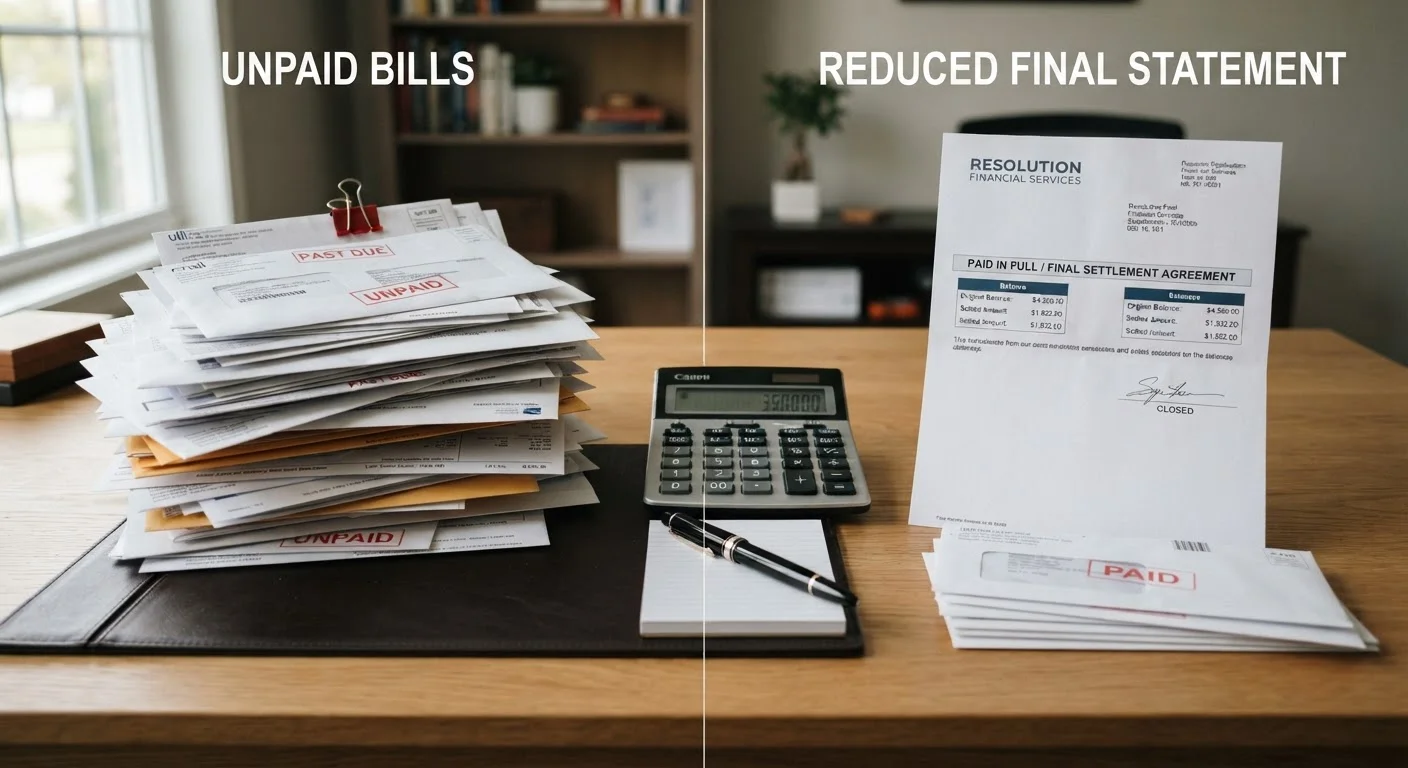
Debt settlement is a negotiation process in which a creditor agrees to accept a lump-sum payment that is less than the full outstanding balance, in exchange for considering the account resolved. It applies almost exclusively to unsecured debt - primarily credit cards, personal loans, and medical bills. Secured debts like mortgages or auto loans involve collateral, which gives lenders less incentive to settle. To understand why that distinction matters, see our overview of secured vs. unsecured debt.
In practice, settlement typically happens in one of two ways: you negotiate directly with the creditor or collection agency yourself, or you hire a third-party debt settlement company to negotiate on your behalf. Settlement companies generally instruct clients to stop making payments and instead deposit money into a dedicated savings account. Once enough funds accumulate, the company attempts to negotiate a reduced payoff. This strategy works, in part, because creditors may prefer a partial recovery over the risk of receiving nothing if a borrower declares bankruptcy.
There is no legal right to have a debt settled. Creditors can refuse, sue for the full balance, or sell the account to a collections agency at any point in the process.
The Advantages: Why Some People Pursue Settlement
For people in genuine financial distress, settlement can offer a path out that feels more manageable than years of minimum payments or the formal legal process of bankruptcy. The core appeal is straightforward: paying less than you owe.
Reduces total debt owed if creditor agrees
A successful settlement can result in paying 40-60 cents on the dollar, meaningfully reducing what you owe. This can provide financial breathing room when full repayment is not realistically achievable.
Faster resolution than minimum payment schedules
Paying off a high-interest credit card at the minimum payment rate can take a decade or more. Settlement, when successful, resolves the debt in a shorter timeframe.
May help avoid bankruptcy filing
For borrowers who qualify, settlement can eliminate debt without going through formal bankruptcy proceedings, which carry their own legal complexity and long-term credit consequences.
Applicable even after accounts go to collections
Once a debt has been sold to a collection agency, the original balance often carries a significant discount on the agency's books - giving additional room to negotiate a lower settlement amount.
Settlement can also provide a defined endpoint. Unlike a long repayment plan, a successful settlement closes the account with a specific agreed amount - giving borrowers psychological closure alongside financial relief.
The Disadvantages: What Settlement Actually Costs You
The trade-offs are significant and often underestimated. Before pursuing settlement, every borrower should have a clear picture of the damage it can do.
Severe and lasting credit score damage
Settled accounts are typically reported as 'settled for less than full balance,' which is a negative mark that can stay on your credit report for up to seven years. The period of missed payments before settlement further depresses your score.
Forgiven debt may be taxed as income
The IRS generally requires borrowers to report cancelled debt as ordinary income, which can create an unexpected tax bill in the year the settlement is finalized. This is separate from any fees paid to a settlement company.
No guarantee creditors will settle
Creditors are under no legal obligation to negotiate. They may refuse, continue collection efforts, or file a lawsuit to recover the full balance - often while you have already stopped making payments.
Settlement company fees reduce net savings
Debt settlement companies typically charge 15-25% of enrolled debt in fees. These costs can significantly offset the savings achieved through negotiation, and must be factored into any financial comparison.
Risk of lawsuits during the process
Stopping payments to fund a settlement account can prompt creditors to sue for the full amount. A court judgment could result in wage garnishment or bank levies, worsening your financial position.
It is also worth noting that settlement companies typically charge fees of 15-25% of the enrolled debt amount, which can substantially reduce the net savings. And during the period when payments are stopped to build a settlement fund, late fees and interest continue to accumulate, growing the balance you will eventually need to negotiate.
For a broader look at how debt interacts with your finances, including what types of debt exist and how interest compounds, see our introductory guide to understanding debt.
The Tax Consequence Most People Overlook
One of the least-discussed consequences of debt settlement is the tax liability it can trigger. The IRS generally treats forgiven or cancelled debt as ordinary taxable income. If a creditor forgives $5,000 of a $12,000 balance, you may owe income tax on that $5,000 in the year the settlement is completed. Creditors are typically required to issue a Form 1099-C (Cancellation of Debt) when $600 or more is forgiven.
The IRS Insolvency Exclusion
If you were insolvent - meaning your total debts exceeded your total assets - at the time a debt was cancelled, you may be able to exclude some or all of the forgiven amount from your taxable income. This is not automatic; you must file IRS Form 982 to claim it. Because the rules are nuanced and the stakes are real, consulting a qualified tax professional before and after any settlement is strongly advisable.
There are exceptions - most notably the insolvency exclusion, which may allow you to exclude forgiven debt from income if your total liabilities exceeded your total assets at the time of settlement. A qualified tax professional can help determine whether this or other exclusions apply to your situation.
Settlement Versus Other Debt Relief Options
Settlement is one tool on a spectrum of debt relief strategies, and it is rarely the first one to consider. Creditors often offer hardship payment plans - reduced interest rates or temporarily lowered minimum payments - to struggling borrowers before accounts go to collections. These protect your credit far better than settlement.
Debt consolidation and balance transfers combine multiple debts into a single, often lower-interest obligation, preserving your credit score while simplifying repayment. These options work best when you can still make regular payments.
At the other end of the spectrum, bankruptcy - particularly Chapter 7 - can discharge qualifying unsecured debts entirely through a legal process. The credit impact is severe but structured. Our article on what happens to debt when you file for bankruptcy explains the key differences in detail.
7 years
Time a settled account stays on credit report
Under the Fair Credit Reporting Act, most negative items, including settled accounts, remain on a consumer's credit report for seven years from the date of first delinquency.
15-25%
Typical debt settlement company fee range
The Consumer Financial Protection Bureau notes that for-profit debt settlement companies commonly charge fees based on a percentage of the enrolled or settled debt amount.
Whatever path you choose, the decision should account for your full financial picture. If you are still building an emergency cushion while managing debt, balancing saving and debt repayment is worth examining carefully before committing to any settlement plan.
This article is for general informational and educational purposes only and does not constitute personalised financial, tax, or legal advice. Consult a qualified financial adviser, tax professional, or attorney for guidance specific to your circumstances.
The content on this site is provided for informational purposes only and should not be considered a substitute for professional advice. While we strive to provide accurate and up-to-date information, we make no guarantees regarding its completeness or accuracy. Always consult a qualified professional for advice specific to your circumstances before making any decisions.