

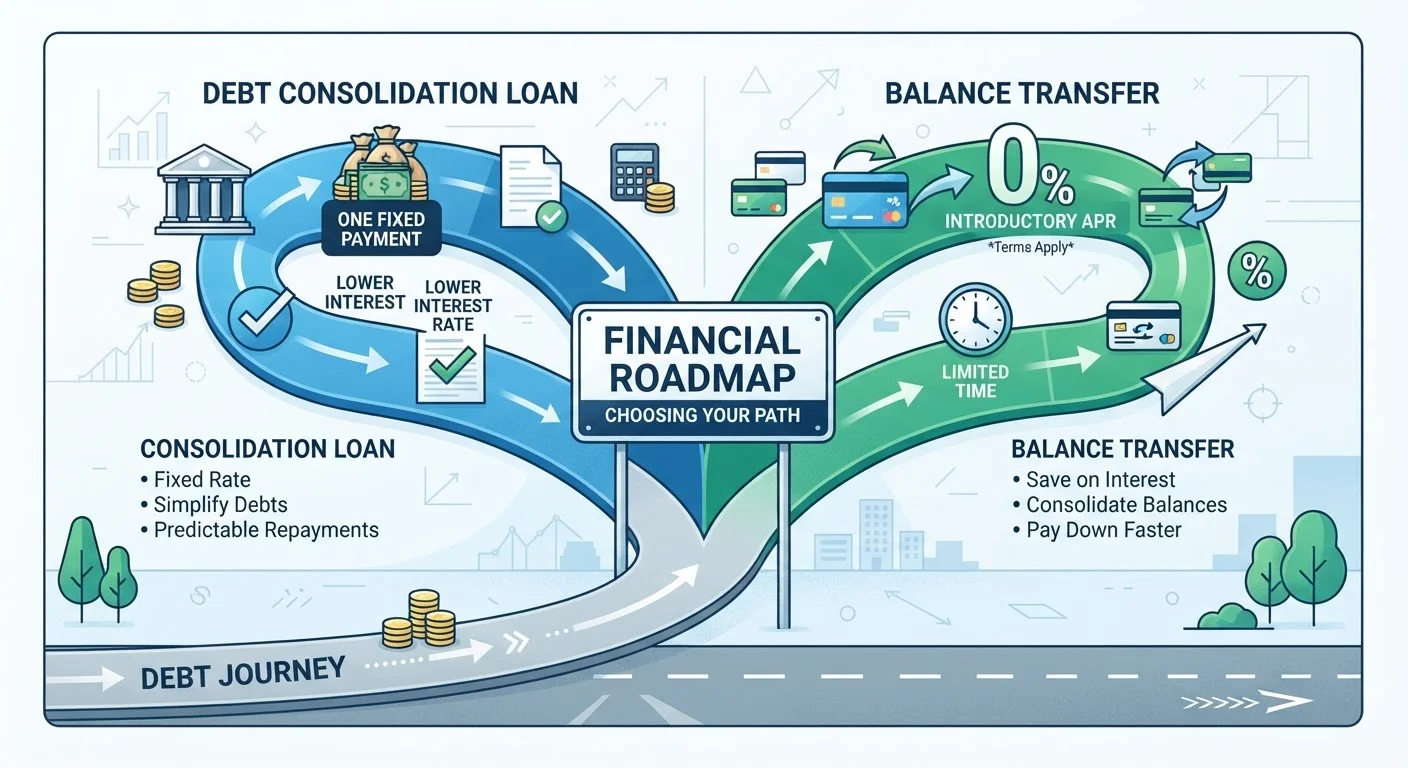
Our Verdict
Debt consolidation loans suit borrowers with larger balances, longer payoff timelines, and a preference for predictable fixed payments. Balance transfer cards offer a powerful short-term advantage for those with strong credit who can realistically pay off their balance within the promotional window. Neither path is universally superior - the right choice depends on the size of your debt, your credit profile, and your spending discipline.
| Best for | Recommended |
|---|---|
| Those with larger balances needing a structured, multi-year payoff plan | Debt Consolidation Loan |
| Those with strong credit and manageable balances they can clear quickly | Balance Transfer Card |
| Borrowers who want predictable monthly payments and a fixed end date | Debt Consolidation Loan |
| Disciplined payers who can maximize a 0% promotional APR period | Balance Transfer Card |
How Each Strategy Works
If you're carrying high-interest debt across multiple accounts, two widely used restructuring tools are worth understanding: debt consolidation loans and balance transfer credit cards. Both aim to reduce the interest burden on what you owe, but they work in fundamentally different ways.
A debt consolidation loan is a personal loan - typically unsecured - that pays off your existing debts in one lump sum. You're left with a single monthly payment at a fixed interest rate over an agreed term, usually two to seven years. Because the rate is fixed, your payment never changes, making budgeting predictable.
A balance transfer card lets you move balances from existing credit cards onto a new card, usually in exchange for a promotional 0% APR period. These windows commonly run from 12 to 21 months. After the promotional period, any remaining balance is subject to the card's standard APR, which is frequently high. Most cards also charge a balance transfer fee - typically 3% to 5% of the amount transferred.
Understanding how different debt types and interest mechanics work is an important first step before choosing either path.
Costs, Fees, and Interest Compared
The true cost of each option depends heavily on the terms you qualify for and how quickly you repay.
| Debt Consolidation Loan | Balance Transfer Card | |
|---|---|---|
| Interest structure | Fixed APR for entire term | 0% promotional, then variable APR |
| Typical repayment window | 2-7 years | 12-21 months (promo period) |
| Upfront fees | 1%-8% origination fee (varies) | 3%-5% balance transfer fee |
| Credit score generally needed | 600+ (best rates at 720+) | 670+ for promotional offers |
| Debt types covered | Credit cards, medical, personal loans | Credit card balances primarily |
| Risk after promotional period | None - rate is fixed at origination | High APR applies to remaining balance |
| Payment predictability | High - fixed monthly payment | Variable - depends on payoff pace |
With a consolidation loan, your APR is determined at origination based on your credit score, income, and debt-to-income ratio. Borrowers with strong credit may qualify for rates well below the average credit card APR, which the Federal Reserve has reported exceeding 20% in recent years. Origination fees on personal loans typically range from 1% to 8% of the loan amount.
Balance transfer cards are most cost-effective when the entire balance is paid off before the promotional period expires. Missing that deadline can be costly - the go-to APR on many cards after the promotional window closes sits in the 25-30% range. Compound interest and minimum payment traps can quickly erode any savings if you fall behind.
Credit Score Requirements and Impact
Both options require a reasonably healthy credit profile, but the thresholds differ.
Lenders offering consolidation loans typically look for a credit score of at least 600-640 for approval, though the most competitive rates generally go to borrowers in the 720+ range. Applying creates a hard inquiry on your credit report, and opening a new installment account changes your credit mix - effects that are usually modest and temporary.
Balance transfer cards with 0% promotional periods are generally reserved for borrowers with good-to-excellent credit, often 670 or higher. Opening a new revolving account reduces your average account age and adds a hard inquiry. However, if the transfer meaningfully reduces your overall credit utilization ratio - the percentage of available revolving credit you're using - that can provide a positive offset.
Avoid New Debt During Repayment
A consolidation loan or balance transfer only helps if you stop adding to existing balances. Continuing to charge expenses on the cards you've paid off - or making purchases on a new balance transfer card - can quickly return you to a worse position than before. Treat the restructuring as a reset, not extra breathing room.
For a broader look at structured repayment approaches once you've consolidated, see how the debt avalanche and snowball methods compare.
Which Circumstances Favour Each Option
No single tool fits every borrower. Use these general frameworks to assess which direction aligns with your situation - and always consider speaking with a licensed financial adviser before making a significant financial decision.
Debt Consolidation Loan May Be Better If:
- You carry a large total balance (generally above $10,000-$15,000) that you cannot realistically clear in 12-21 months
- Your debt includes non-credit-card accounts such as medical bills or personal loans
- You want a fixed monthly payment and a defined payoff date
- You're concerned about the discipline required to avoid using a new credit card
Balance Transfer Card May Be Better If:
- Your total balance is manageable enough to pay off within the promotional period
- You have strong credit and qualify for a card with a long 0% window and a low transfer fee
- You want to eliminate interest entirely - even temporarily - to accelerate payoff
- You're committed to not making new purchases on the card during the promotional period
It's also worth considering whether saving and debt repayment need to run simultaneously. Balancing saving with debt repayment involves tradeoffs that either strategy should account for.
This article is for general informational and educational purposes only and does not constitute personalised financial, tax, or legal advice. Consult a qualified, licensed financial professional before making decisions about your own debt situation.
The content on this site is provided for informational purposes only and should not be considered a substitute for professional advice. While we strive to provide accurate and up-to-date information, we make no guarantees regarding its completeness or accuracy. Always consult a qualified professional for advice specific to your circumstances before making any decisions.