

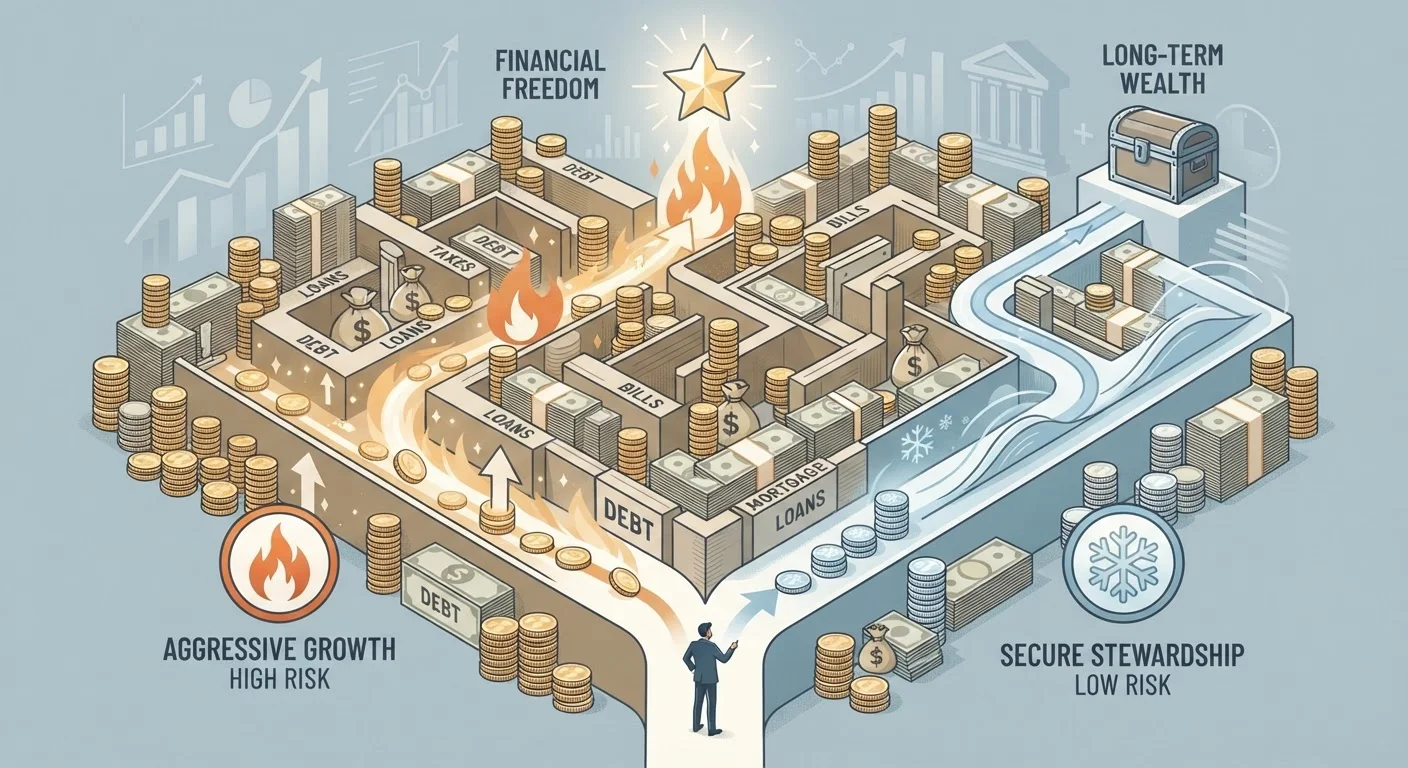
Option A
Debt Avalanche
The mathematically optimal approach to eliminating debt.
Best for: Borrowers who are disciplined, motivated by long-term savings, and want to minimize total interest paid.
Option B
Debt Snowball
The behaviorally driven method that builds momentum through quick wins.
Best for: Borrowers who need motivational milestones and benefit from the psychological reward of eliminating individual debts quickly.
How Each Strategy Works
Both the debt avalanche and debt snowball are structured repayment methods. They share the same core mechanic: you make minimum payments on all debts each month, then direct any additional money toward one designated account. The methods diverge in how they select that target account.
Debt Avalanche: You rank your debts by interest rate, highest to lowest. Every extra dollar goes to the highest-rate balance until it is paid off, then you cascade that payment to the next highest-rate debt. Because interest is the primary cost of carrying debt, this ordering is mathematically optimal - it limits the total interest you pay across all accounts.
Debt Snowball: You rank your debts by balance, smallest to largest, regardless of interest rate. Extra payments go toward the smallest balance first. Once it is cleared, the freed-up payment rolls into the next-smallest account. The method is designed around behavioral momentum - each eliminated debt provides a concrete sense of progress.
For context on the types of debt that might populate either list, see our overview of secured vs. unsecured debt and how each type behaves during repayment.
| Criterion | Debt Avalanche | Debt Snowball |
|---|---|---|
| Payoff order | Highest interest rate first | Smallest balance first |
| Total interest paid | Lower (mathematically optimal) | Potentially higher |
| Time to first debt eliminated | Longer if high-rate debt is large | Faster - smallest balance cleared first |
| Motivational structure | Progress measured in interest saved | Progress measured in accounts cleared |
| Best suited to | Disciplined, analytically motivated borrowers | Borrowers who need tangible milestones |
| Complexity | Low - rank by rate, stay consistent | Low - rank by balance, stay consistent |
The Real Cost Difference
The avalanche method will almost always result in lower total interest paid - sometimes by hundreds or even thousands of dollars, depending on balances, rates, and the repayment timeline. The gap narrows when your debts happen to be arranged so that the smallest balance also carries the highest rate, or when rates across your accounts are very similar.
The snowball method, by contrast, can cost more in interest because lower-rate but larger balances may sit accruing interest while you clear smaller accounts. That said, research published in the Journal of Consumer Research has found that borrowers focused on eliminating individual accounts - rather than reducing aggregate balances - tend to maintain repayment effort more consistently. A strategy you actually follow through on typically outperforms a theoretically superior one you abandon.
~$1,000+
Potential interest savings with avalanche method
Estimates vary widely based on balances and rates, but Consumer Financial Protection Bureau guidance illustrates that targeting high-rate debt first can meaningfully reduce total interest costs compared to minimum-only payments.
77%
Americans carrying some form of debt
According to Pew Research Center data, a large majority of U.S. households carry at least one form of debt, underscoring how broadly repayment strategy choices matter.
Higher follow-through
Account-elimination focus vs. balance-reduction focus
Research in the Journal of Consumer Research found that consumers who focused on paying off individual accounts fully - rather than reducing total debt - were more likely to stay on track with repayment plans.
If you are weighing debt repayment against building savings simultaneously, the dynamics are worth examining carefully. Our article on saving while carrying debt explores how to navigate those competing priorities.
Choosing the Right Method for Your Situation
There is no universally correct answer. A few questions can help clarify which approach fits your circumstances:
- How wide is the rate spread across your debts? If one account charges 24% APR and another charges 6%, the avalanche's advantage is substantial. If all your debts cluster near 15%, the difference is modest.
- How many separate accounts do you have? A borrower with six small debts and one large one may find the snowball clears five of those six quickly, building significant momentum. Someone with only two debts rarely notices a behavioral difference between the methods.
- What is your track record with sustained financial commitments? Honesty here matters. If past debt payoff efforts stalled, the psychological scaffolding of the snowball may be genuinely valuable.
Some borrowers use a hybrid approach: they start with the snowball to eliminate one or two small debts and generate early wins, then shift to the avalanche ordering for the remaining balances. This is not a formally named method, but it reflects the real-world flexibility both strategies permit.
It is also worth knowing that other structural tools - like consolidation loans or balance transfers - can alter the rate landscape entirely before you apply either method. Our comparison of debt consolidation vs. balance transfer covers those options in detail. And for borrowers in severe financial distress, it is worth understanding what happens to debt in bankruptcy before concluding that a structured repayment strategy is the right path forward.
This article is for general informational and educational purposes only and does not constitute personalized financial, tax, or legal advice. Individual financial situations vary. Consult a qualified financial professional before making decisions about your debt repayment strategy.
The content on this site is provided for informational purposes only and should not be considered a substitute for professional advice. While we strive to provide accurate and up-to-date information, we make no guarantees regarding its completeness or accuracy. Always consult a qualified professional for advice specific to your circumstances before making any decisions.