

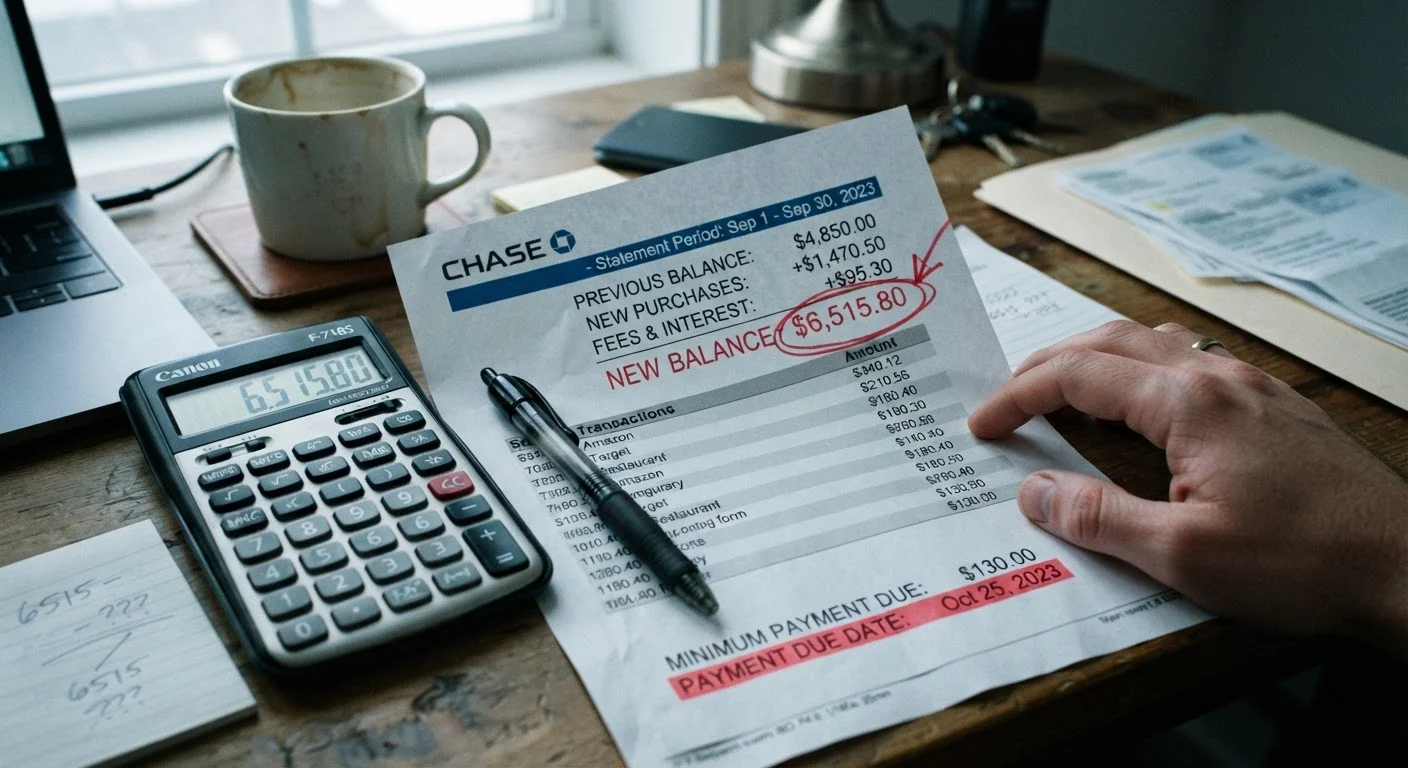
How Interest Works Against You Each Day
Most people understand that carrying a credit card balance means paying interest. What catches many off guard is how frequently that interest compounds. Most card issuers calculate interest daily, applying your annual percentage rate (APR) divided by 365 to your average daily balance. By the time your monthly statement arrives, interest has been accumulating every single day of the billing cycle.
This is why a balance can grow even when you're making regular payments. If your monthly interest charge exceeds - or nearly matches - what you paid, the principal barely moves. For someone carrying $5,000 at a 22% APR, monthly interest alone can exceed $90. A minimum payment of $100 leaves only a few dollars of actual principal reduction. To understand these mechanics from the ground up, see our introduction to debt and interest.
~$6,500
Average U.S. credit card balance per borrower
According to Federal Reserve and TransUnion data, average revolving credit card balances per borrower have remained well above $6,000 in recent years.
20%+
Average credit card APR in the U.S.
The Federal Reserve has tracked average credit card interest rates consistently above 20% annually in recent reporting periods.
~1-3%
Typical minimum payment as a share of balance
Most major card issuers set minimum payments at roughly 1-3% of the outstanding balance or a flat dollar floor, whichever is greater.
The Mistakes That Keep Balances Climbing
Debt growth despite regular payments isn't random - it follows predictable patterns rooted in how credit products are structured and how people respond to them. The following mistakes are among the most common reasons balances stay stubbornly high or continue rising even when you believe you're managing them responsibly.
Paying only the minimum balance each month and assuming that keeps debt under control.
Why it happens: Minimum payments feel manageable and issuers present them as the normal expectation, making them easy to treat as sufficient.
Misunderstanding how daily compounding interest causes balances to grow between payments.
Why it happens: Most people assume interest is calculated once a month on the statement balance, when in reality most cards compound interest daily based on the average daily balance.
Continuing to use a card actively while trying to pay down its balance.
Why it happens: It feels contradictory to avoid a card entirely, and many people assume payments will outpace new charges if they're careful.
Ignoring fees - late charges, cash advance fees, and over-limit fees - that stack onto the principal.
Why it happens: Fees can seem like one-time events rather than balance-growing additions that then attract their own interest going forward.
Treating a balance transfer or consolidation as debt elimination rather than debt relocation.
Why it happens: The relief of a lower rate or a single payment can make it feel like the problem is largely solved, leading to relaxed discipline.
Once you've identified which of these patterns apply to your situation, the next step is choosing a repayment approach that matches your debt profile. Our comparison of the debt avalanche and debt snowball methods walks through both strategies and what each costs over time.
Breaking the Cycle: What Actually Moves the Needle
The most effective lever you have is increasing what you pay each month - consistently and as early in the billing cycle as possible. Even modest increases above the minimum can cut years off a payoff timeline. Beyond payment size, timing matters: because interest accrues daily, making a mid-cycle payment reduces your average daily balance and therefore the interest calculated at month's end.
Penalty APRs Can Permanently Raise Your Rate
Missing a payment or exceeding your credit limit can trigger a penalty APR - often 29.99% or higher - that issuers may apply to your entire balance, not just new purchases. Federal rules require issuers to review penalty rates after six months of on-time payments, but there is no guarantee your rate will be restored. One missed payment can fundamentally change the cost of carrying that debt.
It's also worth examining the broader consequences of carrying high balances over time. Debt doesn't stay neatly contained to a single account - it affects credit utilization ratios, borrowing capacity, and financial flexibility in ways that ripple outward. Our article on how debt ripples into everyday life explores those downstream effects.
Minimum Payments Are Designed to Be Slow
Credit card minimum payment formulas are set by issuers - not by any rule designed to help you pay off debt quickly. On a $5,000 balance at 22% APR, paying only the minimum each month could take well over a decade to clear and cost thousands in interest. This is not a flaw in the math - it is how revolving credit is structured. Paying even modestly above the minimum every month compresses that timeline significantly.
Finally, if your budget feels too tight to pay more than the minimum, it may be worth examining whether you can temporarily redirect savings toward high-interest debt - a tradeoff that often makes mathematical sense. Our guide on balancing debt payoff with saving can help you think through that decision without guesswork.
This article is for general informational and educational purposes only and does not constitute personalized financial or legal advice. Please consult a qualified financial professional for guidance specific to your situation.
The content on this site is provided for informational purposes only and should not be considered a substitute for professional advice. While we strive to provide accurate and up-to-date information, we make no guarantees regarding its completeness or accuracy. Always consult a qualified professional for advice specific to your circumstances before making any decisions.