

How Credit Utilization Is Calculated
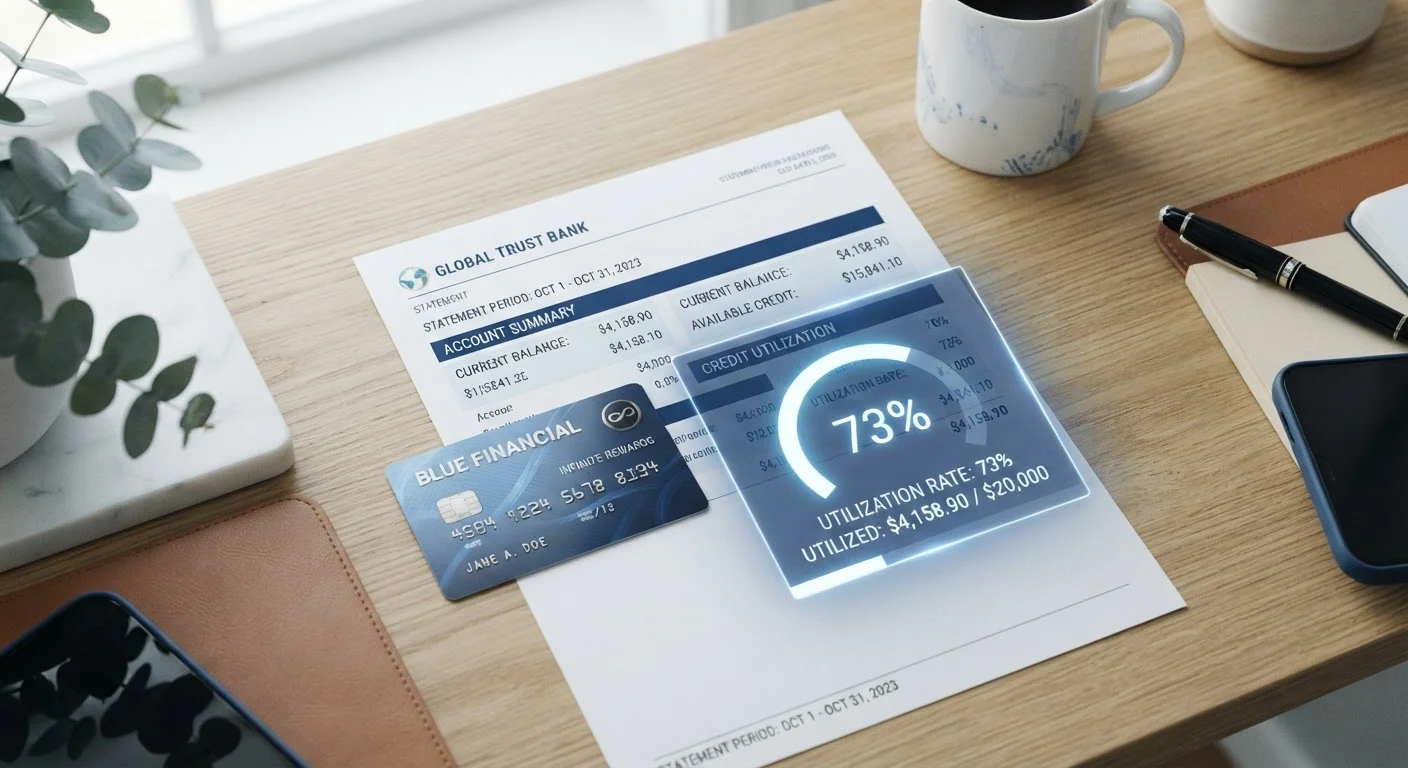
The math behind credit utilization is straightforward. Take the balances you currently carry on your revolving credit accounts - primarily credit cards and lines of credit - and divide that total by the combined credit limits on those accounts. Multiply the result by 100 to get your utilization percentage.
For instance, if you carry $1,500 across two credit cards that together have a $7,500 limit, your aggregate utilization is 20%. Scoring models also look at utilization card by card, so a single maxed-out card can be a negative signal even when your overall ratio is low.
The figure that appears on your credit report reflects the balance your issuer reported to the credit bureaus - typically your statement balance on the reporting date. This is an important nuance: a card you pay in full every month may still show a nonzero utilization if the issuer reports the balance before your payment clears. For a deeper look at how this metric fits alongside other scoring factors, see our Credit Scores Decoded guide.
~30%
Weight of 'amounts owed' in a FICO score
According to FICO's published scoring model breakdown, amounts owed - which includes credit utilization - is the second-largest factor after payment history.
<10%
Utilization ratio common among high scorers
FICO data has consistently shown that consumers with scores above 800 tend to use less than 10% of their available revolving credit.
30%
Widely cited utilization threshold to stay under
Financial educators and credit counselors broadly recommend keeping utilization below 30% as a practical guideline for maintaining a healthy score.
Why Scoring Models Weight It So Heavily
Under the FICO scoring model, credit utilization falls within the "amounts owed" category, which accounts for roughly 30% of a score - second only to payment history. VantageScore similarly treats it as a highly influential factor. The reasoning is straightforward from a lender's perspective: borrowers who routinely use a large share of their available credit may be more financially stretched, which correlates statistically with higher default risk.
Importantly, utilization is evaluated as a point-in-time snapshot, not a long-term trend. A spike one month due to a large purchase doesn't permanently mark your file the way a missed payment does. This responsiveness makes utilization one of the more manageable scoring inputs - changes in your balances can move your score within a single billing cycle once new data is reported. For context on how these scoring patterns connect to real borrowing costs, see what your credit score does to your auto loan.
“Credit utilization is one of the quickest levers consumers can pull to influence their credit score. Unlike a derogatory mark, which lingers for years, a high balance can be addressed within a single billing cycle.”
— Consumer Financial Protection Bureau, U.S. federal agency providing consumer financial education
Patterns That Help and Patterns That Hurt
Certain habits consistently produce lower utilization, while others quietly inflate it in ways people don't anticipate.
Patterns that tend to help
- Paying balances before the statement closing date - this reduces the balance your issuer reports to the bureaus, lowering the ratio that appears on your file.
- Spreading purchases across multiple cards - keeping any single card from climbing toward its limit protects your per-card utilization.
- Requesting credit limit increases periodically - a higher limit on the same spending lowers the ratio, though this may involve a hard inquiry.
- Keeping older cards open and lightly used - available credit from dormant accounts still contributes to your total limit.
Patterns that tend to hurt
- Carrying a large balance on one card - even if other cards are untouched, a near-maxed card is a visible risk signal.
- Closing paid-off cards - this removes their limits from your available credit pool and can raise overall utilization. This is a common misconception addressed in our article on credit score myths people still believe.
- Making large purchases before applying for credit - a temporary balance spike can lower your score at exactly the wrong time.
Maintaining a low, consistent utilization ratio is one of the behaviors associated with strong credit profiles over time. For more on those behaviors, see habits behind high-credit-score households.
How to Monitor and Manage It
You don't need to obsess over your ratio daily, but keeping a general awareness of your balances relative to your limits is a sound practice. Most major card issuers now display your current utilization within their apps or online dashboards. You can also check your utilization across all accounts when you review your credit report, available for free at AnnualCreditReport.com.
If your utilization is higher than you'd like, the most direct path is paying down balances - prioritizing any card near its limit first. If paying down debt isn't feasible immediately, a credit limit increase (where available and where the inquiry cost is acceptable) can provide near-term improvement. Our annual credit health checkup guide walks through a structured way to review your utilization alongside other key credit factors.
Understanding which terms appear on your credit report - including how utilization is labeled and calculated - can make this process less intimidating. The Credit Report Glossary is a useful plain-language reference for that purpose.
This article is for general informational purposes only and does not constitute personalized financial or credit advice. Consult a qualified financial professional for guidance specific to your situation.
Frequently Asked Questions
Most credit experts suggest keeping utilization below 30%, and people with the highest scores often maintain it in the single digits. There is no universally ideal number, but lower is consistently better. Both your aggregate utilization and per-card ratios are evaluated by scoring models.
Paying your balance in full each month avoids interest charges, but it doesn't always mean zero utilization on your credit report. Issuers typically report your statement balance before your payment posts. If you want near-zero utilization reflected, consider paying before your statement closing date.
Utilization is one of the fastest-moving credit score factors. Because it's recalculated each time your card issuer reports updated balances to the bureaus - typically monthly - paying down debt can reflect in your score within one to two billing cycles.
Yes, increasing your credit limit while keeping your spending the same mathematically lowers your utilization ratio. However, a hard inquiry from a limit-increase request can temporarily affect your score, so consider whether the timing makes sense for your situation.
Closing a card removes that card's limit from your total available credit, which can raise your overall utilization ratio if you carry balances on other cards. This is one reason financial educators generally caution against closing older, unused accounts without considering the credit impact.
Credit utilization as scored by major models primarily applies to revolving credit, such as credit cards and lines of credit. Installment loans like auto loans or mortgages are not included in utilization calculations, though they do factor into other parts of your credit profile.
The content on this site is provided for informational purposes only and should not be considered a substitute for professional advice. While we strive to provide accurate and up-to-date information, we make no guarantees regarding its completeness or accuracy. Always consult a qualified professional for advice specific to your circumstances before making any decisions.