

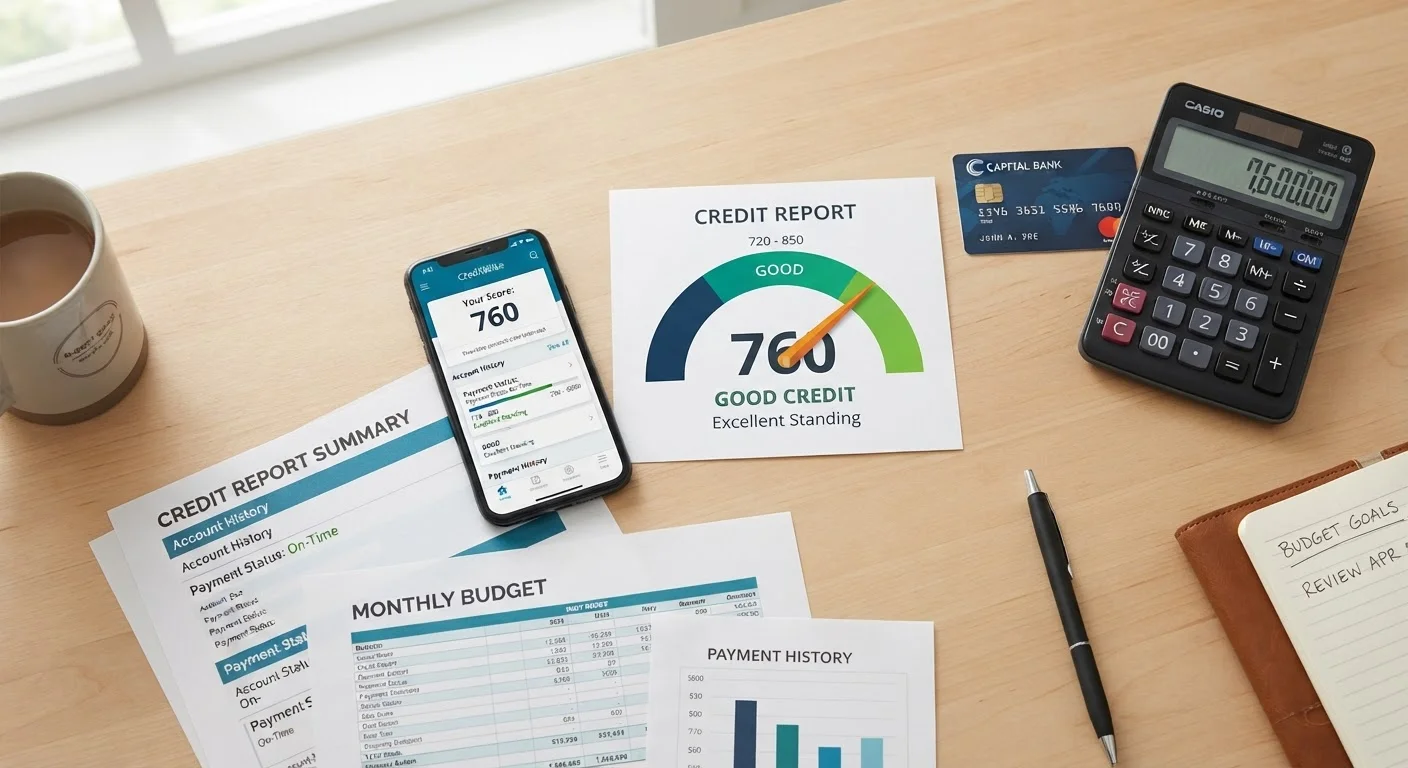
The Five Factors Behind the Number
A credit score isn't a mystery - it's a formula. The dominant model in the U.S., the FICO Score, weighs five distinct categories of information drawn from your credit report. Understanding those categories tells you exactly what behavior the score is measuring.
- Payment history (≈35%): Whether you pay on time. Even one missed payment can cause a noticeable drop, especially on a score that was previously clean.
- Amounts owed / Credit utilization (≈30%): How much of your available revolving credit you're currently using. Lower utilization generally signals lower risk. See our deep dive on credit utilization for a closer look at how this ratio is calculated.
- Length of credit history (≈15%): The age of your oldest account, your newest account, and the average age of all accounts. Longer histories provide more data for lenders to evaluate.
- Credit mix (≈10%): Whether you have experience managing different types of credit - revolving accounts like credit cards and installment accounts like loans. A varied mix can modestly benefit a score.
- New credit (≈10%): Recent hard inquiries and newly opened accounts. Opening several new accounts in a short window can signal financial stress to scoring models.
These percentages reflect general FICO weighting. VantageScore uses similar inputs but applies its own formula, which can produce different results from the same underlying data.
35%
FICO Score weight given to payment history
According to FICO's published scoring methodology, on-time payments represent the largest single factor in a standard FICO Score calculation.
~200M
Americans with a scoreable FICO credit file
FICO has reported that approximately 200 million U.S. consumers have enough credit history to generate a FICO Score.
716
Average U.S. FICO Score
Experian's State of Credit report has tracked the average American FICO Score at approximately 716, placing the typical consumer in the 'good' range.
Why One Person Can Have Many Different Scores
If you've ever pulled your credit score from two different sources and found different numbers, you're not being misled. You genuinely have multiple scores - potentially dozens - and all of them can be technically accurate.
Two variables drive this variation:
- The scoring model and version: FICO alone has released more than 60 score versions, many tailored to specific industries. A FICO Auto Score used by car lenders weighs auto loan payment history more heavily than a general FICO Score. VantageScore 3.0 and 4.0 use different algorithms than FICO entirely.
- The bureau providing the data: Equifax, Experian, and TransUnion each maintain separate files. If one creditor reports a late payment to only one bureau, the scores generated from each bureau's file will differ.
For everyday purposes, monitoring a single score over time is more useful than comparing scores across sources. Trend direction - is your score moving up or down? - matters more than any single snapshot. To understand the vocabulary on the underlying reports driving those scores, our credit report glossary covers the terminology you'll encounter.
A borrower with a 780 credit score applies for a mortgage and receives a significantly lower interest rate than a neighbor with a 640 score applying for the same loan amount.
Someone pays off a credit card balance, dropping their utilization from 70% to 10%, and their score jumps noticeably within a single billing cycle.
A consumer checks their score on a bank app and sees 742, then applies for an auto loan and learns the dealer pulled a 721.
How Lenders Actually Use Your Score
A credit score is an input, not a final verdict. Lenders use it as a fast, standardized way to segment applicants by risk tier - but most lending decisions also consider income, employment status, existing debt obligations, and the type of credit being requested.
The practical consequence of your score shows up in loan pricing. Borrowers in higher score ranges typically receive lower interest rates, while those in lower ranges pay more for the same amount of borrowed money - or may be declined entirely. This spread compounds significantly over time on large loans. For a concrete example of how this plays out with vehicle financing, see what your credit score does to your auto loan.
Check Your Reports, Not Just Your Score
Your credit score is generated from your credit report - so errors on the report feed directly into a lower score. U.S. consumers are entitled to free reports from all three major bureaus at AnnualCreditReport.com. Reviewing reports for inaccurate late payments, duplicate accounts, or unfamiliar accounts is one of the highest-value steps you can take for your credit health.
A credit score is also separate from your overall financial picture. A high score says you manage credit well - it doesn't measure your savings rate, net worth, or income. Those factors matter enormously to financial health but don't appear in the score itself. Once a year, a structured credit health checkup can help you see both dimensions clearly.
This article provides general financial education and is not personalized financial or credit advice. For guidance specific to your situation, consider consulting a qualified financial professional.
Frequently Asked Questions
Most scoring models treat 670-739 as 'good' and 740-799 as 'very good,' with 800 and above considered exceptional. Scores below 580 are generally viewed as poor by lenders. These ranges can vary slightly by model and lender.
Each credit bureau - Equifax, Experian, and TransUnion - maintains its own file on you, and not all creditors report to all three. Different data inputs mean different score outputs, even with the same scoring model.
Scores can update as frequently as creditors report new information, which is typically monthly. A score you check today may differ from one checked in two weeks if a payment was posted or a balance changed.
No. Checking your own score is a 'soft inquiry' and has no impact on your score. Only 'hard inquiries' - triggered when lenders pull your report for a credit decision - can cause a small, temporary dip.
Paying down revolving balances to lower your credit utilization ratio tends to produce the quickest score movement because utilization is recalculated each time a new balance is reported. Correcting errors on your credit report can also produce rapid changes.
Yes. Any account that reports to the bureaus - such as an auto loan, student loan, or even some rent-reporting programs - can generate a scoreable credit file. Credit cards are common but not the only path to building a score.
The content on this site is provided for informational purposes only and should not be considered a substitute for professional advice. While we strive to provide accurate and up-to-date information, we make no guarantees regarding its completeness or accuracy. Always consult a qualified professional for advice specific to your circumstances before making any decisions.