

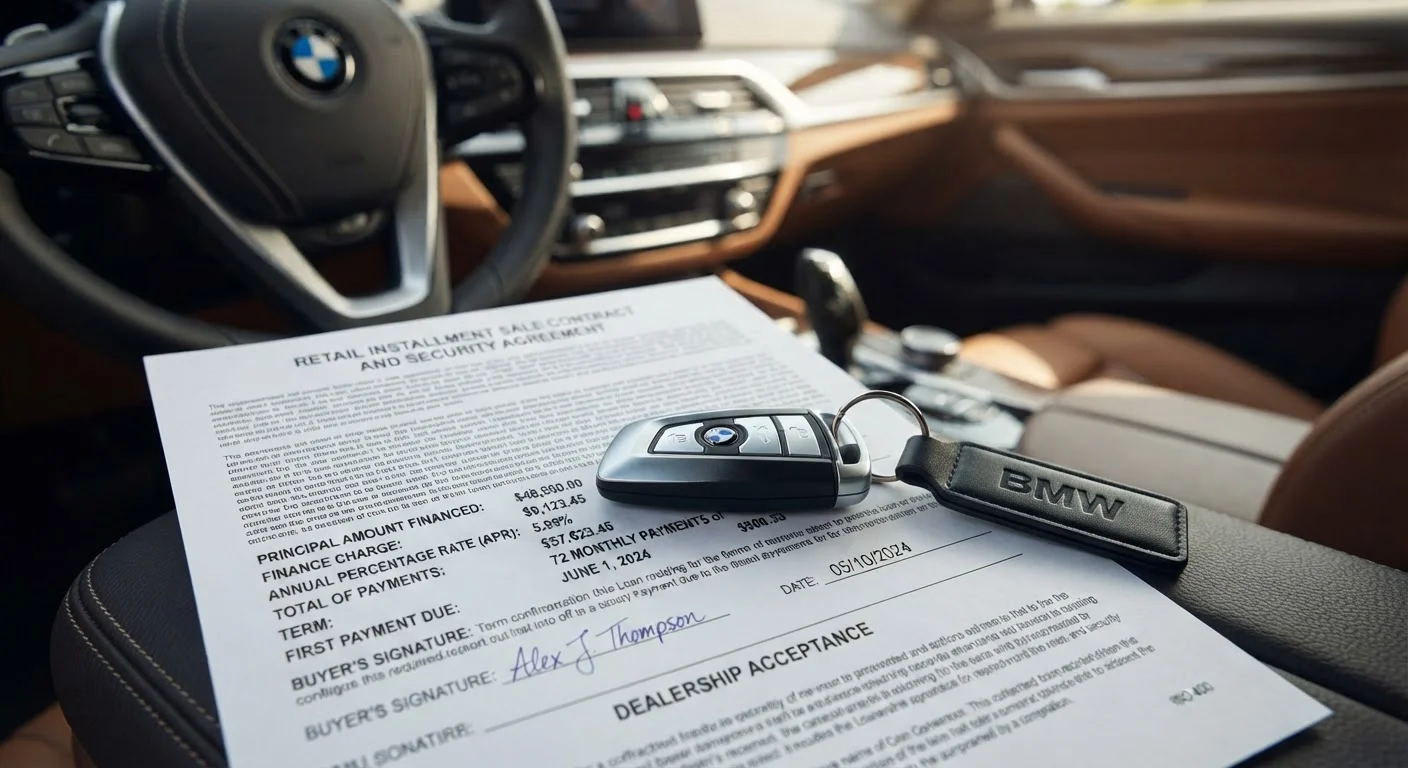
How Lenders Translate Your Score Into a Rate
Auto lenders don't set interest rates randomly. They group applicants into tiers - often labeled prime, near-prime, and subprime - based largely on credit score ranges. The tier you fall into determines the rate bracket you're offered. According to data from the Consumer Financial Protection Bureau and industry sources, borrowers with scores above 720 routinely qualify for the lowest available rates, while those below 620 can face rates that are several percentage points higher for the exact same vehicle and loan amount.
This tiered system means that a difference of 20 or 30 points on your credit score can sometimes push you from one bracket into another, changing your monthly payment and total interest paid by a meaningful amount. That's why it's worth understanding where your score sits before you start shopping - not after you're sitting in a finance office.
~5-6 pts
Typical hard inquiry score drop
FICO estimates a single hard inquiry lowers most consumers' scores by fewer than 5 points, and the effect fades within a year.
35%
Weight of payment history in FICO Score
According to FICO, payment history is the single largest factor in your base credit score calculation.
3-7%+
Typical APR range between prime and subprime borrowers
Industry data consistently shows subprime auto loan rates running several percentage points above those offered to prime borrowers for the same vehicle.
What the Score Is Actually Measuring
Lenders aren't just looking at a number in isolation. Your credit score summarizes five key factors: payment history (the largest component), amounts owed relative to your available credit, length of credit history, new credit inquiries, and mix of credit types. For auto loans specifically, your history with installment debt - mortgages, student loans, previous car loans - carries extra weight in specialized scoring models.
It's worth knowing that the score displayed in many consumer apps or on your bank statement is often a general-purpose FICO Score or VantageScore, which may read differently than the auto-specific score a lender pulls. Before assuming your number is final, consider checking common credit score misconceptions that could be affecting how you interpret your standing.
Auto Scores vs. General Credit Scores
The score you see through a consumer credit monitoring app is typically a general-purpose FICO Score or VantageScore. Auto lenders often pull a different version - such as FICO Auto Score 8 - that's calibrated specifically around installment loan behavior. These scores can differ by 20 points or more in either direction, so your consumer-facing score is a useful guide but not a guaranteed match to what a lender will see.
The Real Cost Difference Across Score Tiers
The clearest way to understand why your score matters is to look at total cost, not just the monthly payment. On a $28,000 loan with a 60-month term, moving from a 4% rate to an 10% rate increases total interest paid from roughly $2,900 to over $7,400. That's a difference of more than $4,500 - not a rounding error.
This is also why it's worth shopping your loan before stepping into a dealership. Dealers have flexibility to mark up the rate a lender offers them - a practice the CFPB has flagged as a potential source of disparate outcomes. Getting pre-approved through your own bank or credit union first gives you a concrete benchmark. You can learn more about how those two paths compare in our guide to financing through a dealership vs. your own lender.
Practical Steps Before You Apply
If your score isn't where you'd like it before an auto loan application, there are evidence-backed ways to improve it in the months leading up to a purchase. Reducing credit card balances - which lowers your credit utilization ratio - tends to produce measurable score movement relatively quickly. Checking your credit reports at AnnualCreditReport.com for errors and disputing any inaccuracies is also worthwhile; incorrect negative entries are not uncommon.
Avoid opening new lines of credit in the 90 days before applying, as new inquiries signal risk to lenders. And when you do apply, rate-shop within a focused time window - most scoring models treat multiple auto inquiries within 14 to 45 days as a single event, so you can compare lenders without stacking up hard-inquiry damage.
Once you're ready to review an actual offer, knowing what questions to ask protects you at the table. Our article on questions worth asking before you sign covers the terms and fees that matter most in the final stage of a car purchase.
This article is for general informational purposes only and does not constitute financial or legal advice. Consult a qualified financial professional for guidance specific to your situation.
Frequently Asked Questions
There is no universal minimum, but scores above 660 typically qualify for competitive rates from most lenders. Scores below 580 are generally considered subprime, which can mean higher rates or a requirement for a larger down payment. Some lenders specialize in financing for lower scores, though their terms are usually less favorable.
The impact is significant. On a $30,000 loan over 60 months, the difference between a prime rate and a subprime rate can add hundreds of dollars to your monthly payment and thousands to your total cost. Even a 1-2 percentage point difference in rate changes the bottom line noticeably.
Each application triggers a hard inquiry, which can temporarily lower your score by a few points. However, most credit scoring models treat multiple auto loan inquiries within a short window - typically 14 to 45 days - as a single inquiry, so rate shopping doesn't compound the damage.
Yes. Paying down revolving balances, catching up on any missed payments, and avoiding new credit applications in the months before you apply can all move your score upward. Even moving from one scoring tier to the next can reduce your interest rate by one or more percentage points.
Not always. Dealerships and banks may pull different versions of your credit report or use different scoring models. It's common for the score a dealer sees to differ from what a direct lender sees, which is one reason pre-approval from your own bank or credit union is a smart starting point.
No. Lenders also consider your income, employment history, debt-to-income ratio, loan-to-value ratio of the vehicle, and the length of time you've held accounts. Your credit score is a critical input, but the full picture of your financial profile matters.
The content on this site is provided for informational purposes only and should not be considered a substitute for professional advice. While we strive to provide accurate and up-to-date information, we make no guarantees regarding its completeness or accuracy. Always consult a qualified professional for advice specific to your circumstances before making any decisions.