

Option A
Zero-Based Budgeting
The meticulous, dollar-by-dollar approach.
Best for: People who want complete control over every spending category and don't mind regular monthly planning.
Option B
Percentage-Based Budgeting
The flexible, rule-of-thumb framework.
Best for: People who want a simple, consistent structure that doesn't require rebuilding their budget each month.
How Each Method Works
Understanding these two frameworks starts with their core mechanics - because while both aim to bring order to your finances, they take fundamentally different routes to get there.
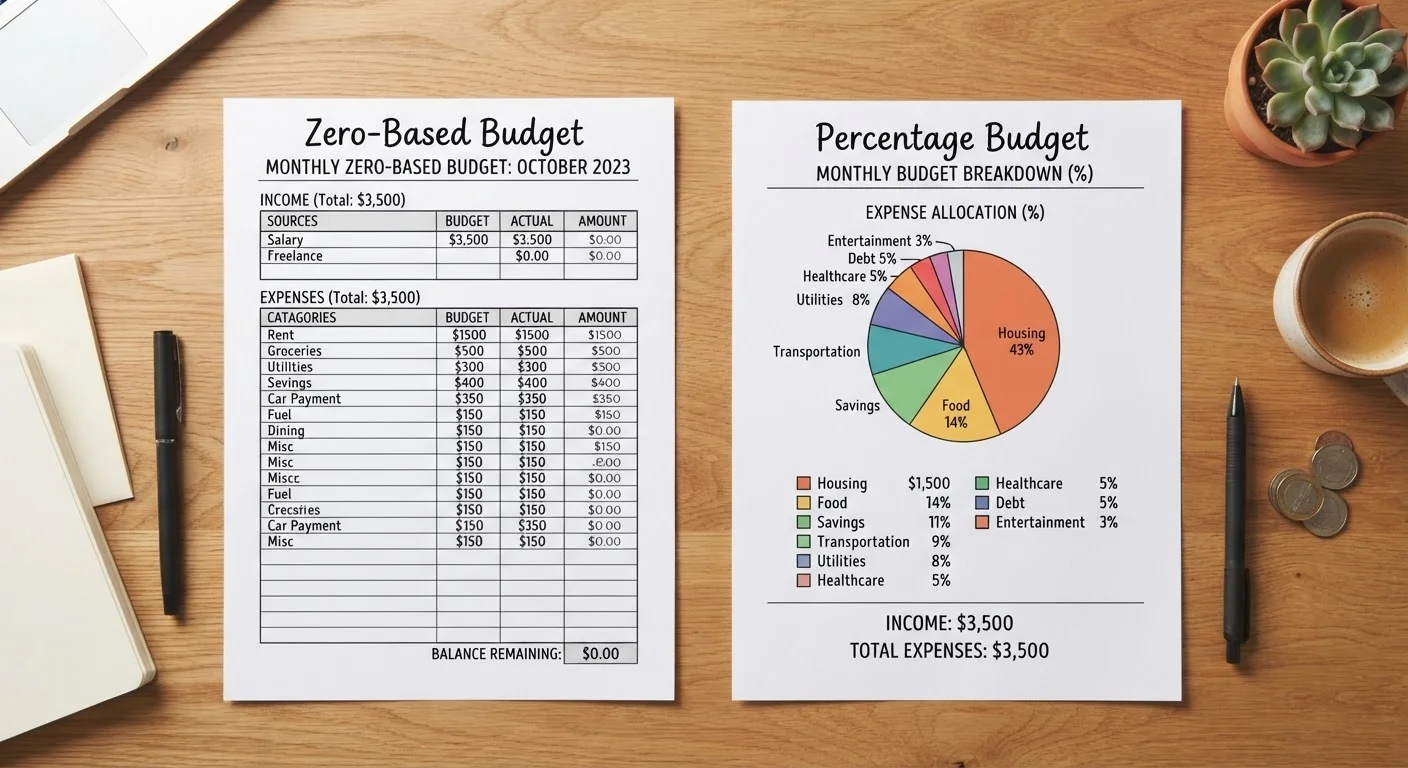
Zero-based budgeting (ZBB) starts from scratch each month. You take your total expected income and assign every single dollar to a category - housing, groceries, savings, debt payments, entertainment - until you reach zero. The goal isn't to spend everything; it's to intentionally account for every dollar, including savings and investments. If income is $4,200 this month, your categories must add up to exactly $4,200.
Percentage-based budgeting works by slicing income into fixed ratios. The most widely referenced framework is the 50/30/20 rule: roughly 50% toward needs, 30% toward wants, and 20% toward savings and debt repayment. These proportions stay roughly constant regardless of whether your paycheck is $3,000 or $6,000, making the system highly portable.
For a deeper walkthrough of building either structure from the ground up, see Your First Personal Budget: A Ground-Up Walkthrough.
| Criterion | Zero-Based Budgeting | Percentage-Based Budgeting |
|---|---|---|
| Core concept | Every dollar assigned to a category | Income split by fixed ratios |
| Monthly setup time | Higher - rebuilt each month | Lower - ratios stay consistent |
| Flexibility | Highly customizable by category | Fixed structure, less granular |
| Best income type | Variable or irregular income | Stable, predictable income |
| Spending visibility | Very high - line-item detail | Moderate - broad categories |
| Beginner-friendliness | Steeper learning curve | Easy to understand and start |
| High cost-of-living adaptability | Adapts to real numbers | Standard ratios may not fit |
Where Each Method Excels - and Falls Short
Zero-based budgeting's biggest strength is transparency. When you must consciously assign every dollar, it becomes difficult to ignore wasteful patterns - that recurring subscription you forgot, the dining-out habit you underestimated. Research consistently shows that awareness of spending is one of the strongest predictors of financial behavior change. The tradeoff is time: ZBB typically requires 30-60 minutes of setup at the start of each month, plus ongoing category tracking.
Percentage-based budgeting wins on simplicity and durability. Because the ratios don't change, there's little to reconfigure when life stays roughly stable. However, the 50/30/20 split was designed as a general guideline, not a universal prescription. In cities where rent alone consumes 40% of take-home pay, forcing expenses into a 50% cap on needs is unrealistic without significant tradeoffs.
50/30/20
Most recognized percentage budget split
The 50/30/20 rule, popularized in personal finance literature, allocates needs, wants, and savings - though it was never intended as a one-size-fits-all prescription.
~30%
Americans with a formal monthly budget
Gallup polling has consistently found that fewer than one-third of American households maintain a detailed monthly budget, underscoring how much room there is for improvement.
40%+
Rent-to-income ratio in many U.S. metros
Harvard's Joint Center for Housing Studies reports that cost-burdened renters - those spending over 30% of income on housing - are widespread, making rigid percentage targets difficult to apply.
For a balanced look specifically at the downsides of the zero-based approach, Pros and Cons of Zero-Based Budgeting covers both sides in detail.
Choosing the Right Framework for You
The most effective budget is the one you'll actually use. That's not a cliché - it's the practical reality that separates people who improve their finances from those who abandon their plan by month two.
Consider zero-based budgeting if: your income varies month to month, you're working through a specific financial goal like paying off debt, you've tried looser systems and found money disappearing without explanation, or you simply enjoy detailed planning.
Consider percentage-based budgeting if: you have stable, predictable income, you want a system that runs mostly on autopilot, you're building your first budget and want a clear starting structure, or you tend to abandon systems that feel too rigid.
It's also worth noting that these methods aren't mutually exclusive. Some people use percentage-based categories as guardrails while zero-basing within each category for precision. Others start with percentages and shift to zero-based budgeting once they're comfortable with tracking. The Personal Budgeting: A Complete Resource explores how to adapt your approach as your situation evolves.
If you're also weighing how to track your budget - whether by app, spreadsheet, or paper - Budgeting on Paper, in a Spreadsheet, or With an App breaks down what changes with each option.
This article is for general informational and educational purposes only and does not constitute personalized financial advice. Consult a qualified financial professional for guidance tailored to your individual circumstances.
The content on this site is provided for informational purposes only and should not be considered a substitute for professional advice. While we strive to provide accurate and up-to-date information, we make no guarantees regarding its completeness or accuracy. Always consult a qualified professional for advice specific to your circumstances before making any decisions.