

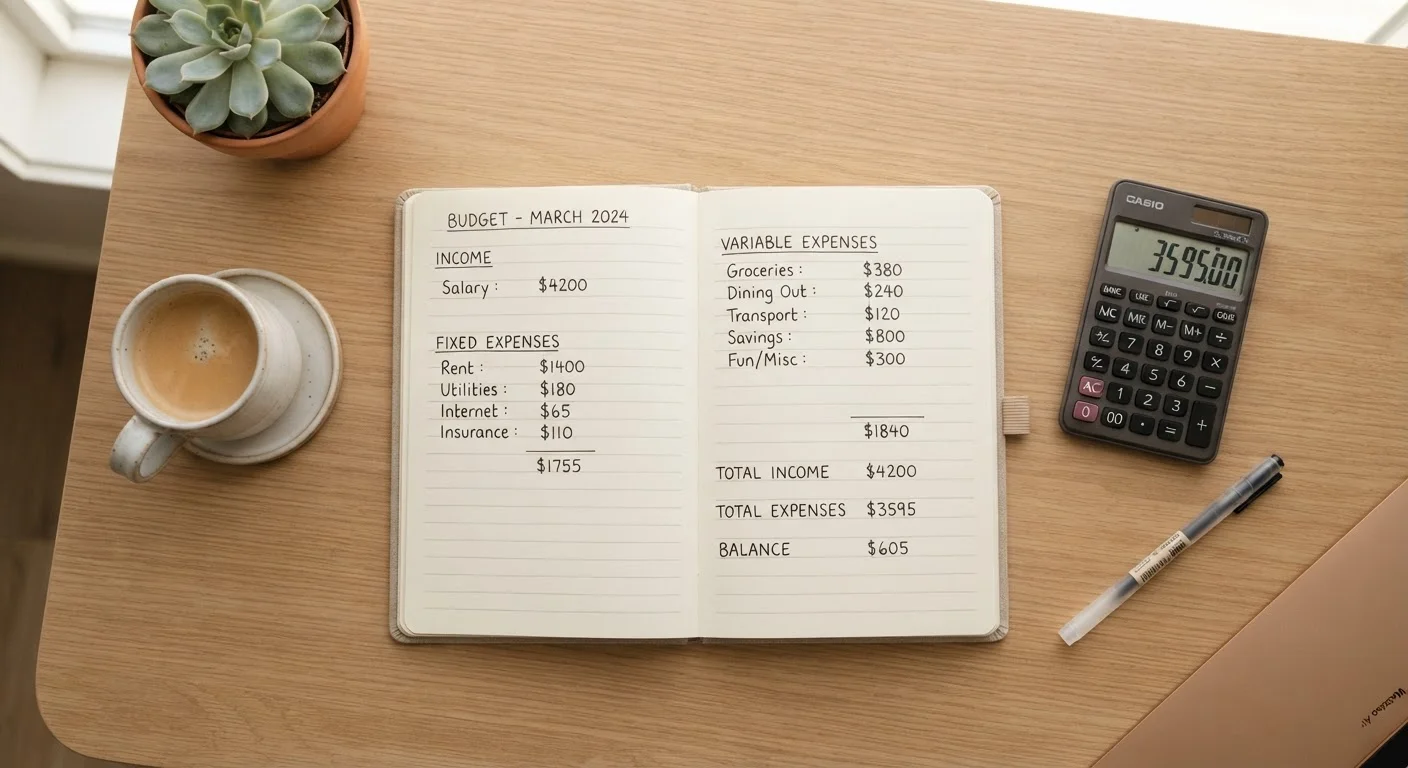
Why Budgeting Works (and Why Most People Quit)
A budget is simply a plan for your money - a way of telling each dollar where to go rather than wondering where it went. Research from the Consumer Financial Protection Bureau consistently links budgeting behavior to reduced financial stress and improved savings outcomes, even at modest income levels.
Most people who abandon budgets do so not because the concept failed them, but because the plan they built was unrealistic. Budgets collapse when they ignore irregular expenses, demand perfection, or impose lifestyle cuts that feel punishing. The goal of this guide is a budget that reflects your actual life - one you can maintain for months and years, not just a pay period.
Start With What You Have
You do not need specialized software or a financial background to build a useful budget. A spreadsheet or even a printed worksheet works well for most people starting out. The tool matters far less than the habit of using it consistently.
This article provides general financial education and is not personalized financial advice. For guidance specific to your situation, consider consulting a licensed financial professional.
Step 1: Map Your Cash Flow
Before you can allocate money, you need to know precisely how much comes in and where it currently goes. Start with net income - the amount deposited into your account after taxes and any payroll deductions. If your income varies month to month, use a conservative average from the past three to six months.
Next, pull 60 to 90 days of bank and credit card statements and categorize every transaction. Group spending into: fixed essentials (rent, loan payments, utilities), variable essentials (groceries, gas, healthcare), discretionary (dining out, subscriptions, entertainment), and irregular (annual fees, car registration, gifts).
74%
Americans living paycheck to paycheck at some point
According to a 2023 survey by PYMNTS and LendingClub, nearly three in four Americans report experiencing paycheck-to-paycheck financial pressure.
$500+
Typical monthly irregular expense average
Financial planning practitioners commonly estimate that irregular expenses - repairs, medical, gifts, fees - average $500 or more per month when annualized across typical U.S. households.
20%
Recommended savings and debt repayment share
The 50/30/20 framework, widely referenced by personal finance educators, recommends directing 20% of net income toward savings goals and debt repayment.
Many people are genuinely surprised by what they find. The irregular category is frequently the most underestimated - costs that don't appear monthly but average several hundred dollars a month when spread across the year.
Once you have a complete spending picture, compare total spending to total income. A gap in either direction - spending more or holding unexplained surpluses - tells you where your budget work needs to focus first.
Step 2: Choose a Budgeting Framework
Different frameworks suit different people. Three proven approaches cover most situations:
- 50/30/20: Allocate 50% of net income to needs, 30% to wants, and 20% to savings and debt repayment. It is broad enough to be sustainable for most households and requires no detailed line-item tracking.
- Zero-based budgeting: Every dollar is assigned a job so income minus expenses equals zero. More detailed, but powerful for people who want maximum control or are aggressively paying down debt. See our Debt & Credit hub for strategies that pair well with this approach.
- Pay-yourself-first: Move a set amount to savings or investments the moment income arrives; budget the remainder freely. Works well for people whose biggest struggle is saving rather than overspending.
No framework is universally superior. The best one is the one you will actually use consistently.
When choosing a budgeting framework, pick the simplest one that addresses your biggest money challenge - not the most sophisticated one you have read about.
Complexity is the enemy of consistency. A straightforward 50/30/20 split that you follow every month produces better results than a detailed zero-based system that you abandon after two weeks.
Review your subscriptions and automatic renewals every six months - cancel any you have not used in 60 days.
Subscription creep is one of the fastest-growing categories of discretionary spending. Regular audits routinely uncover $50-$150 in monthly charges that no longer deliver value.
Step 3: Build Your First Budget
With your cash flow mapped and a framework chosen, build your first budget in four steps:
- Set fixed expenses first. Enter rent or mortgage, minimum loan payments, insurance premiums, and utilities. These have limited flexibility and anchor everything else.
- Fund irregular expenses with a sinking fund. Add up annual irregular costs, divide by 12, and set that amount aside monthly in a separate account or line item. This single habit prevents more budget failures than any other.
- Allocate variable and discretionary categories. Use your historical spending data as a starting point, then adjust based on your goals. If you want to build an emergency fund faster, trim discretionary categories - not fixed ones you cannot realistically change. Our Saving & Emergency Funds hub covers how to size and build a fund that protects your budget from the unexpected.
- Leave a small buffer. A $50-$150 miscellaneous line prevents small surprises from blowing up an otherwise solid plan.
Your first budget will not be perfect. Treat it as a working draft that improves with each month of real data.
Keeping the Budget Alive: Monthly Habits
The difference between a budget that sticks and one that is abandoned is a consistent review habit. A monthly check-in does not need to be elaborate - 15 minutes to compare actual spending against your plan is enough.
During each review, ask three questions: Which categories went over, and why? Did any new irregular expenses appear? Am I on track toward my savings or debt goals? Adjust next month's allocations based on what you learn rather than repeating the same figures mechanically.
Automating transfers to savings on payday removes the willpower element from saving. Pairing a budget with automatic saving is one of the most reliable ways to make financial progress without requiring daily effort. If you are also working to establish or strengthen your credit profile, consistent on-time bill payments - made easier by a clear budget - are fundamental. Our Building Credit From Scratch guide explains how bill-payment history shapes your credit score.
Adjusting Your Budget as Life Changes
A budget is a living document, not a static spreadsheet. Major life events - a job change, a new baby, a move, a medical expense, or a pay raise - each require a deliberate re-mapping of income and expenses. Waiting for the budget to naturally absorb a change typically results in months of untracked drift.
When a significant change occurs, return to Step 1: recalculate net income and re-categorize spending under the new circumstances. Then reapply your framework. You do not need to start from zero - most categories carry forward - but income and fixed-expense lines need to be verified as accurate.
A budget also grows in ambition over time. Early budgets often focus on breaking even or building a starter emergency fund. As income rises and debt falls, budgeting goals typically shift toward wealth-building, larger savings targets, or funding specific goals like a home purchase. Revisiting your framework every year - not just after a crisis - is a healthy practice that keeps your financial plan aligned with your actual priorities.
This article is for general informational and educational purposes only. It does not constitute personalized financial, tax, or legal advice. Consult a qualified financial professional before making decisions specific to your circumstances.
The content on this site is provided for informational purposes only and should not be considered a substitute for professional advice. While we strive to provide accurate and up-to-date information, we make no guarantees regarding its completeness or accuracy. Always consult a qualified professional for advice specific to your circumstances before making any decisions.