

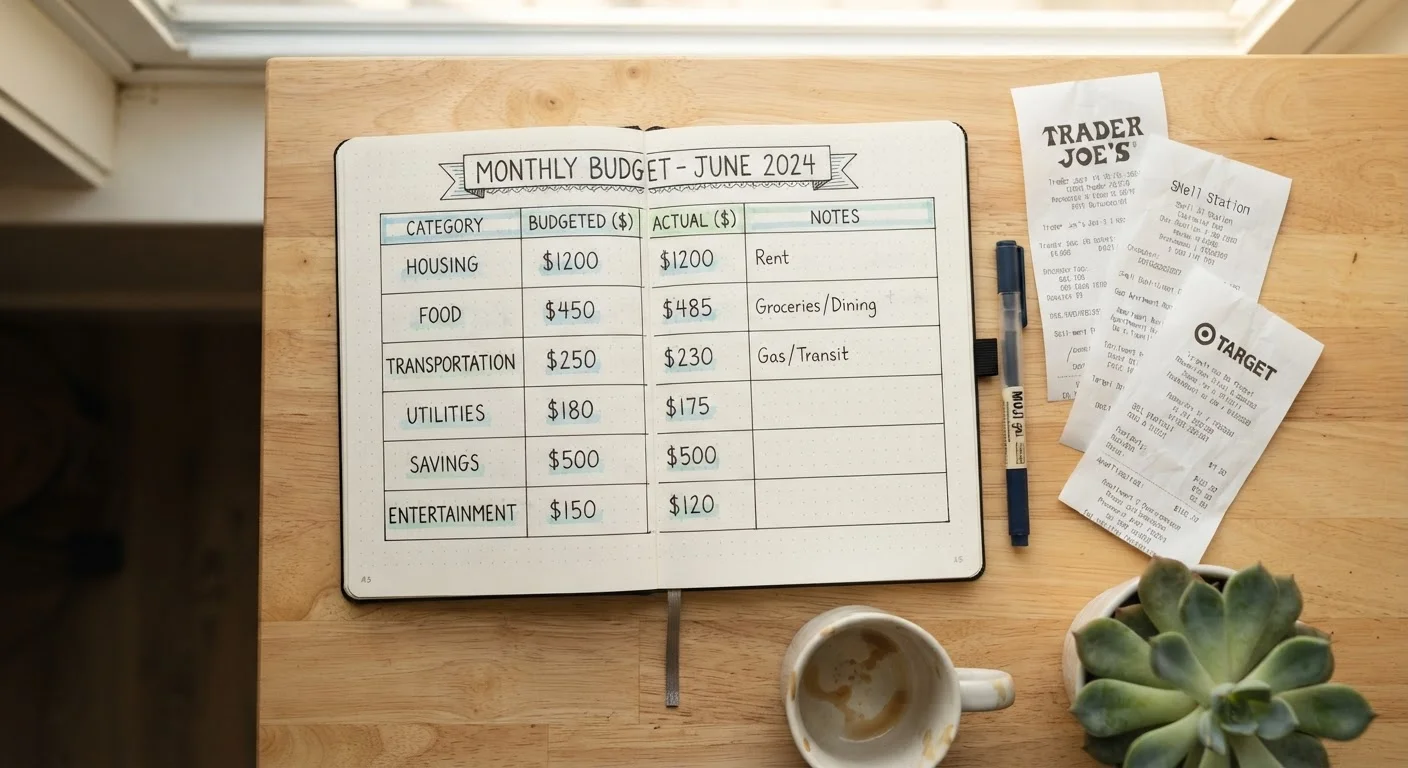
What Spending Categories Actually Are
When you look at a month's worth of bank and credit card transactions, the sheer number of individual entries can make it nearly impossible to see the big picture. Spending categories solve this by grouping similar expenses together under a single label.
Think of categories as buckets. Every dollar you spend gets dropped into one. At the end of the month, you don't count every penny - you look at how full each bucket is. That shift in perspective is what makes a budget readable and useful rather than overwhelming.
A standard set of categories for an American household might include:
- Housing - rent or mortgage, property taxes, renter's or homeowner's insurance
- Food - groceries, household supplies, dining out
- Transportation - car payment, fuel, insurance, public transit
- Utilities - electricity, gas, water, internet, phone
- Healthcare - insurance premiums, copays, prescriptions
- Savings & investments - emergency fund contributions, retirement accounts
- Debt payments - credit cards, student loans, personal loans
- Discretionary - entertainment, hobbies, clothing, subscriptions
For a deeper look at the vocabulary that surrounds these categories, the budgeting terms reference covers key concepts like discretionary spending, sinking funds, and net income in plain language.
33%
Average share of household budget spent on housing
According to the U.S. Bureau of Labor Statistics Consumer Expenditure Survey, housing consistently represents the largest single spending category for American households.
13%
Average share spent on food (home and away)
The BLS Consumer Expenditure Survey reports that food - including groceries and dining out - is typically the second- or third-largest household expense category.
~40%
Americans without a detailed monthly budget
Surveys by the National Foundation for Credit Counseling have consistently found that a large share of U.S. adults do not track their spending with a formal budget or category system.
Why Categories Matter More Than Transaction Lists
Without categories, a budget is just a list. Categories introduce structure - and structure is what reveals whether your actual spending aligns with your intentions.
For example, you might feel like you spend a reasonable amount on food, but once all grocery runs, coffee stops, and restaurant charges are grouped together, the true monthly total often surprises people. That visibility is the point. You can't change behavior you can't clearly see.
Categories also make month-to-month comparison possible. If your transportation spending jumps in October, you can investigate why - perhaps a car repair, a rise in fuel prices, or an unusual commute pattern. Without the category, that spike would be invisible inside a sea of individual line items.
Understanding the difference between fixed and variable expenses sharpens this further. Fixed expenses like rent stay the same each month and are easy to plan for. Variable expenses like groceries or gas fluctuate, and categories help you set realistic limits rather than guessing.
Start With Broad Categories, Then Refine
If you're new to budgeting, resist the urge to build an elaborate 20-category system on day one. Start with five or six broad groups, track them for a full month, and then decide where you need more detail. Complexity added before you understand your own patterns usually leads to abandonment.
Building a Category List That Reflects Your Real Life
Generic budget templates offer a starting point, but they rarely match any one person's situation perfectly. The goal is a category list that is honest about where your money actually goes - not where you wish it went.
A practical approach: pull three months of bank and credit card statements and group every transaction by type. The categories that emerge from your own spending history are almost always more accurate than any pre-made template.
A few principles worth keeping in mind:
- Merge categories you rarely use. If you have separate buckets for "streaming services," "gym membership," and "other subscriptions" but they total less than $30 a month combined, fold them into one "subscriptions" line.
- Split categories that consistently run over budget. If "food" always overshoots, separating groceries from dining out gives you the granularity to address the real driver.
- Include savings as a category, not an afterthought. Treating savings as a spending category - money that leaves your checking account first - is a foundational principle of effective budgeting.
Once your categories are set, the next decision is how you'll track them. The paper, spreadsheet, and app comparison walks through the real trade-offs of each format so you can choose what you'll actually stick with. And if you want a complete end-to-end framework, the personal budgeting complete resource covers every stage from setup to long-term habits.
This article is for general informational and educational purposes only and does not constitute personalized financial advice. For guidance tailored to your specific situation, consider consulting a qualified financial professional.
Frequently Asked Questions
There is no magic number, but most financial educators suggest between 8 and 15 categories for a household budget. Too few categories hide useful detail; too many become tedious to maintain. Start with broad groups and add subcategories only where the extra detail would change a decision.
The most widely used categories include housing, food and groceries, transportation, utilities, healthcare, personal care, debt payments, savings, and discretionary spending (such as dining out or entertainment). Your specific list will depend on your lifestyle and financial goals.
It helps to do so, at least mentally. Many budgeters use the needs-versus-wants distinction to prioritize essential categories before allocating money to discretionary ones. You don't have to label every category this way, but understanding which expenses are optional versus non-negotiable gives you more control when money is tight.
Debt repayment - including credit cards, student loans, and personal loans - is typically its own spending category, separate from housing or utilities. Treating it as a distinct line item makes it easier to track payoff progress and ensures it isn't buried inside broader groups. For more context, see our <a href="/finance/debt-credit">Debt & Credit</a> hub.
Absolutely. Your categories should evolve as your life changes - a new job, a move, or a growing family will shift where your money goes. Review your category structure once or twice a year and adjust it to reflect your current reality rather than holding on to categories that no longer apply.
The content on this site is provided for informational purposes only and should not be considered a substitute for professional advice. While we strive to provide accurate and up-to-date information, we make no guarantees regarding its completeness or accuracy. Always consult a qualified professional for advice specific to your circumstances before making any decisions.