

Start here
What a Repair Estimate Actually Is
Next
Breaking Down the Line Items
Then
Understanding Labor Charges
When you're ready
Questions Worth Asking Before You Approve Work
What a Repair Estimate Actually Is
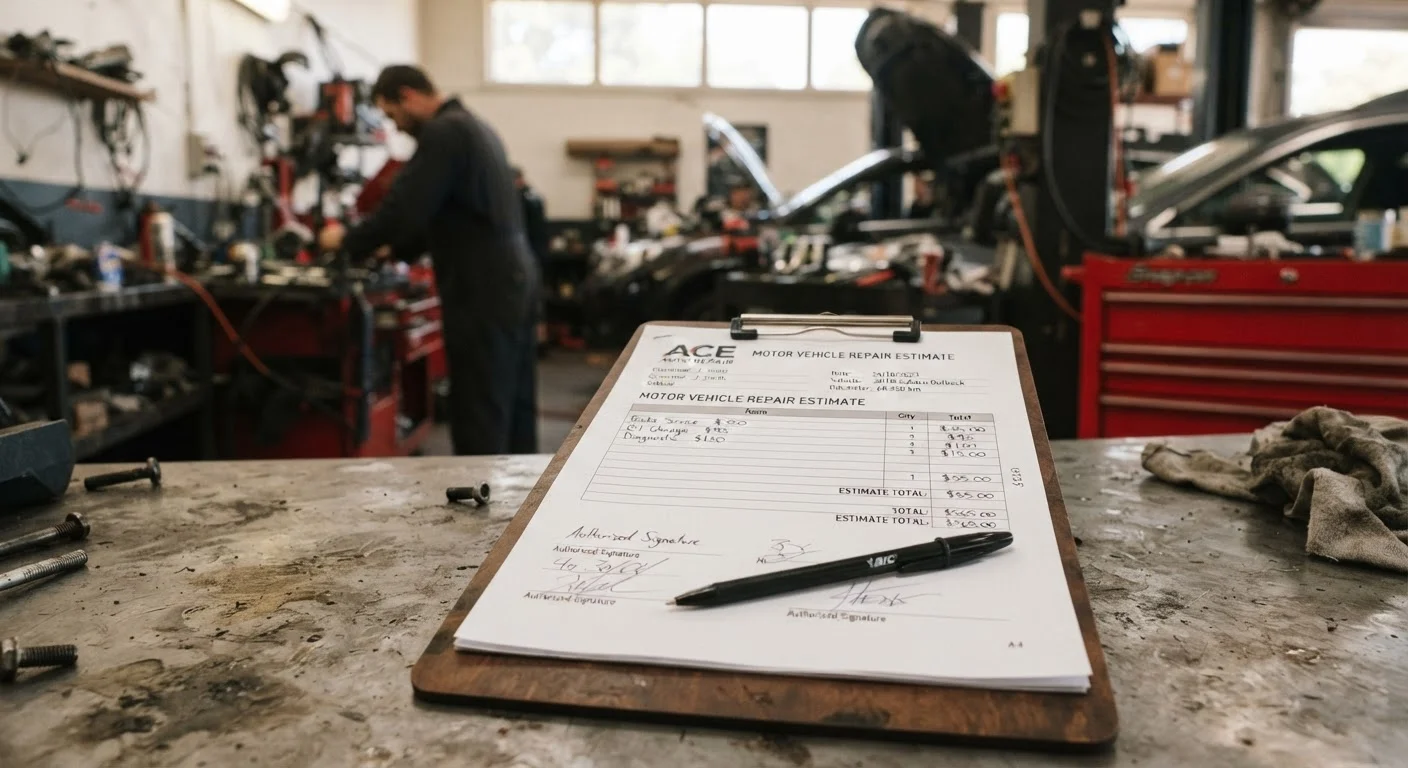
When a shop hands you a repair estimate - sometimes called a repair order or work order - it's a written breakdown of what they plan to do to your vehicle and what they expect to charge. Think of it as a proposed contract: nothing should be done to your car until you've reviewed and authorized the work.
Estimates typically have three distinct cost categories: parts, labor, and miscellaneous fees. Each one is negotiable and worth understanding individually. A shop that can't explain any line item clearly is a shop worth questioning.
If you're new to car ownership and want to build broader context around repair costs, this practical maintenance primer covers the foundational concepts every driver should have before problems arise.
Flat-rate labor
A pricing system where labor is billed based on a published standard time for each job type, not the actual clock time a mechanic spends on your vehicle.
OEM parts
Parts made by or for the original vehicle manufacturer. They are designed to match the exact specifications of your car's factory components.
Aftermarket parts
Replacement parts produced by third-party companies rather than the vehicle's manufacturer. Quality and fit can vary, but many reputable aftermarket parts perform reliably.
Sublet work
Repair tasks your shop sends to an outside specialist. The cost is typically passed through to you, sometimes with an added markup.
R&R
Short for 'remove and replace' - a common shorthand on repair documents indicating a part will be taken out and a new one installed.
Diagnostic fee
A charge for the technician's time spent identifying the root cause of a vehicle problem, often using scan tools or physical inspection.
Breaking Down the Line Items
Most estimates list parts first. Each part will appear by name - sometimes abbreviated - along with a unit price and quantity. You may see two types of parts referenced:
- OEM parts: Made by or for your vehicle's original manufacturer. Generally a precise fit.
- Aftermarket parts: Produced by third-party manufacturers. Quality varies widely, but reputable aftermarket parts can be perfectly acceptable depending on the repair.
Ask which type of parts the shop plans to use. For older vehicles, aftermarket parts are often practical. For newer vehicles still under warranty, OEM parts may be preferable - and in some cases required to preserve warranty coverage.
Below parts, you'll typically find a sublet line if the shop is sending work to a specialist - for example, a transmission rebuild sent to a dedicated transmission facility. Sublet work is passed through to you, often at a markup.
Environmental or shop supply fees also appear on most estimates. These cover things like rags, lubricants, and disposal of hazardous materials such as used oil. These fees are standard, though the percentage varies. It's reasonable to ask what the fee covers if it seems disproportionate to the job.
Skipping routine maintenance is one of the top reasons repair estimates grow larger over time. These overlooked maintenance tasks are a good reminder of where small omissions can compound into expensive line items.
Ask for a Written Estimate Before Work Begins
Always request a written estimate - not just a verbal quote - before authorizing any repair. This gives you a clear record of what was agreed upon and a baseline to compare against the final invoice. Keep a copy for your records.
Understanding Labor Charges
Labor is often the largest portion of a repair bill, and it's frequently the most misunderstood. Most shops set labor prices using a flat-rate system: industry-published guides (such as those from Mitchell or AllData) assign a standard number of hours to each job type, regardless of how long it actually takes the technician.
This means a job listed as 2.5 labor hours may take an experienced tech 90 minutes - or a newer tech three hours - but you're charged the same flat rate either way. Flat-rate pricing is the industry standard, not a deceptive practice, but knowing this helps you evaluate whether a labor quote seems proportionate to the task.
The labor rate itself - expressed as a dollar amount per hour - varies by region, shop type, and whether the facility is a dealership or independent. Dealerships often charge higher hourly rates. Independent shops can vary widely. Neither automatically means better or worse work.
If a job requires removing a major component just to access the part being replaced - known as access labor - that time is typically itemized separately. This is legitimate, as real disassembly time is involved.
Questions Worth Asking Before You Approve Work
Walking into a shop armed with a few straightforward questions puts you in a much stronger position. These aren't adversarial - any reputable technician expects them:
- What exactly did you find, and can you show me? A good shop will walk you through the issue or show you photos, especially for anything not immediately visible.
- Are these repairs urgent, or can some wait? Not everything needs to happen today. Understanding which items are safety-critical versus maintenance-recommended helps you prioritize.
- Is this part OEM or aftermarket, and why? Knowing the answer helps you assess both quality and warranty implications.
- What does this diagnostic fee cover, and is it applied to the repair cost? Policies vary by shop - confirm before authorizing the inspection.
- Will you notify me if the final cost will exceed this estimate? In many states, shops are legally required to get your authorization before exceeding a quoted amount. Know your state's rules.
Much like reviewing a detailed financial document, reading an estimate rewards attention to each line. If you've ever worked through a complex form - say, a mortgage loan estimate - the same principle applies: understand what you're signing before you sign it.
Don't Sign a Blank or Vague Work Authorization
Some shops ask you to sign a broad authorization form before providing a detailed estimate. Be cautious about signing anything that doesn't specify a maximum dollar amount or scope of work. Ask for itemization before you authorize, not after.
Taking a few minutes to read and question an estimate can be the difference between a fair repair and an unnecessarily padded bill. You don't need to be a mechanic - you just need to ask.
Frequently Asked Questions
An estimate is generally not a final contract, but many states require shops to get written authorization before exceeding a quoted amount by a set percentage. Always confirm this with your shop and ask what happens if the final bill is higher than estimated.
A diagnostic fee covers the time a technician spends identifying the root cause of a problem using scan tools or physical inspection. Some shops apply this charge toward the repair cost if you proceed; others do not - it's worth clarifying upfront.
Many shops allow customer-supplied parts, but some decline or charge a higher labor rate because they cannot warranty parts they didn't source. Ask the shop's policy before assuming this will save you money.
OEM (Original Equipment Manufacturer) parts are made by or for the vehicle's manufacturer. Aftermarket parts are made by third-party companies and may vary in quality and fit. Either can be appropriate depending on the repair and your vehicle's age.
For repairs involving significant cost, getting a second opinion from another licensed shop is a reasonable step. It can confirm the diagnosis and give you a sense of whether the pricing is in a typical range for your area.
R&R stands for 'remove and replace,' indicating a part will be taken out and a new one installed. It's one of the most common shorthand terms on automotive repair documents.
The content on this site is provided for informational purposes only and should not be considered a substitute for professional advice. While we strive to provide accurate and up-to-date information, we make no guarantees regarding its completeness or accuracy. Always consult a qualified professional for advice specific to your circumstances before making any decisions.