

Our Verdict
TSA PreCheck is the right starting point for travelers who fly primarily within the U.S. and want faster security lanes. Global Entry costs more and requires a more involved application, but it bundles PreCheck access with expedited customs re-entry - making it a practical choice for anyone who travels internationally with any frequency. Standard screening remains the universal fallback and works everywhere, just with more time and steps involved.
| Best for | Recommended |
|---|---|
| Frequent domestic flyers wanting quicker security | TSA PreCheck |
| Travelers who fly internationally at least once a year | Global Entry |
| Occasional travelers or those new to flying | Standard Screening |
| Budget-conscious travelers who rarely fly | Standard Screening |
What Standard Screening Actually Involves
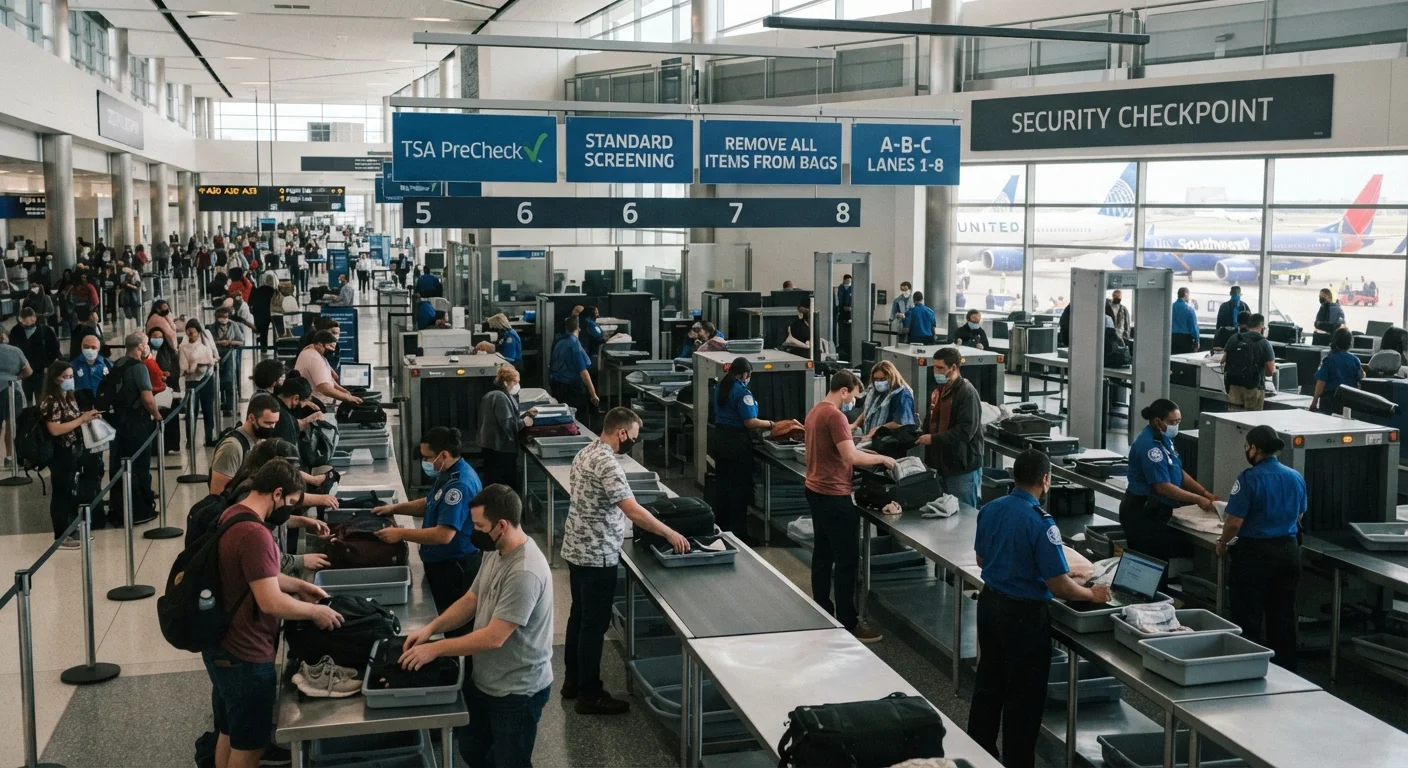
Standard TSA screening is the baseline experience every air traveler in the U.S. encounters unless enrolled in a trusted traveler program. At a standard checkpoint, you'll remove your shoes, belt, and jacket, pull out laptops and liquids, and place everything on the conveyor belt to pass through an X-ray scanner. Full-body imaging scanners are common, and a pat-down may be requested if the scanner flags something.
Wait times vary dramatically depending on the airport, time of day, and season. There's no pre-vetting involved - every passenger in this lane is processed with the same level of scrutiny regardless of their travel history. For the occasional flyer, this process is simply part of the airport routine. But for frequent travelers, the cumulative time adds up quickly.
Standard screening also applies at international entry points on the customs and immigration side - something that neither TSA PreCheck nor Global Entry entirely eliminates, though Global Entry dramatically reduces the friction.
TSA PreCheck: Faster Domestic Security, Same Day
TSA PreCheck is a program run by the Transportation Security Administration that allows pre-vetted travelers to use expedited security lanes at participating U.S. airports. The practical benefits are real: you keep your shoes, belt, and light jacket on, laptops and compliant liquids stay in your bag, and you move through a dedicated lane that typically has shorter queues.
To enroll, you'll complete an online application, pay a non-refundable fee, and attend an in-person appointment at an enrollment center for fingerprinting and identity verification. If approved, you receive a Known Traveler Number (KTN) to enter when booking flights. Membership is valid for five years.
Enter Your KTN When Booking - Not After
Your Known Traveler Number needs to be linked to your reservation at the time of booking for PreCheck to appear on your boarding pass. Adding it afterward isn't always possible depending on the airline, and the window to update a reservation may close before departure. Make it a habit to enter your KTN as part of the initial booking process, not as an afterthought.
Participation depends on both your airline and the airport. Most major U.S. carriers participate, but always confirm your KTN is attached to your reservation before arriving at the airport. A missing KTN means you'll be routed through standard screening regardless of your enrollment status.
Importantly, TSA PreCheck only applies to the security screening side of travel. It does not help at customs or passport control when returning from abroad. For that, you'd need Global Entry.
Global Entry: The Broader Program That Bundles PreCheck
Global Entry is administered by U.S. Customs and Border Protection (CBP) and is designed for international travelers re-entering the United States. At participating airports, approved members use automated kiosks to scan their passport or U.S. permanent resident card, submit fingerprints, and answer customs declaration questions - bypassing the standard customs inspection line entirely.
The application process is more involved than PreCheck. You'll complete a background check, submit an online application through the Trusted Traveler Programs (TTP) portal, and attend a mandatory in-person interview with a CBP officer - often scheduled at an airport enrollment center. Processing times can run several weeks to several months depending on demand, so planning ahead matters.
Global Entry membership automatically includes TSA PreCheck access, making it the more comprehensive option for anyone who travels internationally with regularity. The fee is higher than PreCheck alone, but the combined value is significant. Some credit cards cover the application fee as a benefit - worth checking before applying, though this is a general financial consideration and not a product recommendation.
For travelers planning international trips, the differences between domestic and international trip planning extend well beyond which security lane you use, and Global Entry is just one piece of that larger puzzle.
| Standard Screening | TSA PreCheck | Global Entry | |
|---|---|---|---|
| Who administers it | TSA | TSA | U.S. Customs and Border Protection |
| Application required | No | Yes - online + in-person | Yes - online + interview |
| Expedited domestic security | No | Yes | Yes (included) |
| Expedited customs re-entry | No | No | Yes |
| Membership duration | N/A | 5 years | 5 years |
| Shoes/laptop removal required | Yes | No | No (for security) |
| Background check | No | Yes | Yes |
Eligibility, Limitations, and What to Verify
Both programs require U.S. citizenship, lawful permanent residency, or citizenship of certain other countries for Global Entry (which has partnerships with several nations). Criminal history, immigration violations, or customs infractions can disqualify an applicant - approval is not guaranteed for anyone.
Global Entry does not guarantee entry into the United States. CBP officers retain the right to pull any traveler aside for additional screening, regardless of membership status. Similarly, TSA PreCheck does not guarantee expedited screening on every single trip - TSA uses unpredictable security measures, which means PreCheck members are occasionally redirected to standard lanes.
Before any international trip, always verify your documentation requirements separately. Our pre-trip safety and document checklist covers passports, copies, and other essentials to confirm before leaving home. And if you're traveling abroad, understanding visa requirements and common misconceptions is equally important - Global Entry doesn't substitute for proper visa documentation.
If you're still in early trip planning mode, running through a pre-booking checklist can help you decide whether enrolling in a trusted traveler program makes sense for your specific itinerary before you commit to the application process.
The content on this site is provided for informational purposes only and should not be considered a substitute for professional advice. While we strive to provide accurate and up-to-date information, we make no guarantees regarding its completeness or accuracy. Always consult a qualified professional for advice specific to your circumstances before making any decisions.