

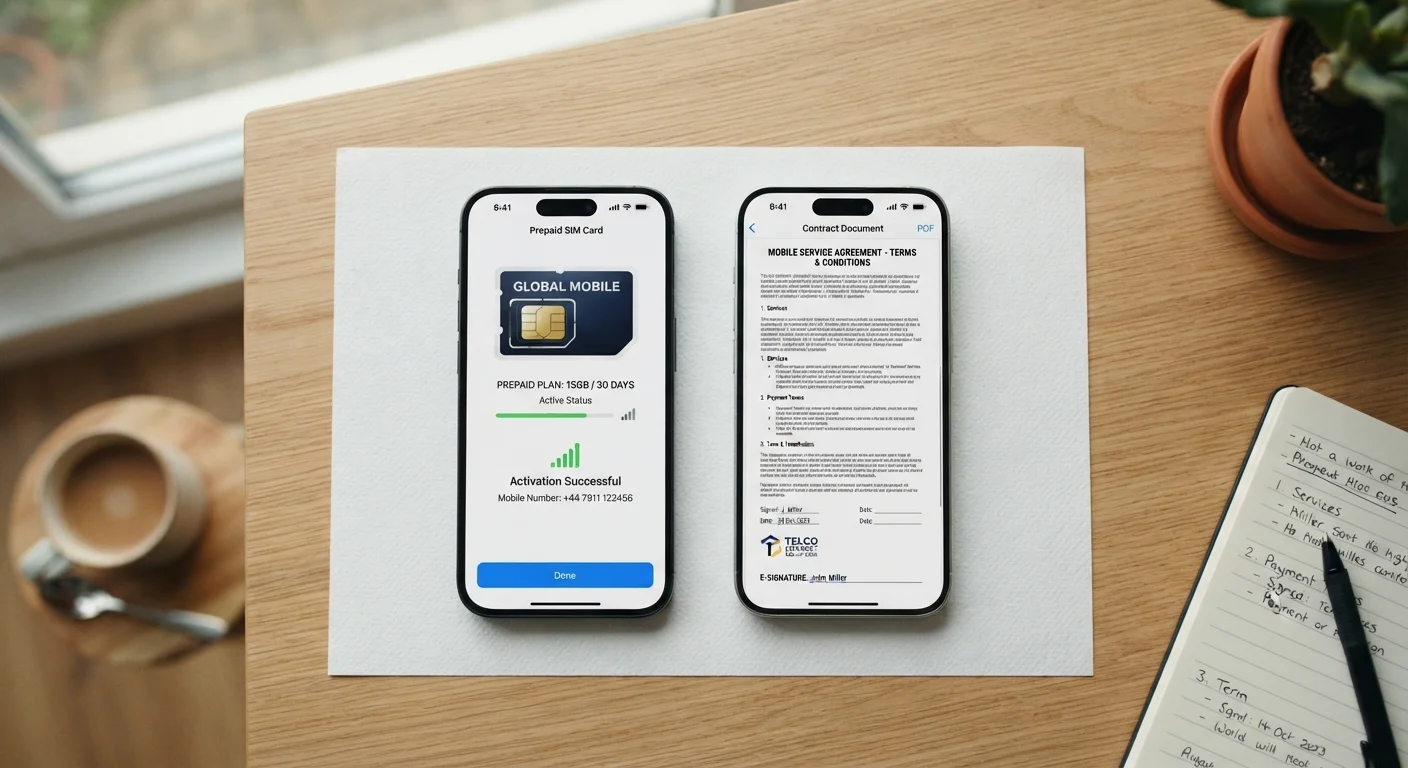
Option A
Prepaid Phone Plans
Pay-first flexibility with no credit check required.
Best for: Consumers who want cost control, no long-term commitment, and straightforward billing.
Option B
Postpaid Phone Plans
Pay-later service with broader device and feature access.
Best for: Consumers who want premium device financing, family account management, and consistent service perks.
The Core Structural Difference
The most fundamental distinction between prepaid and postpaid is timing: prepaid plans require payment before service is activated for each billing cycle, while postpaid plans bill you after you've used the service, typically on a monthly invoice. Everything else - pricing structures, credit requirements, network priority - flows from that single operational difference.
Prepaid customers load a set amount of service (data, minutes, or a flat monthly rate) onto their account in advance. When that allotment runs out or expires, service pauses until the account is replenished. Postpaid customers use service continuously and receive a bill summarizing charges, taxes, and any applicable fees at the end of the billing period.
Understanding this distinction matters because it shapes every other aspect of how each plan type works - from how carriers assess your eligibility to how much priority your data traffic receives. For a deeper look at the specific language carriers use to describe these structures, see what wireless plan fine print is actually telling you.
| Criterion | Prepaid | Postpaid |
|---|---|---|
| Payment timing | Pay before service activates | Pay after service is used |
| Credit check required | Generally no | Typically yes |
| Network priority | Lower during congestion | Higher during congestion |
| Device financing | Rarely available | Commonly available |
| Early exit flexibility | No termination fees | May owe device balance |
| Family account management | Limited, mostly individual | Consolidated billing available |
| Billing predictability | Fixed upfront amount | Variable monthly invoice |
Credit, Eligibility, and Account Control
Postpaid accounts extend credit to customers - the carrier provides service now and trusts you'll pay later. As a result, most carriers run a credit check when you open a postpaid account. A poor or thin credit history can result in a deposit requirement or outright denial.
Prepaid accounts operate on no-credit-extended terms. Because you pay before using the service, carriers have no financial exposure and typically require no credit check. This makes prepaid a practical option for people with limited credit history, those rebuilding after financial difficulty, or anyone who simply prefers not to authorize a credit inquiry.
~40%
U.S. wireless subscribers on prepaid
Industry analysts have estimated that prepaid accounts represent a significant and growing share of total U.S. wireless subscriptions, reflecting demand for no-contract flexibility.
0
Credit checks typically required for prepaid
Prepaid carriers generally do not run credit inquiries, making these plans accessible to a wider range of customers regardless of credit history.
Account control also differs in a less-discussed way: postpaid family plans consolidate multiple lines under one account holder, who controls the billing and - depending on carrier settings - can monitor data usage across lines. Prepaid accounts are almost always individual, which may offer more privacy but less administrative convenience. For a fuller picture of the trade-offs in shared billing arrangements, the family phone plans trade-offs article covers what carriers often don't advertise upfront.
Network Priority and Data Behavior
A frequently overlooked difference is how carriers prioritize data traffic. On most major U.S. networks, postpaid customers typically receive higher priority than prepaid customers during periods of network congestion. This is spelled out in carrier documentation but rarely emphasized in marketing materials.
What this means practically: during peak usage times in crowded areas - stadiums, urban centers, major events - prepaid customers on the same physical network may experience slower data speeds than postpaid subscribers. The gap varies by carrier and location and may be unnoticeable under normal conditions, but it is a structural difference built into how networks manage traffic loads.
Additionally, data behavior at plan limits differs. Prepaid plans commonly throttle or cut data once the allotment is exhausted; postpaid plans may continue data at reduced speeds or charge overage fees, depending on the plan structure. Reviewing how a specific plan handles data at the limit is a key step before committing - a framework for that kind of audit is outlined in questions to answer before committing to any phone plan.
Device Access, Flexibility, and Cost Structure
Postpaid plans dominate the carrier device financing landscape. If you want to spread the cost of a new flagship phone over 24 or 36 monthly installments through your carrier, that option is almost exclusively available through postpaid accounts. Carrier trade-in promotions, installment discounts, and upgrade programs are similarly postpaid-centric.
Prepaid customers typically need to purchase a compatible unlocked device outright or use a carrier-sold prepaid handset. While upfront cost is higher, they avoid installment agreements that can create financial entanglement if you want to switch carriers mid-cycle.
On the flexibility dimension, prepaid plans have a structural advantage: there are no early termination fees, no device payoff balances to settle before switching, and no annual contracts. Month-to-month postpaid plans also lack termination fees, but if you've accepted device financing through the carrier, leaving early generally means paying off the remaining device balance in full.
Some plan features marketed heavily on both plan types add less value in practice than they appear to. Features that sound great but rarely matter is worth reviewing before letting perks drive your decision. Ultimately, matching a plan to how you actually use your phone - not how carriers describe ideal usage - is the more reliable approach, as explored in matching a plan to how you use your phone.
MVNO Plans Blur the Lines
Many lower-cost carriers are Mobile Virtual Network Operators (MVNOs) - companies that lease network access from major carriers and resell it, often as prepaid service. MVNOs use the same physical towers as their host networks but are typically subject to lower network priority. This means the network quality experience may differ from what you'd get on the host carrier's own postpaid plan, even though the underlying infrastructure is the same.
The content on this site is provided for informational purposes only and should not be considered a substitute for professional advice. While we strive to provide accurate and up-to-date information, we make no guarantees regarding its completeness or accuracy. Always consult a qualified professional for advice specific to your circumstances before making any decisions.