

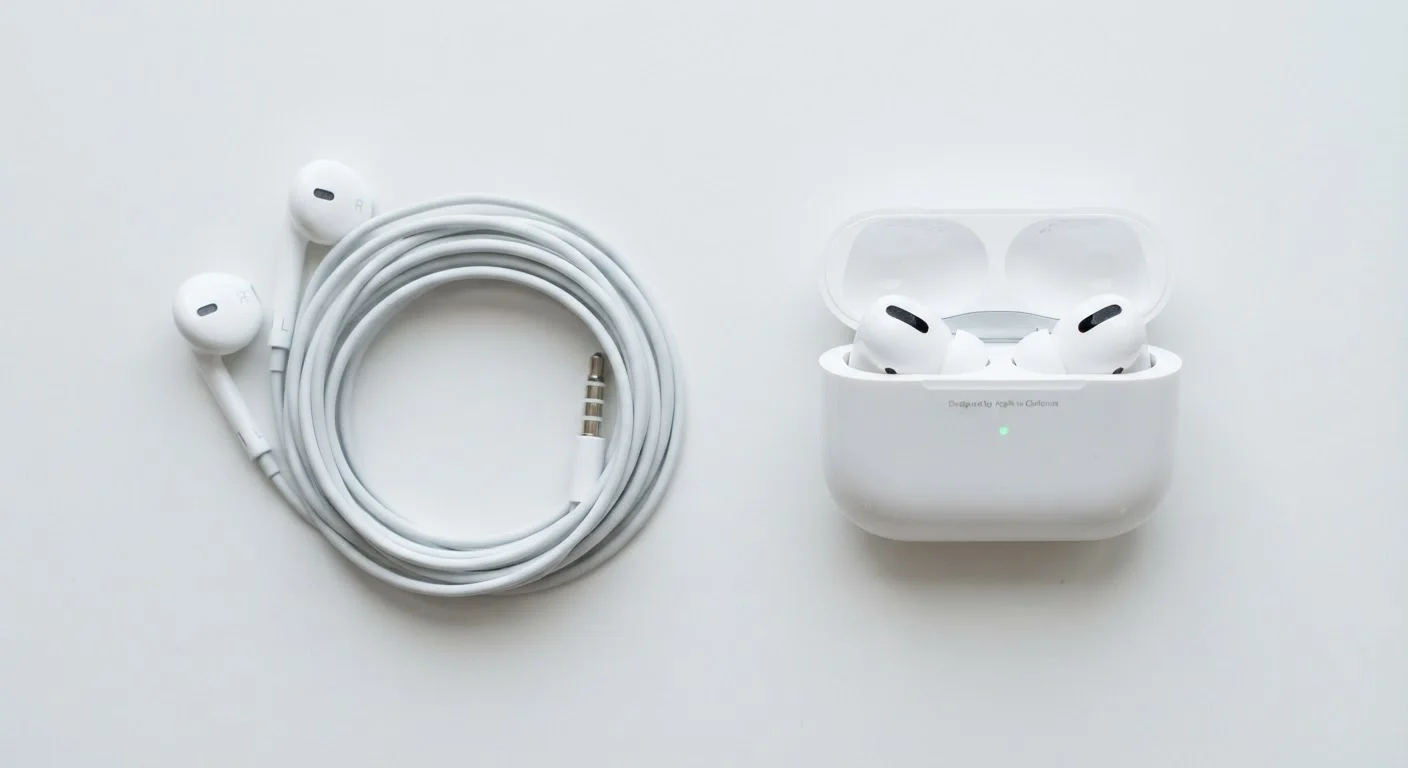
Option A
Wired Earbuds
The reliable, plug-and-play audio workhorse.
Best for: Listeners who prioritize consistent audio quality, zero latency, and no charging dependency.
Option B
Wireless Earbuds
The untethered, feature-rich modern option.
Best for: Active users and commuters who value freedom of movement and smart device integration.
The Core Technical Differences
The cable isn't just a physical inconvenience - it's also an audio pathway. Wired earbuds receive an analog or digital signal directly from the source device, converting it to sound with no intermediate transmission step. Wireless earbuds, by contrast, receive audio via Bluetooth, which requires the signal to be compressed, transmitted wirelessly, and then decoded at the earbud end.
This compression process is governed by a codec - a set of encoding and decoding rules. Common codecs include SBC (the baseline standard), AAC (widely used with Apple devices), and aptX or LDAC (higher-quality options found on Android and select devices). The codec your earbuds and device mutually support determines how much audio data is preserved. In practice, most listeners cannot distinguish Bluetooth audio from wired under everyday conditions, but the gap becomes more noticeable on high-resolution audio files or with audiophile-grade source material.
| Criterion | Wired Earbuds | Wireless Earbuds |
|---|---|---|
| Audio latency | Near-zero | 40-200ms (codec-dependent) |
| Audio compression | None (direct signal) | Bluetooth codec required |
| Battery required | No | Yes (5-8 hrs typical) |
| Long-term durability | No battery degradation | Battery capacity decreases over time |
| Advanced features (ANC, touch) | Rarely included | Common in mid-range models |
| Freedom of movement | Limited by cable | Full range of motion |
| Typical upfront cost | Lower for equivalent audio | Higher due to wireless hardware |
Latency - the delay between a sound being produced and you hearing it - is another concrete difference. Wired connections have near-zero latency. Bluetooth introduces a delay typically ranging from 40 to 200 milliseconds depending on the codec and device. For music listening, this is imperceptible. For video watching or gaming, it can cause audio and visuals to fall slightly out of sync, which some users find distracting.
Battery, Longevity, and Hidden Costs
Wireless earbuds introduce a component that wired earbuds entirely lack: a rechargeable battery. Most wireless earbuds deliver between 5 and 8 hours of playback per charge, with the accompanying case providing additional top-ups. This is adequate for most daily use, but it introduces a dependency - if you forget to charge them, you have no audio.
5-8 hrs
Typical wireless earbud playback per charge
Most mainstream wireless earbuds achieve this range under moderate volume conditions, per manufacturer specifications.
40-200ms
Bluetooth audio latency range
Latency varies significantly by Bluetooth codec; aptX Low Latency targets under 40ms while standard SBC can reach 200ms.
~500 cycles
Estimated charge cycles before battery capacity drops
Lithium-ion batteries commonly retain around 80% capacity after 300-500 full charge cycles, a general industry benchmark.
Battery degradation is also a long-term consideration. Lithium-ion batteries lose capacity over hundreds of charge cycles. After two to three years of regular use, a wireless earbud's battery life may drop noticeably from its original rating. Many wireless earbuds have non-replaceable batteries, which can effectively limit the usable life of the product.
Wired earbuds have no such limitation. A well-built pair with a durable cable can last many years. The main failure points are physical - cable fraying near the jack or ear housing - rather than chemical degradation. For readers thinking about long-term value, this distinction matters. It's a dynamic similar to what we explore in wired vs. wireless home networking, where the cabled option often wins on durability and consistency even when the wireless alternative is more convenient.
Features, Fit, and Everyday Usability
Wireless earbuds have driven a wave of feature development that wired models rarely match at similar price points. Active Noise Cancellation (ANC) - which uses microphones to detect and counteract ambient sound - is now common in mid-range wireless earbuds. Transparency modes, touch controls, automatic ear detection (pausing when removed), and companion apps for EQ tuning are also widespread in wireless form factors.
Wired earbuds, by contrast, are simpler by design. They typically include an inline remote for basic playback and call control, but advanced features require no power because they don't exist - the cable does the job. This simplicity is a genuine advantage for users who want reliability without setup friction. Plug in, press play.
Fit and comfort also differ in subtle ways. Wireless earbuds tend to be heavier due to their internal components and battery, which can matter during extended wear. The absence of a cable eliminates the physical pull that causes some wired earbuds to shift or fall out during movement - a key reason wireless options are favored for exercise.
When deciding between these formats, it's worth thinking about how your earbud choice fits into your broader device setup. Readers who are also weighing connectivity decisions might find our look at prepaid vs. postpaid phone plans useful for thinking about how device and plan choices interact.
The content on this site is provided for informational purposes only and should not be considered a substitute for professional advice. While we strive to provide accurate and up-to-date information, we make no guarantees regarding its completeness or accuracy. Always consult a qualified professional for advice specific to your circumstances before making any decisions.