

Start here
What an Electrical Panel Actually Does
Build knowledge
Anatomy of a Breaker Panel
Spot trouble
Warning Signs Worth Knowing
Take safe action
What You Can Safely Do Yourself
Next step
Talking to an Electrician With Confidence
What an Electrical Panel Actually Does
Utility power arrives at your home as a single high-voltage feed. Your electrical panel - also called a breaker box or load center - receives that feed and splits it into smaller, manageable circuits that run to your outlets, lights, appliances, and HVAC equipment. Think of it as a traffic hub: one main road feeds dozens of smaller streets, each carrying the appropriate load for its destination.
Every circuit is protected by a breaker rated for a specific amperage. When a circuit draws more current than its breaker allows, the breaker "trips" - switching off automatically to prevent overheating and fire. This is the panel's core safety function, and understanding it changes how you interpret everyday electrical events in your home.
Circuit breaker
A resettable switch inside your panel that automatically cuts power to a circuit when it detects more current than the circuit is rated to carry safely.
Amperage (amps)
The measure of how much electrical current flows through a wire or circuit. Each breaker and wire is rated for a maximum amperage to prevent overheating.
Single-pole breaker
A standard one-switch breaker that controls a 120-volt circuit - used for most outlets and lighting in a home.
Double-pole breaker
Two linked breaker switches that together control a 240-volt circuit, typically used for large appliances like dryers, electric ranges, and central air conditioners.
Ground fault
An unintended path that electricity takes to the ground - often through a person or water - which can cause shock or fire. GFCI outlets and certain breakers are designed to detect and stop this quickly.
Service entrance
The wires bringing utility power into the top of your electrical panel. These wires remain live even when the main breaker is switched off, making the area extremely dangerous without utility shutoff.
Anatomy of a Breaker Panel
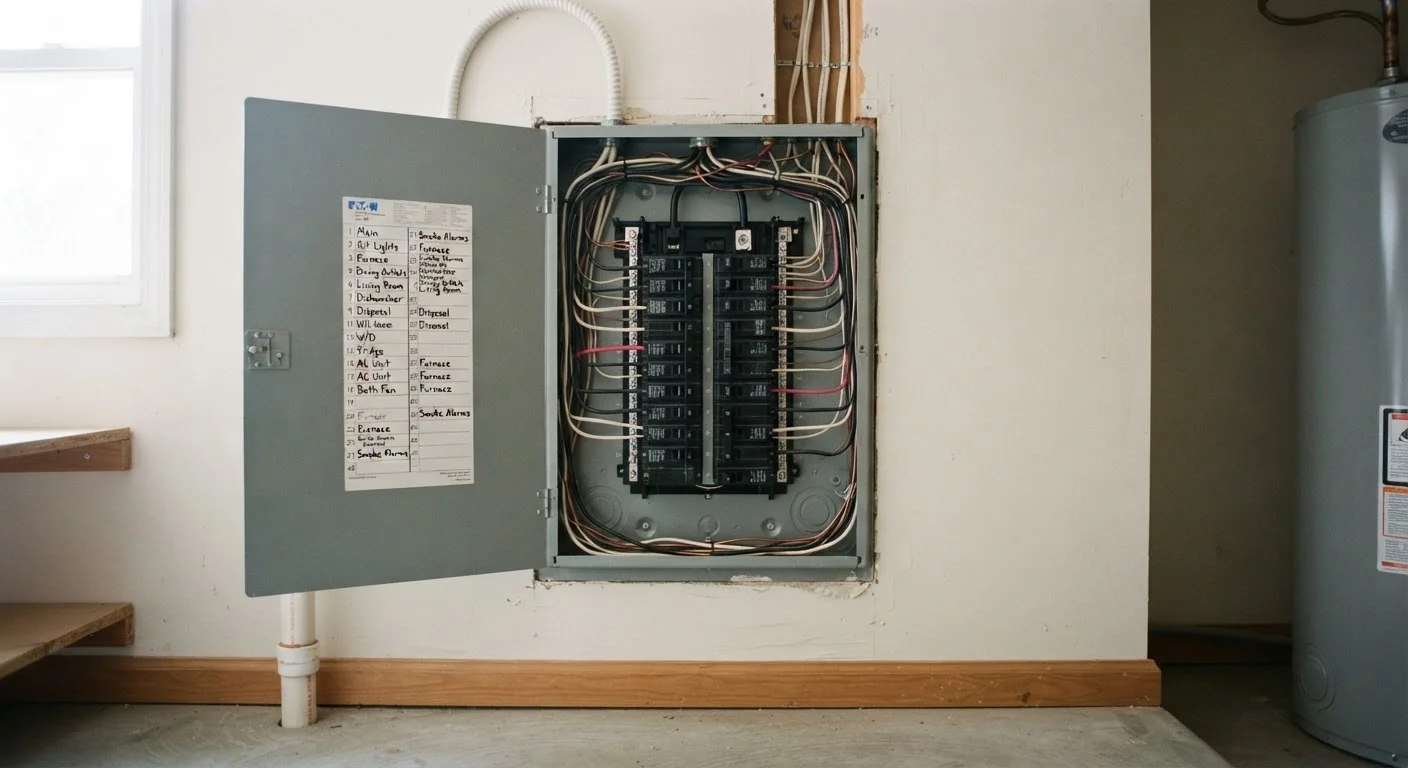
Open the panel door (the outer metal cover, not the inner dead-front cover) and you'll typically see:
- Main breaker: A large double-pole breaker at the top rated for the panel's total amperage - commonly 100A or 200A. Switching it off cuts power to every circuit in the home.
- Branch circuit breakers: The rows of individual breakers below, each protecting one circuit. Single-pole breakers (one switch) handle 120-volt circuits; double-pole breakers (two switches linked together) handle 240-volt circuits for dryers, ranges, and central air.
- Neutral and ground bus bars: Metal strips along the sides where white (neutral) and bare copper (ground) wires terminate. These complete circuits and provide a safe path for fault current.
- Directory card: The labeled map inside the door identifying which breaker controls which area. Keeping this current is genuinely useful in an emergency.
If you're evaluating a home before purchase, the electrical panel is one of the key inspection points worth examining. Our home tour checklist covers what to look for beyond cosmetics.
Warning Signs Worth Knowing
Your panel communicates problems in recognizable ways. None of the following should be ignored:
- Breakers that trip frequently - occasional tripping is normal under heavy load, but regular or unprovoked tripping suggests a wiring fault or an undersized circuit.
- Burning or melting smell near the panel - this is an urgent warning sign. Do not delay calling a licensed electrician.
- Scorch marks or discoloration on or around the panel door or individual breakers.
- Buzzing or crackling sounds from inside the panel cabinet.
- Lights that flicker or dim when large appliances cycle on - this can point to a loose connection or capacity issues.
- A warm panel door - some warmth is normal, but heat that's noticeable to the touch warrants professional evaluation.
Never Open the Inner Panel Cover
The inner dead-front cover - the second layer inside the panel - conceals live wiring that can cause serious injury or death even when the main breaker is off, because the service entrance conductors remain energized. Opening this cover is strictly a task for licensed electricians. If you notice warning signs that seem to originate inside the panel, keep the cabinet closed and call a professional promptly.
Planning a renovation? Electrical capacity should be one of your first checklist items. Our room-by-room renovation readiness checklist walks through what to verify before work begins.
What You Can Safely Do Yourself
There is a clear line between what homeowners can reasonably handle and what requires a licensed electrician. On the safe side of that line:
- Resetting a tripped breaker: Push it firmly to OFF, then back to ON. If it trips again, stop and call a professional.
- Labeling your circuits: Switch breakers off one at a time and note what loses power. A well-labeled directory card is a real safety asset.
- Locating your main shutoff: Know where the main breaker is before you ever need it in an emergency.
- Visual inspection of the exterior: Check for rust, moisture intrusion around the panel, or obvious physical damage to the cabinet.
Working inside the panel - touching wiring, replacing breakers, or adding circuits - should always be performed by a licensed electrician. Even with the main breaker off, the service entrance wires above it remain energized. For a broader look at when a project exceeds the DIY threshold, see signs a repair job needs a licensed professional.
Label Your Panel Before You Need It
Take 30 minutes on a weekend to map every circuit in your home and update the directory card inside your panel door. Use a simple plug-in lamp to confirm which breaker controls each outlet. A complete, accurate label map is one of the most practical things you can do for safety and emergency preparedness.
Talking to an Electrician With Confidence
The goal of understanding your panel isn't to do the work yourself - it's to be a more informed participant when you do call a professional. When you contact an electrician, be ready to describe:
- The panel's main breaker amperage (printed on the breaker itself)
- Approximately how old the home is and whether the panel appears original
- Specific symptoms: which circuit trips, under what conditions, and how often
- Any smells, sounds, or visible signs you've noticed
This kind of detail helps an electrician prioritize, diagnose faster, and give you a more accurate estimate. It also signals that you're an engaged homeowner - which tends to result in clearer communication from service providers. Much like understanding a repair invoice in any trade, knowing the vocabulary makes the conversation more productive.
This article is for general informational purposes only. Electrical work involves serious safety risks. Always consult a licensed, qualified electrician before performing any work on your home's electrical system, and verify local permit and code requirements with your municipality.
Frequently Asked Questions
Common indicators include breakers that trip repeatedly, the panel feeling warm to the touch, flickering lights throughout the home, or a panel that is more than 25-40 years old. Certain older panel types have known reliability concerns that a licensed electrician can assess. Always have a professional evaluate before deciding on replacement.
Resetting a tripped breaker is generally considered safe for homeowners. Switch it firmly to the OFF position first, then back to ON. If it trips again immediately or repeatedly, stop and call an electrician - repeated tripping signals an underlying issue that needs professional diagnosis.
Fuse boxes use single-use fuses that melt and must be replaced when a circuit is overloaded. Breaker panels use resettable switches. Most homes built after the 1960s have breaker panels; fuse boxes in older homes may warrant an upgrade discussion with a licensed electrician.
Most modern homes are served by a 100-amp or 200-amp main panel. Larger homes or those with electric vehicles, central air conditioning, or high-demand appliances often benefit from 200 amps. A licensed electrician can assess whether your current capacity meets your household's needs.
A breaker that trips again immediately after resetting usually indicates a short circuit, a ground fault, or a genuinely overloaded circuit. Do not continue resetting it. Unplug devices on that circuit and call a licensed electrician to investigate the root cause.
Yes - a clearly labeled panel is a meaningful safety and convenience tool. You can map circuits by switching breakers off one at a time and noting which outlets and fixtures lose power. Write labels directly on the directory card inside the panel door.
The content on this site is provided for informational purposes only and should not be considered a substitute for professional advice. While we strive to provide accurate and up-to-date information, we make no guarantees regarding its completeness or accuracy. Always consult a qualified professional for advice specific to your circumstances before making any decisions.