

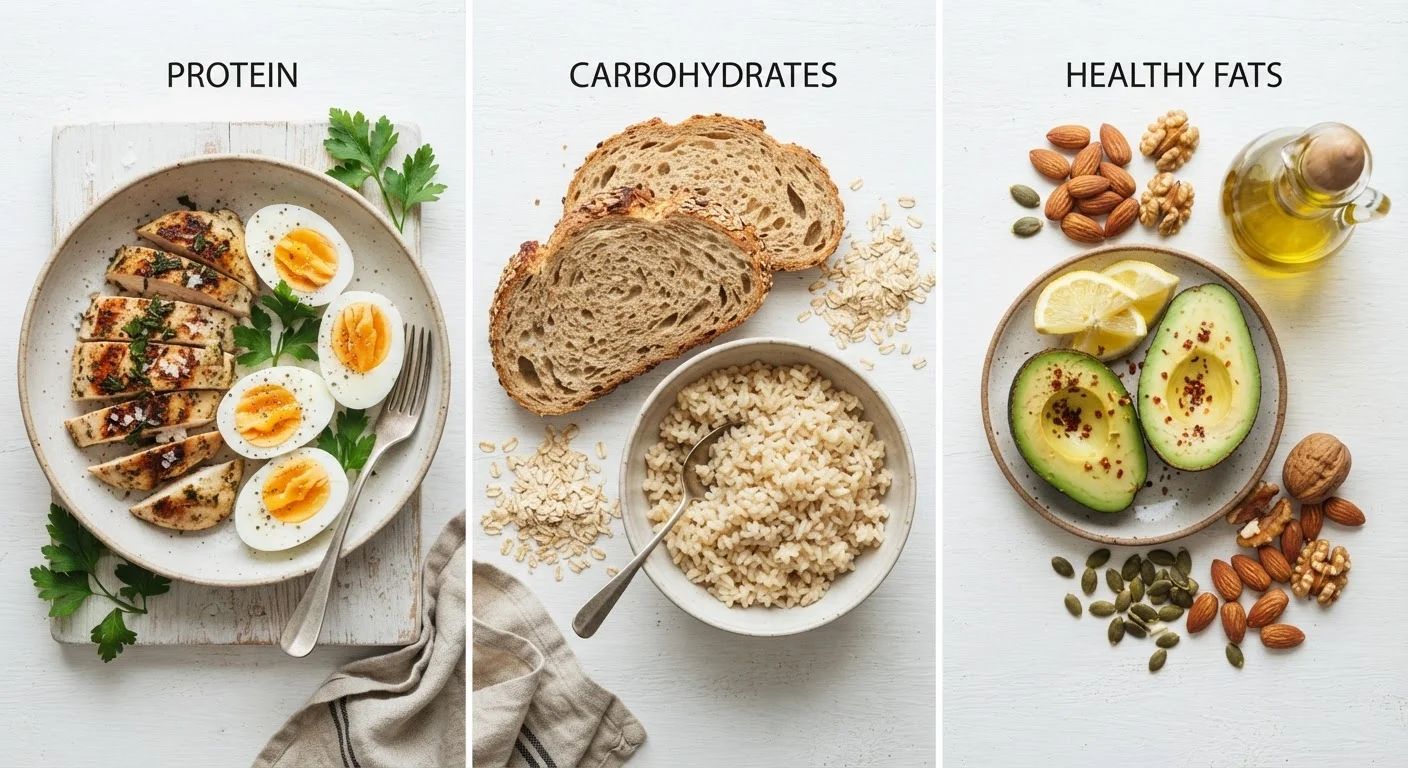
Why Macronutrients Matter
Every food you eat contains some combination of three macronutrients: protein, carbohydrates, and fat. These are called "macro" nutrients because your body needs them in relatively large amounts - unlike vitamins and minerals, which are required in much smaller quantities. (For a look at those micronutrients, see our plain-language micronutrient reference.)
Understanding what each macronutrient does - and why your body needs all three - helps you evaluate nutrition claims more critically and make food choices you can sustain. None of the three are inherently harmful; cutting any of them entirely almost always creates trade-offs.
| Calories per gram - Protein | 4 calories (Established dietary science standard) |
| Calories per gram - Carbohydrates | 4 calories (Established dietary science standard) |
| Calories per gram - Fat | 9 calories (Established dietary science standard) |
| Essential amino acids | 9 (must come from food) (National Institutes of Health) |
| Fat-soluble vitamins requiring dietary fat for absorption | A, D, E, and K (Established nutritional science) |
| Trans fats in U.S. food supply | Largely prohibited (FDA final rule, effective 2018) |
Protein: Structure, Repair, and More
Protein is the body's primary building material. It forms muscle tissue, enzymes, hormones, antibodies, and the structural scaffolding of skin, hair, and nails. Every cell in your body contains protein.
When you eat protein, your digestive system breaks it into smaller units called amino acids. There are 20 amino acids in total; nine of these are essential, meaning your body cannot produce them and must obtain them from food. Foods that contain all nine essential amino acids in adequate amounts - such as eggs, meat, fish, dairy, soy, and quinoa - are called complete proteins. Most plant proteins are incomplete individually but can complement each other when varied across meals.
Protein also contributes to satiety. Because it takes longer to digest than simple carbohydrates, protein-containing meals tend to keep people feeling fuller for longer. Each gram of protein provides 4 calories of energy, though the body prefers to use carbohydrates and fat for fuel first, reserving protein for structural roles.
Macronutrient
Any of the three main classes of nutrients - protein, carbohydrates, and fat - that the body needs in relatively large amounts to function. Each provides calories and serves distinct physiological roles.
Amino acids
The building blocks that make up proteins. Of the 20 amino acids, nine are considered essential because the body cannot produce them on its own and must get them from food.
Complete protein
A protein source that contains all nine essential amino acids in amounts sufficient to support the body's needs. Examples include eggs, meat, fish, dairy, soy, and quinoa.
Glucose
A simple sugar that is the body's primary fuel source, especially for the brain and muscles. Carbohydrates are broken down into glucose during digestion.
Unsaturated fat
A type of dietary fat - found in plant oils, nuts, avocados, and fatty fish - that remains liquid at room temperature and is generally associated with favorable cardiovascular health outcomes in research.
Saturated fat
A type of fat found mainly in animal products and some tropical oils that is solid at room temperature. Current dietary guidelines recommend limiting intake, though research on its specific effects continues to evolve.
Carbohydrates: The Body's Preferred Fuel
Carbohydrates are the body's first-choice energy source. When digested, carbs break down into glucose, which cells use to power nearly every function - from muscle contractions to brain activity. The brain is particularly dependent on glucose and has a limited ability to run on alternative fuels for extended periods.
Not all carbohydrates behave the same way in the body. Simple carbohydrates (sugars) digest quickly and raise blood glucose rapidly. Complex carbohydrates - found in whole grains, legumes, and vegetables - digest more slowly, providing more gradual energy and typically carrying more fiber, vitamins, and minerals. Fiber, a type of carbohydrate that humans cannot fully digest, plays a major role in digestive health and blood sugar regulation. Learn more in our article on fiber and why most Americans under-eat it.
Like protein, carbohydrates provide 4 calories per gram. The idea that carbohydrates are categorically fattening is not supported by the broader evidence base - as our nutrition myths article examines in detail.
Fat: Energy Reserve, Insulation, and Nutrient Absorption
Dietary fat is the most calorie-dense macronutrient, providing 9 calories per gram - more than twice that of protein or carbohydrates. That density makes fat a critical long-term energy reserve, but fat does far more than store energy.
Fat is essential for absorbing fat-soluble vitamins: A, D, E, and K. Without adequate fat in a meal, your body cannot properly absorb these nutrients even if they're present in your food. Fat also cushions organs, helps regulate body temperature, supports cell membrane integrity, and is necessary for producing certain hormones.
The type of fat matters. Unsaturated fats - found in olive oil, avocados, nuts, and fatty fish - are associated with favorable cardiovascular outcomes in research. Saturated fats, found primarily in animal products and some tropical oils, remain a subject of ongoing nutritional science discussion; current dietary guidelines generally recommend limiting them. Trans fats (artificially produced through partial hydrogenation) are associated with negative health outcomes and are largely banned from the U.S. food supply.
Balance Over Elimination
The strongest dietary patterns studied - including Mediterranean-style eating and other whole-food-based approaches - share a common feature: they include all three macronutrients rather than eliminating one. The source and quality of each macronutrient tends to matter more than the precise ratio.
Reading a nutrition label can help you understand how macronutrients are distributed in the foods you eat. Our article on what the nutrition label is actually telling you walks through that information clearly. For practical day-to-day application, see our guide to building a balanced plate.
Individual macronutrient needs vary based on age, activity level, health status, and other factors. If you have specific dietary concerns or health conditions, a registered dietitian or your healthcare provider can offer guidance tailored to your situation.
This article is for general informational and educational purposes only and is not a substitute for professional medical or nutritional advice. Always consult a qualified healthcare professional before making significant changes to your diet.
The content on this site is provided for informational purposes only and should not be considered a substitute for professional advice. While we strive to provide accurate and up-to-date information, we make no guarantees regarding its completeness or accuracy. Always consult a qualified professional for advice specific to your circumstances before making any decisions.