

The Science of Stopping Distance
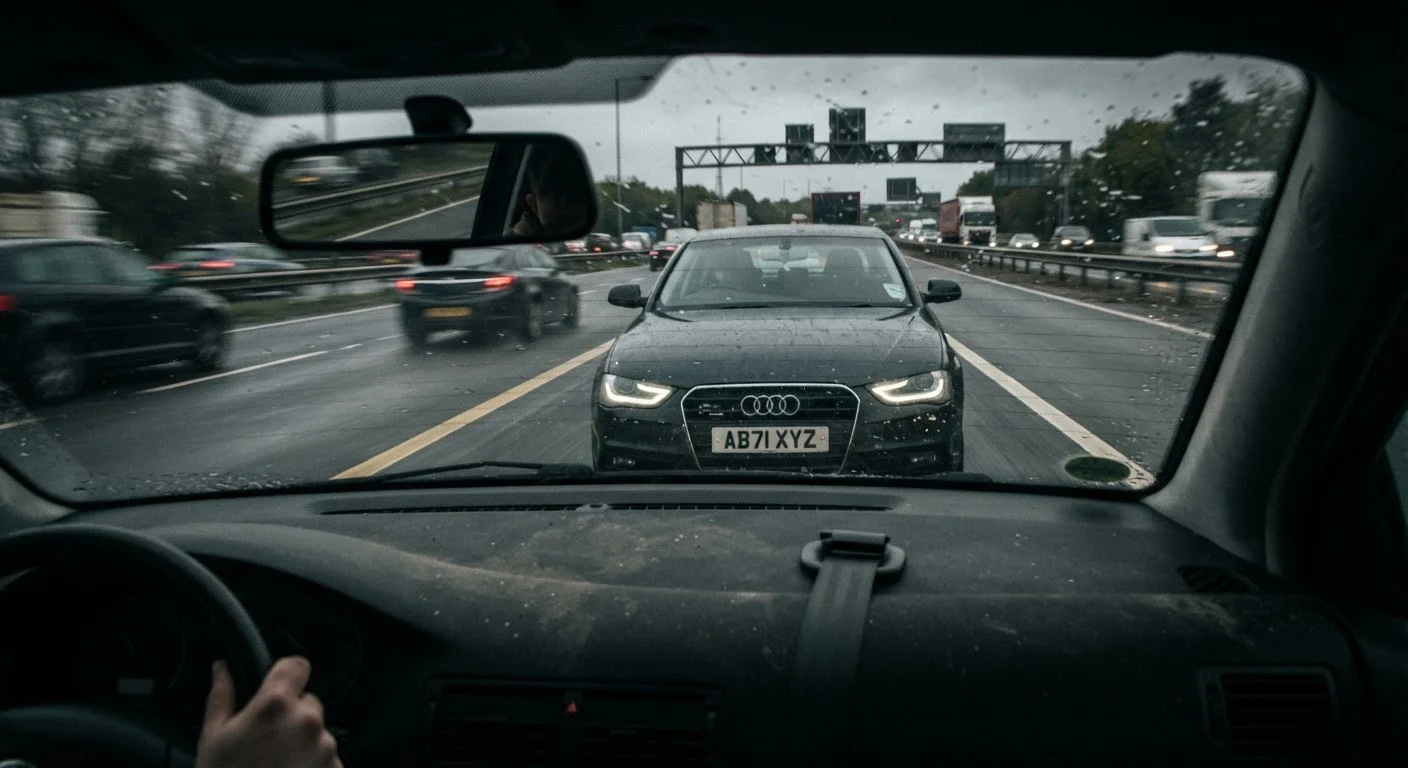
When drivers think about tailgating, they often focus on the gap they can see - the visible space between bumpers. But the real danger lives in physics, not perception.
Stopping distance is made up of two parts: reaction distance and braking distance. Reaction distance is how far your vehicle travels during the time between when your brain registers danger and your foot actually hits the brake. At 60 mph, even a swift reaction time of 1.5 seconds means your car has already traveled 132 feet - before you've slowed down at all. Braking distance then adds another 130-180 feet depending on road surface, tire condition, and vehicle weight.
Add those together, and a 60 mph stop can consume well over 260 feet. A driver following just one car length behind - roughly 15 feet - has essentially no margin for survival in a sudden stop scenario.
~29%
Of all U.S. crashes are rear-end collisions
According to NHTSA data, rear-end crashes represent one of the most frequent crash types on American roads, with following behavior cited as a key contributing factor.
264+ ft
Typical stopping distance at 60 mph
This estimate combines average reaction distance and braking distance on dry pavement for a standard passenger vehicle in good condition.
1-1.5 sec
Average human reaction time while driving
NHTSA and traffic safety researchers commonly use 1.5 seconds as a conservative benchmark for driver reaction time under normal alertness conditions.
525 ft
Stopping distance for a loaded semi-truck at 65 mph
The Federal Motor Carrier Safety Administration notes that fully loaded commercial trucks require significantly more stopping distance than passenger vehicles.
Wet or icy roads compound the problem dramatically. Water reduces tire friction, pushing braking distances 50-100% longer than on dry pavement. Yet many drivers maintain the same gap regardless of conditions.
How to Measure a Safe Following Distance
The 3-second rule is the most practical tool drivers have. Here's how it works: pick a fixed landmark - a road sign, a bridge, a tree. When the vehicle ahead passes it, count "one-thousand-one, one-thousand-two, one-thousand-three." If you pass the same landmark before you finish counting, you're following too closely.
Three seconds is the minimum for clear, dry roads in normal traffic. Safety experts and many state driver's manuals recommend extending that buffer substantially in the following situations:
- Rain or wet pavement: 4-6 seconds
- Heavy fog or low visibility: 5+ seconds
- Following a large truck or SUV: 4+ seconds (view obstruction adds risk)
- Fatigue or distraction: Increase your buffer - impaired alertness slows reaction time. See our guide on driver fatigue for how drowsiness affects driving judgment.
- Ice or snow: 8-10 seconds or more
Use a Landmark, Not a Bumper, as Your Marker
Avoid calibrating your gap by looking at the bumper of the car ahead - at speed, gaps close faster than they appear. Instead, practice the 3-second rule using roadside landmarks every time you drive. This turns safe following distance into a habit rather than a judgment call made under pressure.
Speed also changes the math considerably. This is why tailgating on a freeway is categorically more dangerous than the same gap on a city street - and why it pairs with speeding risks as a compounding hazard.
Why Tailgating Feels Normal - But Isn't
One reason tailgating persists is that it often doesn't feel dangerous in the moment. Inside a moving car, motion reference points are limited. Speed feels relative, and drivers tend to underestimate how quickly a gap collapses when the car ahead brakes hard.
Traffic psychology research also identifies "highway hypnosis" - a state of reduced vigilance on monotonous roads - as a factor that subtly degrades following distance judgment. This can interact with fatigue and distraction to make unsafe gaps feel routine.
There's also a social dimension. On congested highways, drivers sometimes follow closely to prevent others from merging ahead of them. This creates the illusion of efficiency while dramatically increasing crash risk for everyone in the lane. For a closer look at how lane changes become dangerous in dense traffic, see our guide on highway merging.
Tailgating is especially dangerous around vulnerable road users. A rear-end collision that pushes a car into a cyclist or pedestrian in an intersection can be catastrophic. The habits covered in our article on sharing the road connect directly to maintaining adequate spacing.
Legal Consequences and Fault in a Crash
Every U.S. state prohibits following too closely, typically using language requiring a "reasonable and prudent" distance given speed, traffic, and road conditions. Specific numerical minimums vary, but enforcement is consistent: a citation for following too closely can mean fines, license points, and increased insurance costs.
In the event of a rear-end collision, the driver who struck from behind is presumed at fault in most states. This presumption can be rebutted in limited circumstances - for example, if the lead driver brake-checked intentionally - but it's a difficult defense. Insurance consequences following an at-fault rear-end crash can be significant and long-lasting.
Brake-Checking Is Never a Safe Response
If you feel frustrated by a tailgater, it may be tempting to tap your brakes to signal them to back off. This is commonly called "brake-checking" and is both dangerous and potentially illegal. It can cause the vehicle behind you to collide with your car, and in some jurisdictions it can expose you to liability. The safest response is always to create space by changing lanes or gradually slowing to let the other driver pass.
It's worth noting that commercial drivers, including truck drivers operating under federal regulations, are held to strict following-distance standards. A fully loaded 80,000-pound semi requires far greater stopping distance than a passenger car - a reality that makes tailgating a large truck particularly hazardous, as the view ahead is blocked and the truck's brake performance is far less predictable under heavy loads.
Frequently Asked Questions
At highway speeds, a minimum 3-second gap between your front bumper and the vehicle ahead is the standard guidance for dry conditions. In adverse weather or behind large vehicles, extend that to at least 4-6 seconds. At 65 mph, 3 seconds translates to roughly 285 feet of space.
Yes. Every U.S. state has a law requiring drivers to maintain a 'reasonable and prudent' following distance, though exact wording varies. Violations can result in traffic citations, fines, and license points. In a crash, the following driver is typically found at fault.
Research in traffic psychology points to several factors: frustration with slower drivers, underestimation of stopping distance at speed, and the illusion that being close 'keeps traffic moving.' Many drivers also simply don't register how fast they're closing on a braking vehicle.
Do not brake-check the driver behind you - that escalates danger for everyone. Instead, signal and safely change lanes if possible, or gradually reduce speed to encourage them to pass. Stay calm and avoid engaging with the other driver.
No - 3 seconds is a dry-road minimum. In rain, the 3-second gap should expand to at least 4-6 seconds because wet roads significantly increase stopping distances. In ice or snow, some safety experts suggest 8-10 seconds or more.
Yes, significantly. A fully loaded semi-truck traveling at 65 mph can require up to 525 feet to stop - roughly double the distance of a passenger car. Driving closely behind a large truck also blocks your view of the road ahead, compounding the risk.
The content on this site is provided for informational purposes only and should not be considered a substitute for professional advice. While we strive to provide accurate and up-to-date information, we make no guarantees regarding its completeness or accuracy. Always consult a qualified professional for advice specific to your circumstances before making any decisions.