

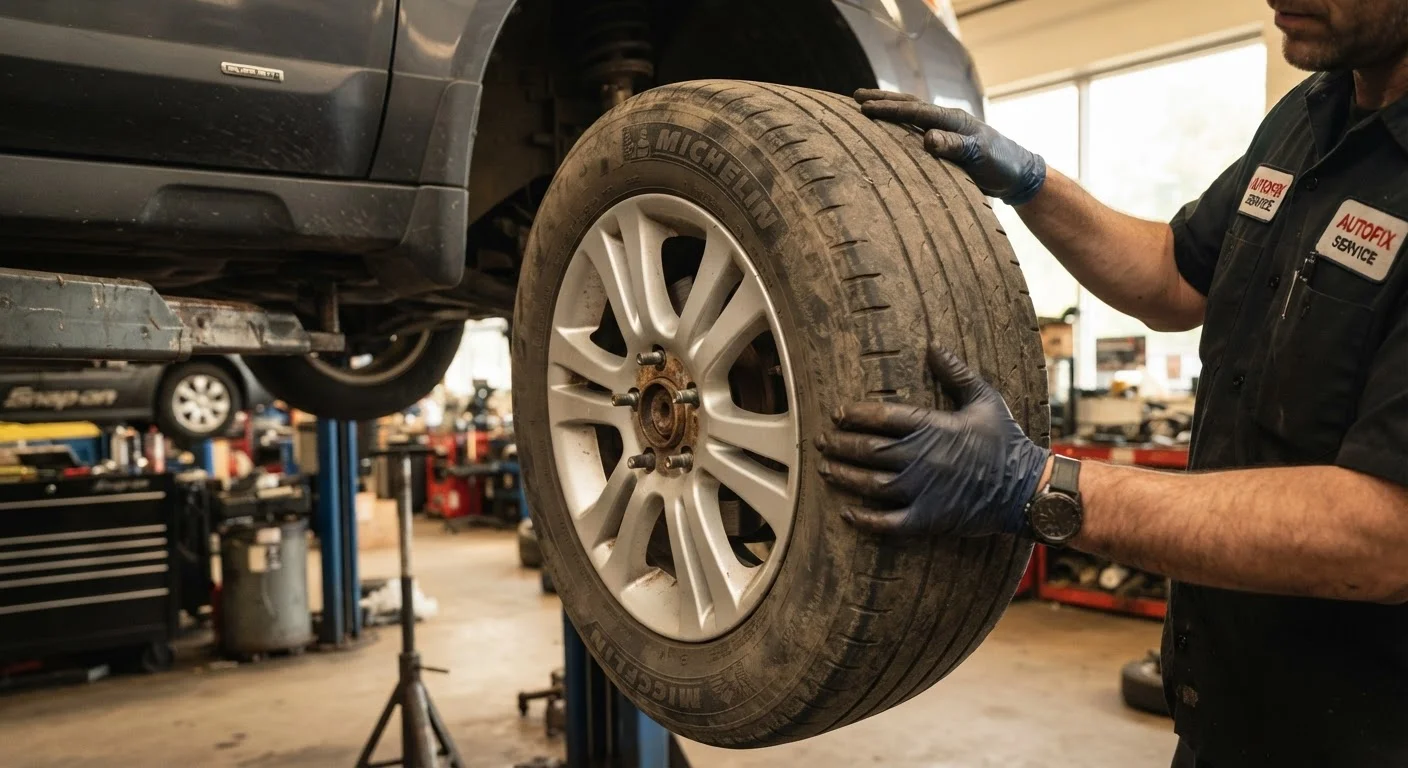
Why Tires Don't Wear Evenly on Their Own
Most drivers think of their four tires as doing the same job - rolling down the road. In reality, each wheel position subjects a tire to a distinct set of forces, and those forces add up over thousands of miles.
On a front-wheel-drive vehicle, the front tires bear a double burden: they deliver engine power to the pavement and handle steering input. They also absorb the majority of braking force. The result is that front tires on FWD cars can wear two to three times faster than the rear tires in the same period.
Rear-wheel-drive vehicles shift the power demand to the back, but the front tires still manage steering and most braking stress. And on all-wheel-drive platforms, each tire sees a unique combination of torque and cornering load depending on how the system manages power distribution at any given moment.
Beyond drivetrain layout, factors like vehicle weight distribution, suspension geometry, and even your regular driving routes - more left turns than right turns, frequent highway merging - create consistent, predictable wear patterns. None of these forces self-correct. Without intervention, uneven wear compounds with every mile. See also how tire pressure levels influence real-world driving costs - another variable that accelerates uneven wear when ignored.
2-3×
Faster front-tire wear on FWD vehicles vs. rear
Automotive engineers and tire manufacturers consistently document this disparity due to combined steering, braking, and propulsion demands on front tires.
5,000-7,500 mi
Typical recommended tire rotation interval
This range reflects guidance from major vehicle manufacturers and tire industry bodies, though specific vehicles may vary - always check your owner's manual.
2/32"
Maximum tread depth mismatch on many AWD systems
Many AWD manufacturers specify this tolerance across all four tires to avoid strain on differentials and transfer cases; exceeding it may void drivetrain warranties.
The Rotation Patterns and What They Accomplish
Tire rotation isn't random. Shops follow established patterns designed for specific drivetrain types, and using the wrong pattern can actually cause problems.
- Forward cross (common for FWD): Front tires move straight to the rear; rear tires cross to opposite front positions. This counters the heavy front-tire wear typical of FWD vehicles.
- Rearward cross (common for RWD and AWD): Rear tires move straight to the front; front tires cross to opposite rear positions.
- X-pattern: All four tires switch positions diagonally. Sometimes used on FWD vehicles with particularly aggressive front-tire wear.
- Side-to-side: Used only for vehicles with different-sized tires on front and rear axles (staggered fitment), common on performance cars.
Directional tires - those with a tread pattern designed to rotate in one specific direction - can only move front-to-rear on the same side of the vehicle, unless they're dismounted from the rim and remounted, which adds cost. Your tire sidewall or owner's manual will indicate if your tires are directional.
Check Your Owner's Manual First
Rotation interval and pattern recommendations vary by vehicle make, model, and tire type. Your owner's manual is the authoritative source for your specific vehicle - don't rely solely on general rules of thumb. If you've lost your manual, most automakers publish them online through their official websites.
What Skipping Rotation Actually Costs You
The financial case for rotation is straightforward. A set of quality all-season tires for a mid-size sedan can cost between $400 and $800 installed. A tire rotation at an independent shop typically runs $20 to $50, and many dealerships include it in prepaid maintenance packages.
When front tires on a FWD vehicle wear out prematurely, a driver faces a choice: replace just those two tires (creating a tread depth mismatch with the rear), or replace all four. Neither option is ideal. On AWD vehicles, manufacturers and drivetrain engineers generally recommend keeping all four tires within a narrow tread depth tolerance - sometimes as little as 2/32 of an inch across all four - to protect the AWD system from strain. Mismatched tread depths force the system's center differential or coupling to work overtime, and those components are expensive to repair.
Beyond direct cost, uneven wear affects safety in measurable ways. Tires with significantly different tread depths across an axle can behave differently under hard braking, pulling the vehicle to one side. In wet conditions, a tire with shallower tread evacuates water less efficiently, increasing hydroplaning risk.
This is one of those overlooked maintenance tasks that lead to expensive repairs - the cost of skipping it is invisible until it isn't.
A driver with a front-wheel-drive sedan skips rotation for 30,000 miles and finds the front tires need replacement while the rear tires still have substantial tread left.
An AWD SUV owner gets a warning from a dealer that a tread depth difference between front and rear tires is stressing the transfer case.
A driver notices the car pulling slightly to the right during highway driving and discovers the right-front tire has a significantly different wear pattern than the left-front.
How to Stay on Schedule Without Overthinking It
The most reliable strategy is to tie tire rotation to another service interval you already track. For drivers who change oil every 5,000 to 6,000 miles, rotating tires at the same visit keeps both schedules aligned with minimal mental overhead.
If your oil change interval is longer - say, 10,000 miles on a synthetic-oil vehicle - set a separate reminder at the halfway point. Some modern vehicles have tire rotation reminders built into the instrument cluster as part of the vehicle's maintenance tracking system.
It's also worth doing a visual tire check every month or so - not a formal inspection, but a walk-around glance. Obvious signs of uneven wear include a tire that looks visibly more worn on one edge (called camber wear or edge wear), cupping or scalloping on the tread surface (often a sign of suspension issues as well), or one tire that's noticeably lower than the others. If you spot these patterns between rotations, visit a shop sooner rather than later - sometimes alignment or suspension problems are the underlying cause, and rotation alone won't fix that.
For drivers who aren't comfortable doing this themselves, a balanced look at DIY versus professional maintenance can help you decide where to draw the line. And if you drive infrequently, don't assume you're off the hook - vehicles that sit idle face their own maintenance challenges that includes periodic tire checks regardless of mileage accumulated.
Tire rotation is also one area where the conventional wisdom holds up - unlike some car maintenance myths that persist despite being outdated. The mechanics behind uneven wear are real, the fix is proven, and the cost of doing it consistently is minimal compared to the cost of replacing tires ahead of schedule.
Frequently Asked Questions
Most vehicle manufacturers recommend tire rotation every 5,000 to 7,500 miles, though some intervals stretch to 10,000 miles depending on the vehicle and tire type. A reliable habit is to rotate tires at every oil change if your change interval aligns. Always check your owner's manual for the recommendation specific to your vehicle.
Yes. By redistributing wear more evenly across all four tires, rotation helps each tire reach the end of its usable life at roughly the same time rather than forcing you to replace two worn-out tires prematurely while the others still have life left. Consistent rotation can meaningfully extend the set's overall mileage.
Rotating tires at home is possible if you have a quality floor jack, jack stands, a torque wrench, and some mechanical comfort. However, it's a task that carries safety risks if done incorrectly - an improperly secured vehicle on jack stands is dangerous. Many drivers prefer to have a shop handle it, especially since it's often low-cost or bundled with other services.
Without regular rotation, front tires on front-wheel-drive vehicles tend to wear significantly faster than the rear, often leading to premature replacement of just two tires. Worse, mismatched tread depths across axles can affect handling balance, braking distances, and - in all-wheel-drive vehicles - can strain the drivetrain.
AWD vehicles actually have a stronger case for regular rotation. Because power is distributed to all four wheels, tread depth mismatches across tires force the AWD system to work harder to compensate, which can cause premature wear on differentials and transfer cases - repairs that cost far more than a rotation.
The content on this site is provided for informational purposes only and should not be considered a substitute for professional advice. While we strive to provide accurate and up-to-date information, we make no guarantees regarding its completeness or accuracy. Always consult a qualified professional for advice specific to your circumstances before making any decisions.