

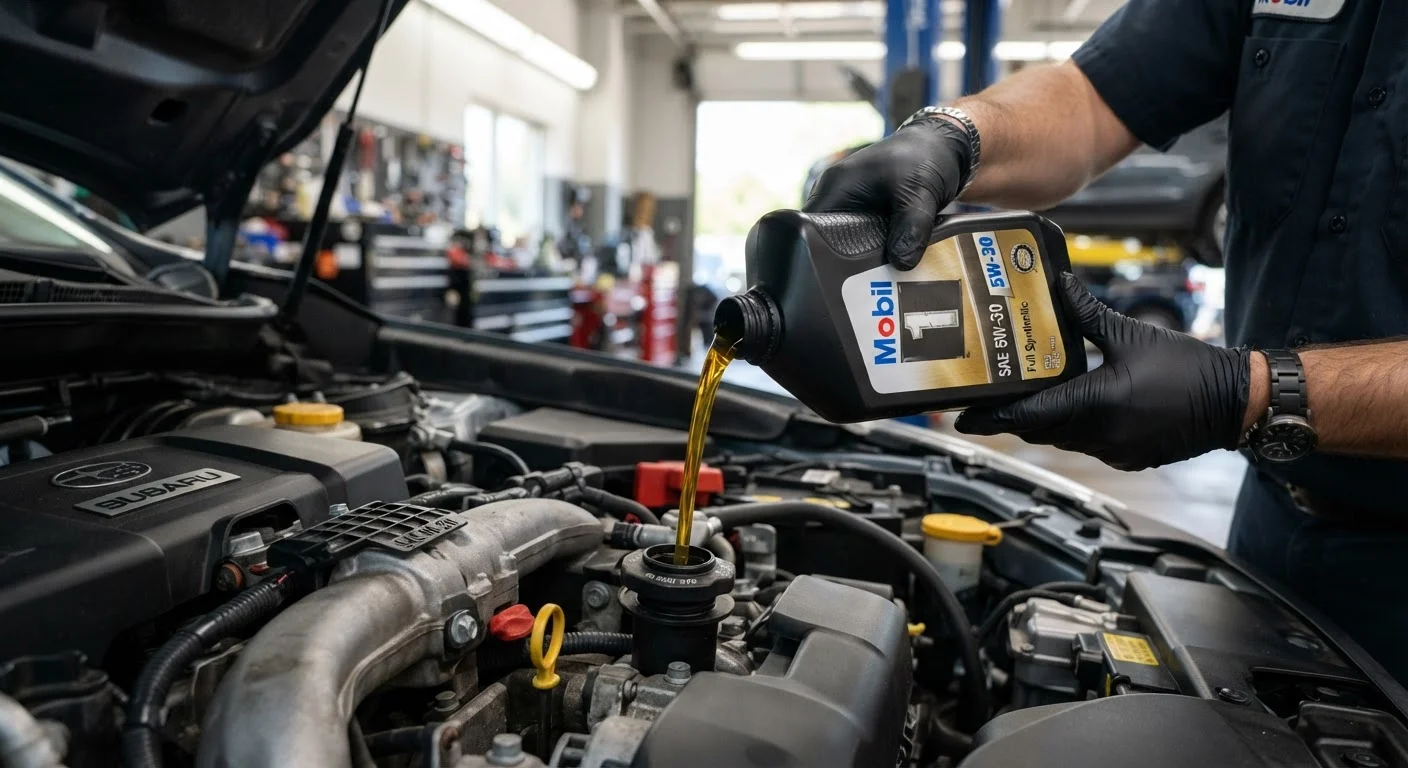
Option A
Synthetic Motor Oil
The engineered, high-performance formulation.
Best for: Drivers with modern vehicles, extreme climates, turbocharged engines, or high-mileage cars needing stronger protection.
Option B
Conventional Motor Oil
The time-tested, petroleum-based standard.
Best for: Drivers with older vehicles, mild driving conditions, and engines designed before synthetic oils became widespread.
What Actually Separates These Two Oils
Motor oil has one primary job: create a protective film between moving metal parts inside your engine so they don't grind against each other. But how well that film holds up under stress depends heavily on how the oil is made.
Conventional motor oil starts as crude petroleum that's drilled from the ground, then refined to remove impurities. The refining process is effective, but it can't eliminate every irregularity - conventional oil contains a mix of molecule sizes and shapes that behave differently under varying temperatures and loads.
Synthetic motor oil is built differently. Instead of being refined from crude, its base oil is chemically constructed - starting from simpler compounds and assembling molecules of consistent size and shape. That uniformity is the key advantage. Uniform molecules flow more predictably, resist breakdown at high temperatures, and stay fluid at cold temperatures better than their conventionally refined counterparts.
Most synthetic oils also contain a more sophisticated additive package - including detergents, anti-wear agents, and antioxidants - though conventional oils carry additives too. It's the base oil chemistry that creates the fundamental difference. For a broader look at what motor oil does alongside your other vehicle fluids, see our guide to car fluids.
| Criterion | Synthetic Motor Oil | Conventional Motor Oil |
|---|---|---|
| Base source | Chemically engineered compounds | Refined crude petroleum |
| Molecule consistency | Uniform size and shape | Variable, mixed molecules |
| Cold-start performance | Flows faster in cold temps | Thickens more in cold weather |
| Heat resistance | Resists breakdown at high temps | More prone to oxidation under heat |
| Typical oil change interval | 7,500-15,000 miles (manufacturer-dependent) | 3,000-5,000 miles typically |
| Cost per quart | Generally higher | Generally lower |
| Older engine compatibility | May require high-mileage blend | Well-suited to older engine designs |
| Turbo/high-output engines | Recommended or required | Often not sufficient |
Where Each Oil Performs Best - and Where It Falls Short
Temperature is one of the clearest performance dividing lines. In cold-weather starts, oil needs to circulate quickly before metal-on-metal contact causes wear. Conventional oil thickens more at low temperatures, meaning it takes slightly longer to reach critical engine components after a cold start. Synthetic flows faster in those first crucial seconds.
At the high end of the temperature spectrum - inside a turbocharged engine or during extended highway driving on a hot day - synthetic's molecular stability means it resists thinning and oxidizing better. Conventional oil can break down faster under prolonged heat, leaving behind sludge deposits that restrict oil flow over time.
~5-8 seconds
Critical engine wear window at cold start
Engineers generally consider the first few seconds after a cold start - before oil fully circulates - to be when the majority of engine wear occurs over a vehicle's lifetime.
Up to 3x
Longer drain interval vs. conventional
Many vehicle manufacturers allow synthetic oil change intervals of 10,000-15,000 miles compared to the 3,000-5,000 miles commonly cited for conventional oil, though this varies by vehicle and driving conditions.
~70%
New U.S. vehicles factory-filled with synthetic
Industry estimates suggest a large and growing majority of new vehicles sold in the United States come from the factory pre-filled with full synthetic or synthetic-blend motor oil.
That said, conventional oil isn't wrong for every situation. Vehicles designed and manufactured before the widespread adoption of synthetics, particularly those with older seals, may actually experience minor oil seepage if switched to a full synthetic - because synthetic's smaller, more uniform molecules can find pathways conventional oil couldn't. High-mileage synthetic blends exist specifically to navigate this concern, conditioning older seals while still providing improved protection.
If you've inherited some outdated beliefs about oil changes - like the old "3,000-mile rule" - it's worth reading about common car maintenance myths that may be costing you money unnecessarily.
Making the Right Call for Your Engine
The clearest guidance available to any driver is their vehicle owner's manual. Manufacturers specify the oil viscosity grade (such as 5W-30) and often indicate whether synthetic is required, recommended, or acceptable. Some modern engines - particularly those with variable valve timing systems - are specifically engineered to function with synthetic oil and may not perform as designed on conventional.
For drivers of high-mileage vehicles, the calculus gets a bit more nuanced. Vehicles past 75,000 to 100,000 miles often benefit from high-mileage oil formulations, whether synthetic or blended. These products typically include seal conditioners and extra detergents to address the realities of an aging engine. For a comprehensive look at caring for a vehicle in this category, our article on keeping a high-mileage vehicle running well covers the full picture.
One practical note: oil change intervals should always follow manufacturer recommendations rather than generic rules. Synthetic oil's extended drain capability is real, but it doesn't mean indefinite. Oil still accumulates combustion byproducts and depletes its additive package over time regardless of base oil type.
If you're considering handling your own oil changes, DIY car maintenance guidance can help you assess whether it's the right task to take on yourself.
Always Check Your Owner's Manual First
No general guidance about oil type overrides what your vehicle's manufacturer specifies. Using the wrong viscosity grade - even if it's a premium synthetic - can cause real problems in engines engineered for a specific oil weight. When in doubt, a qualified mechanic can confirm what's appropriate for your specific make, model, and mileage.
The content on this site is provided for informational purposes only and should not be considered a substitute for professional advice. While we strive to provide accurate and up-to-date information, we make no guarantees regarding its completeness or accuracy. Always consult a qualified professional for advice specific to your circumstances before making any decisions.