

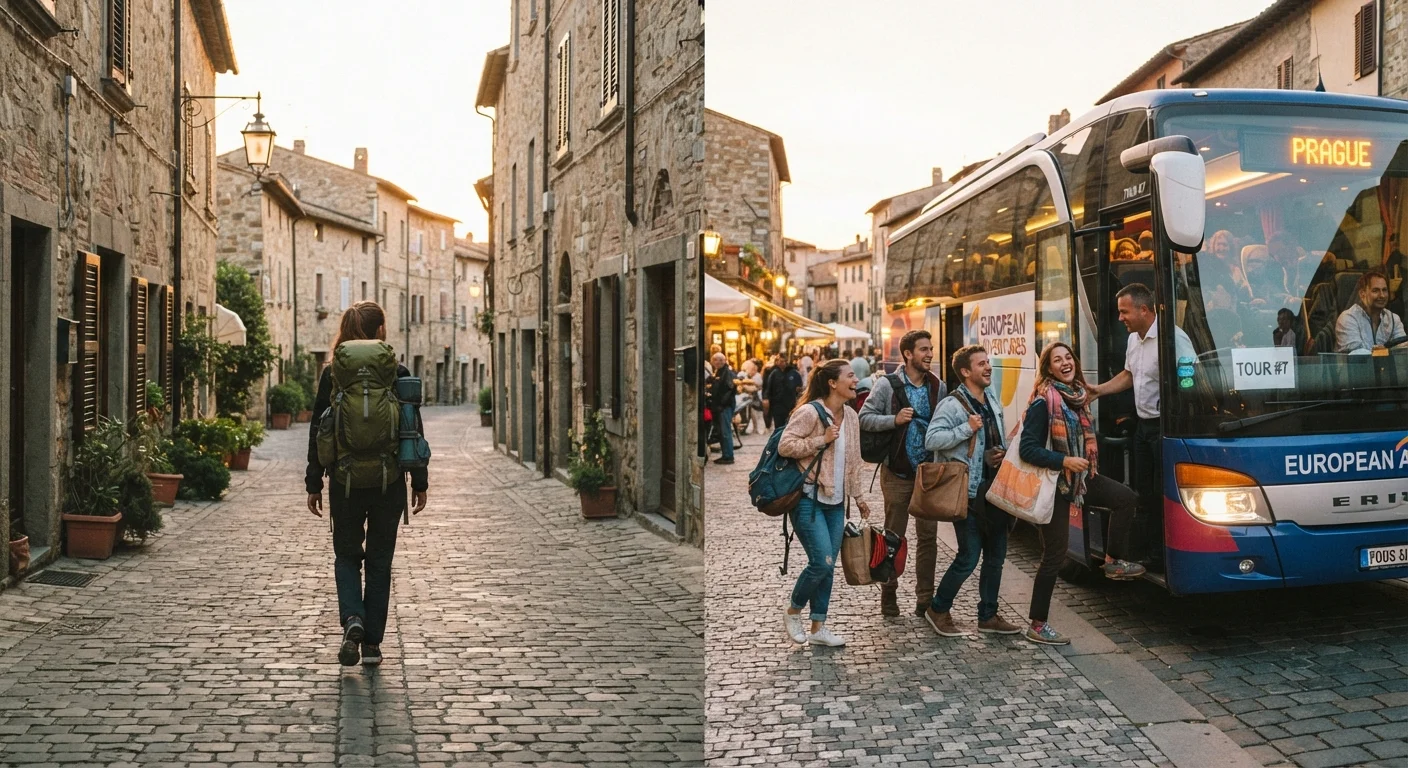
Option A
Solo Travel
The fully self-directed, go-at-your-own-pace approach.
Best for: Independent travelers who want maximum flexibility, spontaneity, and personal discovery on their trips.
Option B
Group Tours
The structured, socially built-in, logistics-handled option.
Best for: Travelers who value convenience, built-in companionship, and guided context - especially in unfamiliar destinations.
The Core Difference: Who's Driving the Trip
The fundamental split between solo travel and group tours isn't really about budget or even safety - it's about who controls the decisions. In solo travel, every choice is yours: where to sleep, what to eat, how long to stay, when to leave. In a group tour, those decisions are made in advance and shared across everyone participating.
That distinction ripples through every part of the experience. Solo travelers absorb the full cognitive load of a trip - researching routes, managing bookings, navigating problems when they arise. Group tour participants hand that load to an organizer and guide in exchange for structure. Neither arrangement is objectively better; they suit different people at different moments in their travel lives.
For a deeper look at how planning logistics shift based on format, see how trip planning differs between solo and group travel.
Flexibility, Pace, and Spontaneity
Solo travel's biggest advantage is adaptability. You can extend a stay in a town you love, cut short an experience that disappoints, or restructure your day based on a local recommendation you received over breakfast. This kind of responsiveness is genuinely hard to replicate in a group setting.
Group tours operate on fixed schedules - departure times, included meals, pre-booked sites. Some tours build in free afternoons, but the overall arc is set. If the group visits a site you find uninteresting, you're still on the bus.
| Criterion | Solo Travel | Group Tours |
|---|---|---|
| Schedule flexibility | Fully flexible, self-directed | Fixed itinerary, limited flexibility |
| Planning burden | High - all research on you | Low - handled by organizer |
| Built-in social connection | None - you create it | Yes - shared group experience |
| Single-traveler cost | Variable - can be very lean | Bundled - may include solo surcharge |
| Local access and context | Self-researched | Guided, often deeper in key areas |
| Best destination fit | Familiar regions, easy-access cities | Complex, remote, or permit-required areas |
Spontaneity also connects to how comfortable you are with uncertainty. Solo travelers who thrive tend to treat an unplanned detour as a feature. Travelers who find ambiguity stressful may find that a clear daily itinerary actually makes the experience more enjoyable. Understanding what makes an itinerary work can help either type of traveler plan more effectively.
Social Experience and Safety Considerations
Solo travel is not inherently lonely, but it does require more active effort to connect with people. Many solo travelers report that traveling alone actually makes them more open to conversations with locals and fellow travelers - a dynamic that can be harder to access when you're always embedded in a group. Accommodation choices like hostels can significantly shape the social dimension of a solo trip.
Group tours provide built-in social structure, which matters to a lot of travelers. Shared experiences create bonds quickly, and many people form lasting friendships on tours. That said, group dynamics can cut both ways - a difficult fellow traveler or a mismatch in energy levels can affect the entire experience.
Safety Varies Significantly by Destination
Safety considerations for solo travelers aren't uniform - they depend on destination infrastructure, local culture, and the individual traveler's experience level. Solo travel in a walkable, well-signed European city is a very different proposition from solo travel in a region with limited English signage, unreliable transit, or elevated safety concerns. Always verify current travel advisories through official government sources - such as the U.S. Department of State - before finalizing any destination.
On safety: solo travelers carry more personal responsibility for their awareness and decisions, particularly in unfamiliar environments. Destination matters significantly here. Destination choice looks different when you're traveling alone, and infrastructure, language accessibility, and local safety culture all factor in.
Cost: It's More Nuanced Than It Looks
The assumption that solo travel is always cheaper - or always more expensive - doesn't hold up well in practice. Solo travelers pay single-occupancy rates at hotels, which often carry a significant premium. They also absorb all transportation costs without sharing. On the other hand, they can make frugal choices at every point, skip expensive included meals, and move to cheaper destinations whenever they want.
Group tours bundle accommodation, transportation, and often some meals into one price. That bundling can represent real value, especially in destinations where arranging access to certain sites independently is complicated or costly. But you're also paying for services you may not want - and there's usually less room to trade down.
~25%
Solo traveler share of international trips
Industry research has consistently found that solo travelers represent a significant and growing segment of international leisure travel, with estimates commonly ranging around 25% of trips taken.
50-100%
Typical single-supplement premium at hotels
Solo travelers are commonly charged a single-supplement fee ranging from 50% to 100% above the per-person rate designed for double occupancy, a well-documented pain point in travel budgeting.
The honest answer is that cost depends heavily on your travel style, your destination, and the specific tour. Travelers who eat simply, use public transit, and stay in modest accommodation often find solo travel competitive or cheaper. Travelers who prefer comfort and convenience may find group tours land in a similar price range with less hassle.
The content on this site is provided for informational purposes only and should not be considered a substitute for professional advice. While we strive to provide accurate and up-to-date information, we make no guarantees regarding its completeness or accuracy. Always consult a qualified professional for advice specific to your circumstances before making any decisions.