

Option A
Data Deprioritization
A conditional slowdown triggered only by network congestion.
Best for: Subscribers on unlimited plans who want to understand when and why speeds may temporarily dip during peak hours.
Option B
Hard Data Throttling
A fixed speed cap applied automatically once a usage threshold is crossed.
Best for: Readers trying to anticipate predictable speed limits tied to plan tiers or monthly data allowances.
What Each Term Actually Means
Wireless carriers use two distinct mechanisms to manage data speeds, and confusing them can lead to choosing the wrong plan for your lifestyle. Both show up in plan disclosures - sometimes in the same document - but they operate on entirely different logic.
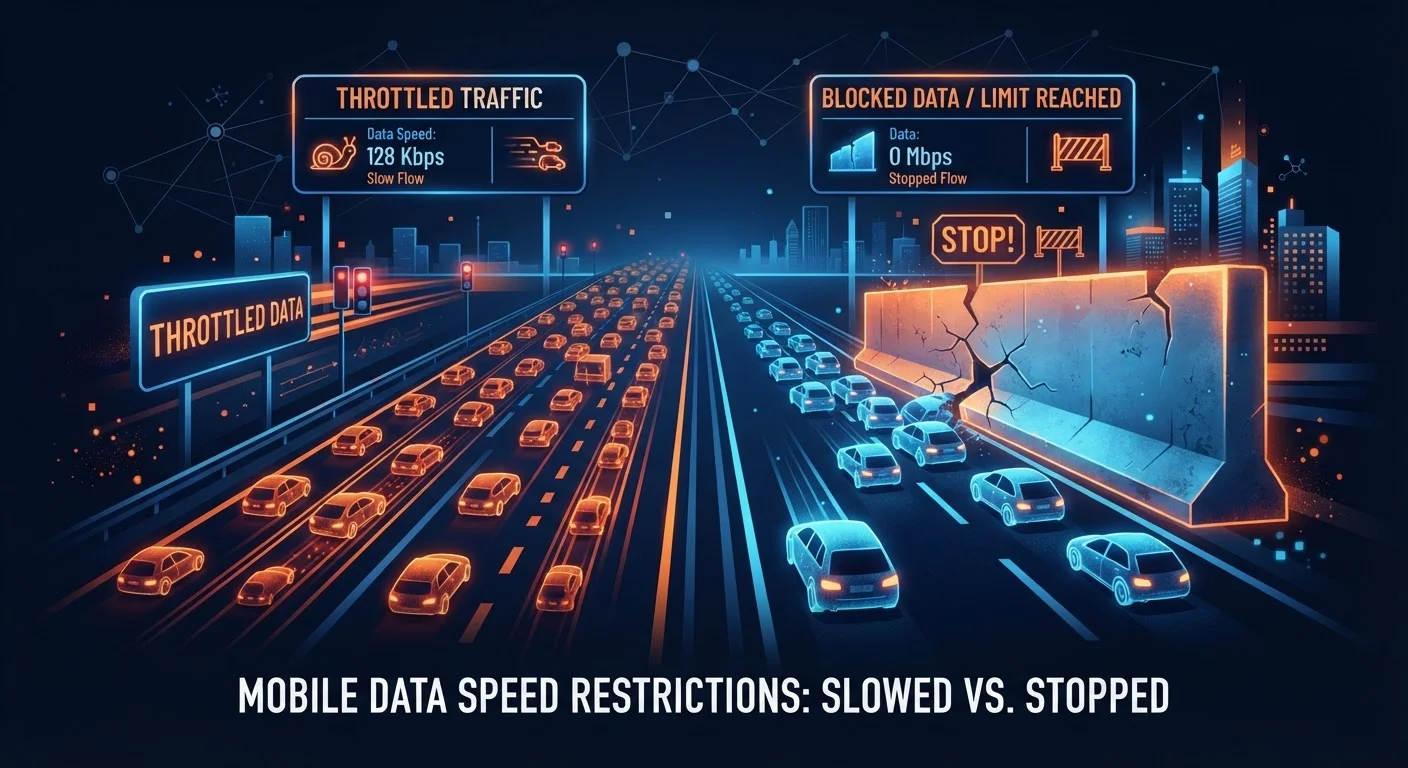
Data deprioritization is a conditional slowdown. When a cell tower becomes congested - typically during rush hour in a busy area - your carrier temporarily moves high-data users lower in the queue. Once congestion clears, your speeds return to normal. Carriers commonly apply this after you've used a set amount of data in a billing cycle (often around 22-50 GB on premium unlimited plans), but the slowdown only materializes if the tower you're connected to is actually busy. If you're in a low-traffic area or using data at 2 a.m., you may never notice a thing.
Hard data throttling works differently. Once you consume a plan's defined high-speed data allotment, your speeds are mechanically reduced to a fixed ceiling - commonly 128 Kbps to 1.5 Mbps - for the rest of the billing cycle. This happens automatically, unconditionally, and regardless of whether network congestion exists at that moment. You hit the threshold on a quiet Tuesday morning in a rural area, and the cap still applies.
See our guide to reading wireless plan fine print to understand exactly how carriers disclose both practices in their terms of service.
| Criterion | Data Deprioritization | Hard Data Throttling |
|---|---|---|
| Trigger | Network congestion at a tower | Reaching a fixed data cap |
| Speed impact | Temporary, variable slowdown | Fixed speed ceiling for rest of cycle |
| Duration | Until congestion clears | Until billing cycle resets |
| Predictability | Depends on location and time of day | Fully predictable once threshold is known |
| Common plan type | Premium unlimited tiers | Entry-level or capped data plans |
| Off-peak impact | Minimal to none | Full cap still applies regardless |
| Disclosure location | Unlimited plan terms, fine print | Plan data allowance details |
Real-World Impact and What to Watch For
The practical difference between the two often comes down to predictability. With hard throttling, you can anticipate the slowdown - track your usage, budget accordingly, and avoid streaming high-definition video near the end of your cycle. With deprioritization, the experience is less predictable: a packed stadium, a downtown core at noon, or a busy airport can all trigger temporary slowdowns even if you're nowhere near your deprioritization threshold.
128 Kbps
Typical hard throttle speed ceiling
Many carrier plans throttle hotspot or base data to 128 Kbps after the high-speed allotment is consumed, according to published carrier terms.
22-50 GB
Common deprioritization threshold range
Carriers generally begin deprioritizing unlimited plan users after this range of monthly data consumption, per publicly disclosed network management policies.
1-3 Mbps
Minimum speed for SD video streaming
Standard-definition video typically requires at least 1 Mbps sustained throughput, meaning hard-throttled connections near 128 Kbps will struggle to stream reliably.
Throttling speeds of 128 Kbps are generally too slow for standard-definition video streaming (which typically requires around 1-3 Mbps) but sufficient for basic messaging and lightweight web browsing. Deprioritized speeds, by contrast, can still be quite fast when the tower recovers - users often report speeds returning to normal within minutes.
If your household depends on a mobile hotspot as a primary connection, these distinctions matter even more. Understanding how much speed your household actually needs can help you gauge whether a throttled or deprioritized connection will cover your real usage patterns.
One important nuance: some plans layer both mechanisms. A carrier might deprioritize you after 50 GB and then hard-throttle your hotspot data after a separate, smaller allowance. Always read the full plan disclosure rather than relying on marketing summaries alone. Our ISP fine-print explainer covers what to look for in those documents.
Network Management Disclosure Requirements
Under FCC open internet principles, carriers are generally expected to disclose their network management practices, including deprioritization thresholds and throttling policies. These disclosures are often found in the 'network management' or 'terms of service' section of a carrier's website rather than in the plan summary page. Regulatory requirements in this area have evolved over time, so verifying current rules through official sources is advisable.
If you've ever wondered whether your slow connection is a plan restriction or a home network issue, the distinction is worth investigating. Slow Wi-Fi even on a fast plan covers the equipment and configuration factors that can mimic throttling symptoms.
The content on this site is provided for informational purposes only and should not be considered a substitute for professional advice. While we strive to provide accurate and up-to-date information, we make no guarantees regarding its completeness or accuracy. Always consult a qualified professional for advice specific to your circumstances before making any decisions.