

Our Verdict
No single insulation type wins for every situation. Fiberglass batts suit straightforward new-construction framing on a budget, spray foam is the performance choice for sealing gaps and maximizing efficiency in tight spaces, and blown-in shines when retrofitting existing walls or topping off attic floors. Match the material to the space, your budget, and your comfort with DIY work.
| Best for | Recommended |
|---|---|
| Budget-conscious new construction or accessible wall cavities | Fiberglass Batts |
| Maximum thermal performance and air sealing in tight or irregular spaces | Spray Foam |
| Retrofitting attics or closed existing walls without major demolition | Blown-In Insulation |
Understanding R-Value Before You Choose
R-value is the standard measure of how well insulation resists heat flow. The higher the R-value, the more effective the material is at slowing heat transfer between inside and outside your home. The U.S. Department of Energy publishes recommended R-values by climate zone - colder regions typically require higher R-values in attics and walls than milder ones.
Before comparing materials, know two things: the R-value your local code or climate calls for, and the available depth or thickness of the space you're insulating. These two factors together will narrow your options considerably.
| Fiberglass Batts | Spray Foam (Closed-Cell) | Blown-In (Cellulose) | |
|---|---|---|---|
| R-value per inch | R-3.0 to R-3.8 | R-6.0 to R-7.0 | R-3.2 to R-3.8 |
| Air sealing ability | None | Excellent | Minimal |
| Relative cost | Low | High | Low to moderate |
| DIY friendly | Yes | No - professional recommended | Attics yes; walls, hire a pro |
| Best application | Open framed walls/floors | Rim joists, crawlspaces, tight spaces | Attics and existing closed walls |
| Moisture resistance | Low | High (closed-cell) | Moderate |
Fiberglass Batts: The Familiar Standard
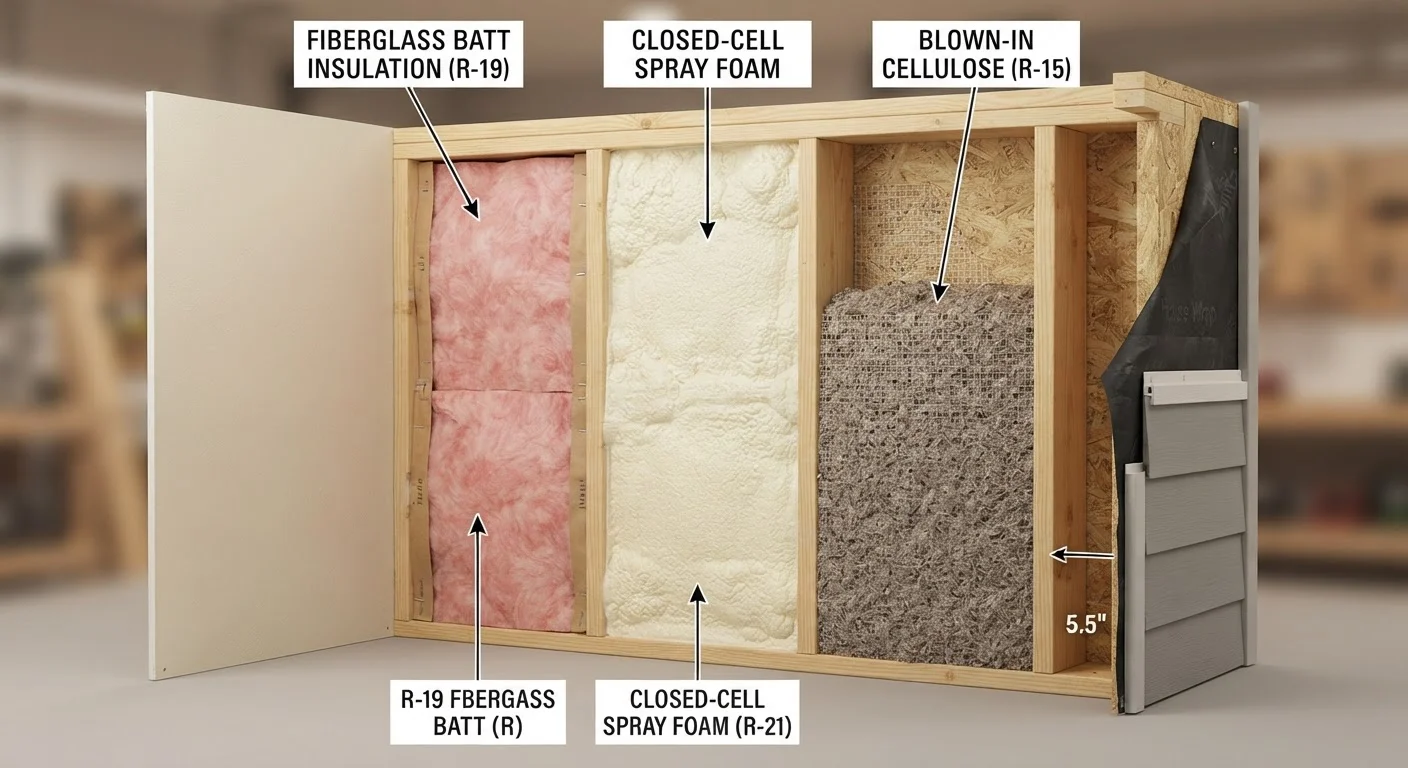
Fiberglass batts - those familiar pink or yellow blankets sold at every home center - are the most widely used insulation in American homes. They're made from spun glass fibers and come pre-cut to fit standard 16-inch and 24-inch stud spacing, which makes them a natural fit for open, newly framed walls and floors.
R-value: Approximately R-3.0 to R-3.8 per inch, depending on density. A standard 3.5-inch batt for a 2×4 wall delivers roughly R-13 to R-15.
DIY suitability: High. Batts can be cut with a utility knife and installed without special equipment. Proper fit is critical - gaps or compression significantly reduce effectiveness.
Limitations: Fiberglass batts do not air seal. They allow air to move through and around them, so they work best when paired with a separate air barrier such as house wrap or drywall with taped seams. They're also less effective in irregular cavities where pieces must be cut and fitted around obstructions.
Get the Fit Right for Full Performance
A fiberglass batt that's compressed or has gaps around its edges can lose a significant portion of its rated R-value. Cut pieces to fit snugly without squashing them, and fill any gaps around wires or pipes with small cut-off pieces. A tight, full fit is more important than the brand or facing type you choose.
Spray Foam: High Performance, Higher Investment
Spray polyurethane foam (SPF) is applied as a liquid that expands and hardens in place, conforming to any shape. It comes in two main forms: open-cell and closed-cell. Open-cell foam is softer, less dense, and delivers around R-3.5 per inch. Closed-cell foam is rigid, moisture-resistant, and achieves roughly R-6.0 to R-7.0 per inch - the highest of the three types discussed here.
Closed-cell spray foam also acts as a vapor retarder, which can eliminate the need for a separate vapor barrier in certain climates. Both types dramatically reduce air infiltration, which is often the largest source of energy loss in existing homes.
Cost: Spray foam is substantially more expensive than batts or blown-in - often two to three times the material and labor cost. Professional installation is strongly recommended; improper mixing ratios or application can result in off-gassing or reduced performance.
Blown-In Insulation: The Retrofit Specialist
Blown-in insulation - made from either fiberglass or cellulose (recycled paper fiber treated for fire resistance) - is pneumatically blown into place using a hose and blower machine. This makes it ideal for two situations: blanketing large open attic floors, and retrofitting closed existing walls through small drilled holes.
R-value: Cellulose delivers approximately R-3.2 to R-3.8 per inch. Blown-in fiberglass runs R-2.2 to R-4.0 per inch depending on density and brand.
Attic use: Blown-in is one of the most cost-effective ways to bring an underinsulated attic up to recommended levels. It settles over time, so installers account for this by blowing to a greater initial depth.
Wall retrofits: A contractor drills a series of small holes in the exterior or interior wall surface, fills cavities, then patches. It's far less disruptive than opening walls for batts. Many rental centers loan blower machines for DIY attic work; wall retrofits are better left to professionals to ensure even fill.
Which Type Fits Your Project?
Use this quick framework to guide your decision:
- New framed walls or floor joists with open access: Fiberglass batts are straightforward and cost-effective.
- Rim joists, crawlspace walls, or areas needing air sealing: Closed-cell spray foam provides both insulation and an air/vapor barrier in a single step.
- Attic floors - new or existing: Blown-in insulation is fast, effective, and accessible to confident DIYers with rented equipment.
- Existing closed walls: Blown-in retrofit is your primary option without opening the wall.
- Tight budgets, large areas: Fiberglass batts or blown-in cellulose offer the most coverage per dollar.
Keep in mind that any insulation project touching electrical panels, structural elements, or requiring permits should involve a licensed professional. Check your local building department for requirements before starting.
The content on this site is provided for informational purposes only and should not be considered a substitute for professional advice. While we strive to provide accurate and up-to-date information, we make no guarantees regarding its completeness or accuracy. Always consult a qualified professional for advice specific to your circumstances before making any decisions.