

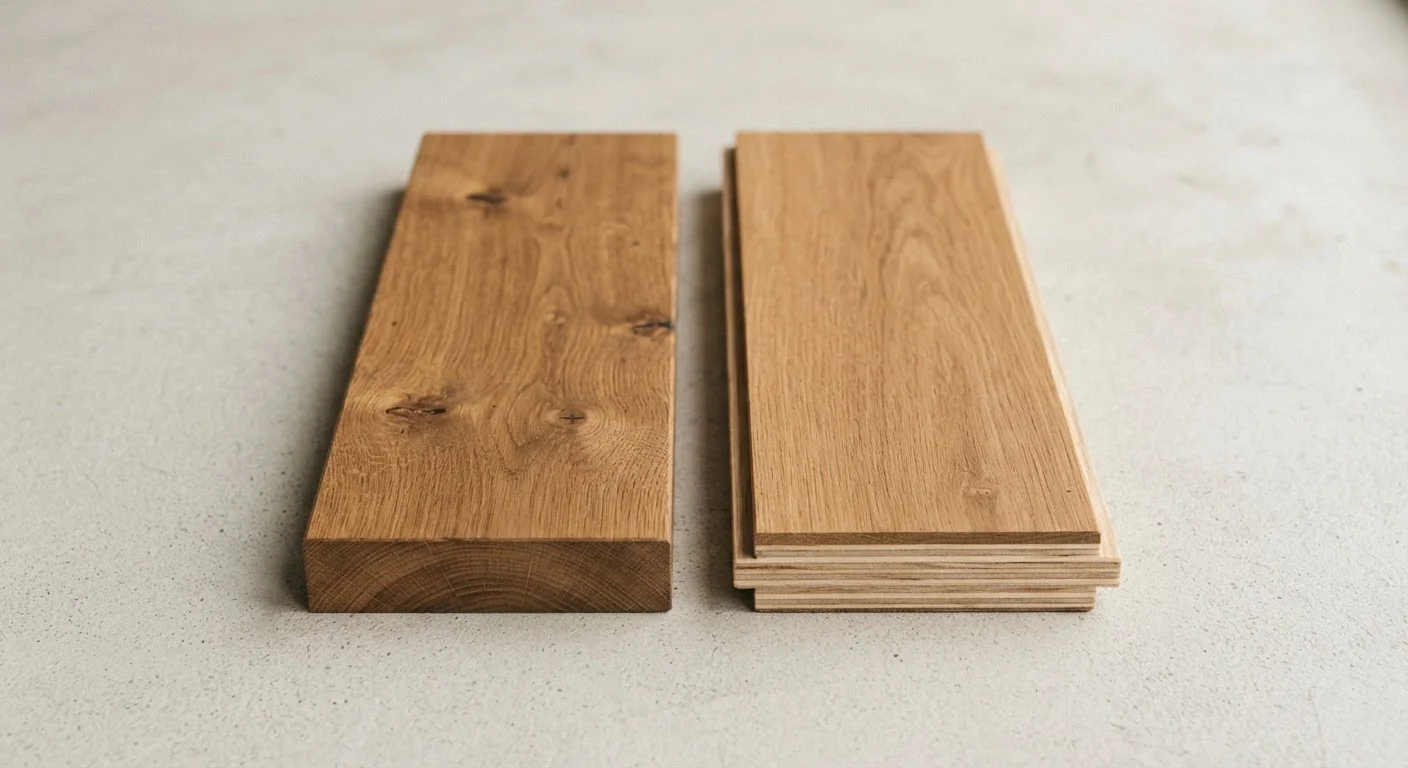
Option A
Solid Hardwood Flooring
The time-tested classic built for the long game.
Best for: Dry living areas in stable climates where long-term refinishing and maximum lifespan are priorities.
Option B
Engineered Wood Flooring
The moisture-smart alternative with real-wood style.
Best for: Homes with humidity fluctuations, basements, or rooms where solid wood's expansion risks would be a concern.
What's Actually Inside Each Plank
The most important distinction between these two flooring types isn't visible from above - it's what's happening underneath the surface layer. Solid hardwood is milled from a single piece of wood, typically ¾ inch thick. That consistent depth is what allows it to be sanded flat and refinished whenever the surface shows wear.
Engineered wood flooring is constructed differently: a thin veneer of real hardwood (called the wear layer) is bonded over multiple layers of high-density plywood or fiberboard, alternating the grain direction of each layer. This cross-ply construction is what gives engineered wood its dimensional stability - it's far less likely to expand, contract, or warp when humidity changes.
The wear layer on engineered wood typically ranges from 2mm to 6mm. Thicker wear layers allow for one or two refinishing cycles; thinner ones do not. When evaluating engineered options, always check the manufacturer's stated wear layer thickness before purchasing.
| Criterion | Solid Hardwood | Engineered Wood |
|---|---|---|
| Construction | Single piece of solid wood | Hardwood veneer over plywood core |
| Moisture tolerance | Low - needs stable humidity | Higher - handles humidity swings better |
| Suitable installation grade | Above grade only | Above, on, or below grade |
| Refinishability | 6-8 times typically | 0-3 times depending on wear layer |
| Installation methods | Nail/staple down | Nail, glue, or float |
| Radiant heat compatibility | Generally not recommended | Many products compatible |
| Typical plank thickness | ¾ inch | ⅜ to ¾ inch |
Moisture, Movement, and Where Each Floor Belongs
Wood is a hygroscopic material - it absorbs and releases moisture from the surrounding air. As it does, it expands and contracts. This natural movement is the single biggest factor in choosing between solid and engineered flooring.
Solid hardwood is sensitive to moisture swings. It should generally be installed above grade (above ground level) and in rooms where relative humidity stays relatively consistent, ideally between 35% and 55%. Kitchens, bathrooms, and basements are typically not recommended locations for solid hardwood. Wide-plank solid floors are even more susceptible to movement than narrower boards.
Engineered wood tolerates greater humidity variation without the same risk of cupping (edges rising) or gapping (planks pulling apart). It can be installed above, on, or below grade, making it appropriate for basements and slab-on-grade construction where solid hardwood would be problematic.
35-55%
Recommended indoor relative humidity for wood floors
The National Wood Flooring Association (NWFA) advises maintaining this humidity range year-round to minimize wood movement and prevent gaps or cupping.
2mm-6mm
Typical engineered wood wear layer range
Wear layer thickness is one of the most important specs to evaluate when comparing engineered wood products, as it directly determines refinishability.
Neither type is waterproof. Standing water or persistent moisture from a flood or leak can damage both. The difference is in how each responds to the everyday humidity changes that occur in a typical household.
Installation Methods and Subfloor Compatibility
Solid hardwood is almost always nailed or stapled to a wood subfloor - it requires a subfloor of adequate thickness (typically at least ¾ inch plywood) to accept fasteners properly. Glue-down is occasionally used for solid hardwood over concrete in specific situations, but it's not the norm and requires careful moisture testing first.
Engineered wood is more flexible in this regard. It can be:
- Nailed or stapled to a wood subfloor, similar to solid hardwood
- Glued down directly to concrete or plywood
- Floated over a foam underlayment, with planks clicked or glued together at the edges rather than fastened to the subfloor
Floating installation is popular for DIYers because it doesn't require nailing equipment and is more forgiving over minor subfloor imperfections. However, floating floors can feel slightly hollow underfoot compared to a fully adhered or nailed floor - something worth experiencing in a showroom before committing.
For any installation over concrete, a moisture test is essential regardless of which product you choose. Your flooring retailer or installer can walk you through appropriate testing methods for your subfloor type.
Permits and Professional Installation
Most flooring projects don't require a building permit, but if you're modifying your subfloor significantly or installing over radiant heating, it's worth verifying with your local building department. For complex subfloor repairs, glue-down applications over concrete, or large open-plan spaces, hiring a licensed flooring installer can prevent costly mistakes and may be required to maintain product warranties.
Refinishing: How Many Times Can You Sand It Down?
One of solid hardwood's strongest long-term arguments is refinishability. A standard ¾-inch solid plank can typically be sanded and refinished six to eight times over its life - enough to address decades of scratches, stains, and dents while restoring the floor to a like-new appearance. This is a meaningful factor for homeowners who plan to stay in a home long-term or want to change the floor's stain color in the future.
Engineered wood's refinishability depends entirely on its wear layer thickness. A 2mm wear layer may allow one light sand; a 6mm wear layer can handle two or possibly three refinishing cycles with careful sanding. Engineered floors with very thin veneer layers - common in budget-tier products - should not be sanded at all.
In practice, most homeowners refinish their floors once or twice over the life of their home. For many people, even a single refinishing cycle on a quality engineered floor is sufficient. The key is knowing what you're buying before installation so the decision aligns with your long-term expectations.
The content on this site is provided for informational purposes only and should not be considered a substitute for professional advice. While we strive to provide accurate and up-to-date information, we make no guarantees regarding its completeness or accuracy. Always consult a qualified professional for advice specific to your circumstances before making any decisions.