

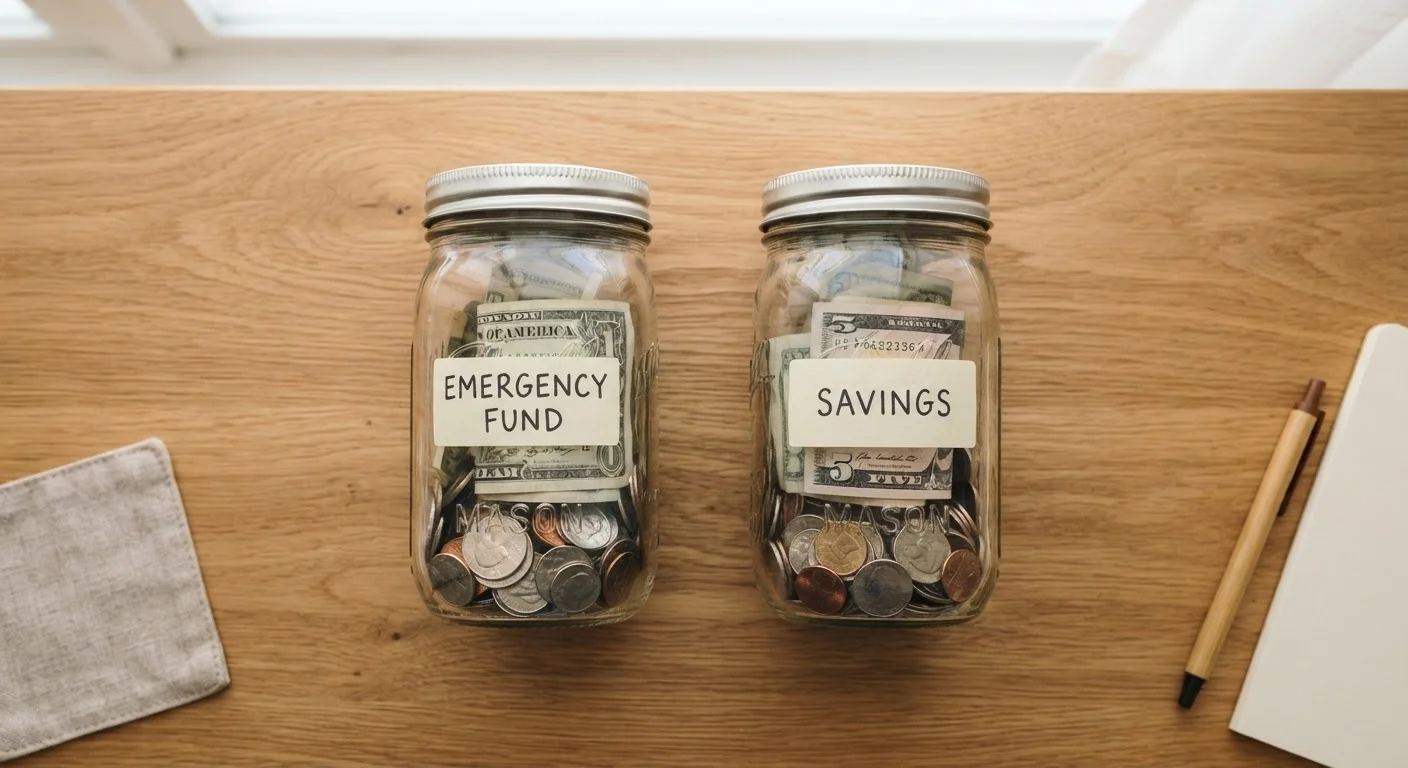
Two Accounts, Two Very Different Jobs
Most people use the words "emergency fund" and "savings" interchangeably. In everyday conversation, that's understandable - both involve setting money aside. But in practice, treating them as the same thing is one of the most common financial habits that quietly undermines stability.
Savings is a broad category. It can mean money you're accumulating for a vacation, a home down payment, a new car, or retirement. These are goal-directed dollars with a purpose and a timeline you've chosen in advance.
An emergency fund is different in a fundamental way: it exists for things you didn't plan for and hope you never need. Its purpose isn't to grow wealth or fund ambitions - it's to act as a financial circuit breaker when life disrupts your income or hits you with an unexpected cost.
Separating money into distinct buckets - one for emergencies, others for goals - is a concrete strategy that removes ambiguity and protects each pool of money from the other.
What Qualifies as an Emergency
The definition matters because it shapes how you use - and protect - the fund. A genuine financial emergency has three characteristics: it is unexpected, it is necessary to address, and delaying it would cause real harm.
- Job loss or sudden income reduction - your fund covers essential bills while you find new work.
- Medical expenses not covered by insurance - an emergency room visit or urgent procedure with out-of-pocket costs.
- Critical car repair - if your vehicle is essential to getting to work, a breakdown qualifies.
- Essential home system failure - a broken furnace in winter or a failed water heater.
What doesn't qualify: a sale on something you've been wanting, a trip that came up at a good price, or a predictable annual expense like car registration. The temptation to raid emergency savings for non-emergencies is real and common - having a clear mental definition of what qualifies is your first line of defense.
Irregular Expenses Are Not Emergencies
Annual car registration, holiday gifts, or a predictable home repair are not emergencies - they're irregular expenses you can anticipate. Building a separate sinking fund for these costs protects your true emergency fund from being drained by things you could have planned for. Treat predictable-but-infrequent costs as their own savings category.
Why the Separation Matters in Practice
When emergency and savings money share the same account, two problems emerge. First, it becomes difficult to know how much you actually have available for true emergencies versus how much is earmarked for planned goals. Second, the money is psychologically easier to access for any spending - the boundary between purposes blurs.
Consider what happens when someone has $8,000 in a combined account - $3,000 mentally reserved for emergencies and $5,000 for a kitchen renovation. A $2,000 car repair shows up. They pay it, but now both mental buckets have shrunk without a clear record of which absorbed the cost. Rebuilding the right amount becomes harder because the target is fuzzy.
~57%
Americans unable to cover a $1,000 emergency expense from savings
According to Bankrate's annual emergency savings report, a majority of U.S. adults would need to borrow or use credit to handle an unexpected $1,000 expense.
3-6 months
Recommended emergency fund coverage target
Most financial planning guidance, including from the Consumer Financial Protection Bureau, points to three to six months of essential expenses as a practical benchmark.
A separate emergency fund - even held at a different bank - creates a friction-based barrier that slows impulsive access and preserves the fund's integrity. This is the same logic behind keeping multiple savings buckets for different financial goals.
Building the Habit, Starting Where You Are
One of the most persistent misconceptions about emergency funds is that you need a large sum before starting. In reality, any amount held separately with clear intent counts as the beginning of an emergency fund. A $500 buffer has real value - it can handle a minor car repair or a medical copay without touching a credit card.
If you're starting from zero, the goal is not to build three to six months of expenses overnight. It's to begin consistently. Automating a small transfer each pay period - even $25 or $50 - removes the decision friction that causes most people to delay. See our step-by-step guide to building your first emergency fund for a practical starting framework.
Where you keep the fund matters too. A high-yield savings account or money market account typically offers better returns than a standard checking account while keeping your money accessible when you need it.
Finally, if you're not sure how much to target, reviewing common emergency fund myths can help you cut through the noise and set a realistic goal that actually fits your life.
This article is for general informational purposes only and does not constitute personalized financial advice. For guidance tailored to your situation, consult a qualified financial professional.
Frequently Asked Questions
Technically, yes - but it often backfires in practice. When emergency and savings money share the same account, it becomes harder to track what's protected and easier to spend emergency dollars on non-emergencies. Keeping them in separate accounts reinforces their different purposes.
A widely used benchmark is three to six months of essential living expenses - rent or mortgage, utilities, food, insurance, and minimum debt payments. Those with variable income or fewer income sources may benefit from targeting the higher end of that range.
A high-yield savings account or money market account is generally a practical choice - both keep your money accessible and earn more than a standard checking account. Avoid investing emergency funds in stocks or other volatile assets, since you need predictable access to the money.
A credit card can help in a pinch, but it is not a substitute for an emergency fund. Using credit means taking on debt with interest, which can turn a single financial shock into a longer-term financial burden. An emergency fund lets you handle crises without adding to debt.
True emergencies are unexpected, necessary, and urgent - job loss, a medical bill not covered by insurance, an essential appliance failure, or an emergency car repair. A planned vacation, a sale on electronics, or a predictable annual expense do not qualify.
The content on this site is provided for informational purposes only and should not be considered a substitute for professional advice. While we strive to provide accurate and up-to-date information, we make no guarantees regarding its completeness or accuracy. Always consult a qualified professional for advice specific to your circumstances before making any decisions.